Four steps: swept area, wind power, the Betz limit, real output
The power in a stream of wind is the kinetic energy of the air passing through the rotor, and it depends on three things — how dense the air is, how big a disc the blades sweep, and how fast the air moves — with the speed doing by far the most work, because it enters cubed:
swept area (m²) = π × (rotor diameter ÷ 2)²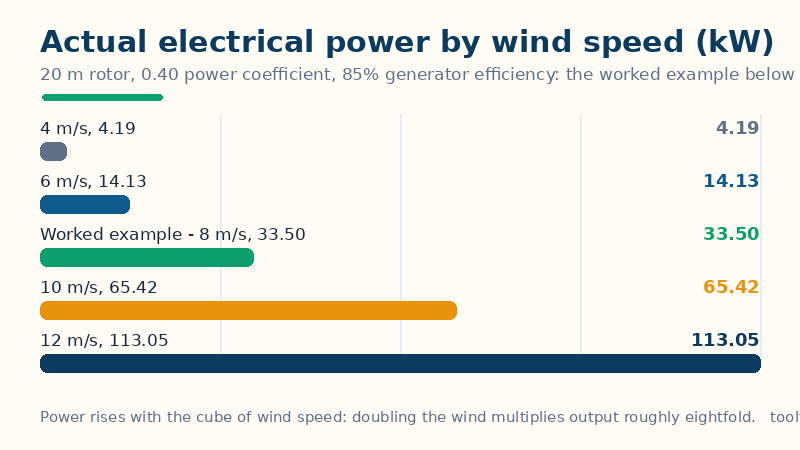
available wind power (W) = ½ × air density × swept area × wind speed³actual power (W) = available power × power coefficient × generator efficiencyannual energy (kWh) = actual power (kW) × 8,760 hours × capacity factorNo rotor can take all the power in the wind: the air has to keep moving after it passes the blades, or it would pile up in front of them. The Betz limit puts the ceiling at 59.3% of the available power — a hard physical maximum, not an engineering target — and real rotors reach a power coefficient of about 0.35 to 0.45, with the generator and drivetrain taking another share on top. The capacity factor is the last step and the most commonly fudged: the wind does not blow at one speed all year, so the annual energy is the steady-speed power times the hours in a year times the share of rated output the site actually delivers — roughly 9% to 22% for small wind turbines, according to University of Missouri Extension, and 25% to 45% for onshore utility sites in good locations.
Worked example: 20 m rotor, 8 m/s wind, Cp 0.40, 85% efficiency
Swept area = π × 10² = 314.16 m². Available wind power = ½ × 1.225 × 314.16 × 8³ = 98,520.3 W. The Betz maximum is 59.3% of that, 58,422.6 W — the most any rotor could ever take from this wind. Actual output = 98,520.3 × 0.40 × 0.85 = 33,496.9 W, or 33.50 kW. At that wind speed all day the turbine would make 33.50 × 24 = 803.9 kWh a day, and over a year at a 30% capacity factor it makes 33.50 × 8,760 × 0.30 = 88,030 kWh — about 8 homes at the US average of 10,800 kWh a year. The calculator's table shows the same 20 m rotor at other wind speeds, and the cube law is visible in every row: 4 m/s gives 4.19 kW, 6 m/s gives 14.13 kW, 10 m/s gives 65.42 kW and 12 m/s gives 113.05 kW. Going from 10 m/s to 12 m/s — a 20% faster wind — raises the power by about 73%, and doubling the wind from 6 m/s to 12 m/s multiplies it eightfold. That is why hub height and site selection dominate turbine economics far more than rotor size: the wind at 100 feet is meaningfully faster than the wind at 30 feet.
The home-turbine shortcut, and why it gives a different annual figure
For a small home turbine there is a second, widely published estimator that works from the average wind speed alone: annual kWh ≈ 0.01328 × rotor diameter² (feet) × average wind speed³ (mph), published by the nonprofit Windustry. An 18 ft rotor in a 10 mph average wind gives 0.01328 × 324 × 1,000 = 4,300 kWh a year; at a 12 mph average the same rotor gives 0.01328 × 324 × 1,728 = 7,400 kWh a year. That looks inconsistent with the single-speed method on this page — the same 18 ft rotor at a steady 10 mph (4.47 m/s) makes only about 440 W, which at a 30% capacity factor is about 1,156 kWh a year — but the two methods answer different questions. The shortcut folds the wind's distribution into its constant: real wind spends hours above its own average, and because power rises with the cube of speed, those faster hours contribute far more than the slower hours take away. The single-speed figure on this page is the power at one steady wind speed; the shortcut is an estimate of a whole year of varying wind. Use the shortcut to judge whether a home site is worth a closer look, and use the physics on this page to compare rotors and speeds. Either way, the US Department of Energy's rule stands: a small wind turbine needs an annual average wind speed of at least 10 mph at hub height to be economically viable, and the wind must be measured at the height the tower would stand, not at ground level.
How to read your result, and its limits
Four cautions keep the number honest. First, the capacity factor is a guess until the site is measured: a full year of hourly wind data at hub height is what a professional yield assessment uses, and a single average speed with a round capacity factor is a planning figure, not a promise. Second, cut-in and cut-out speeds are not modelled: real turbines stand still below about 3–4 m/s and shut down above about 20–25 m/s to protect themselves, so the power curve is flat at both ends in a way this page's formula does not show. Third, air density falls with altitude and temperature: at a high, hot site the same wind carries less power than the 1.225 kg/m³ sea-level figure assumes — adjust the density input if the site is well above sea level. Fourth, the kilowatt rating is not the yield: a turbine's rated power is its output at one chosen wind speed, and certified small turbines carry a rated annual energy figure at an 11.2 mph average under the small-turbine standard — compare models on that figure, not on the kilowatt rating. For the solar half of the same roof, the solar panel calculator sizes the array from your own bill; for what the power is worth once it is made, the electricity cost calculator prices any kilowatt-hour at your own rate.
Common mistakes
- Reading power as proportional to wind speed. It is proportional to the cube: a 10% faster wind gives about 33% more power, and a 25% faster wind nearly doubles it. Small differences in the site's average wind speed matter enormously.
- Treating the Betz limit as a target. 59.3% is the most any rotor can ever extract; a real rotor at 40% is already doing well. A tool that claims a power coefficient above 59.3% is wrong by definition.
- Multiplying steady power by 8,760 and calling it the annual yield. The wind does not blow at one speed all year. Annual energy needs the capacity factor — or better, the real wind distribution — or the answer is several times too high.
- Using ground-level wind speed. Wind is faster higher up, and a tower that stands 80–120 feet sees a materially better wind than an anemometer at the back door. Measure at hub height, or the whole calculation is built on the wrong speed.
Related tools: Carbon Footprint Calculator — Your household's yearly CO2 in tonnes — electricity, gas, driving and flights, each multiplied by its published emission factor.
Frequently asked questions
How much power does a wind turbine produce?
It depends on the cube of the wind speed, the rotor size and the efficiency. A 20 m rotor in an 8 m/s wind, at a 0.40 power coefficient and 85% generator efficiency, makes 33.50 kW — but the same rotor makes only 4.19 kW at 4 m/s and 113.05 kW at 12 m/s, because doubling the wind multiplies the power roughly eightfold.
What is the Betz limit?
The maximum share of the wind's power any rotor can extract: 59.3%. The air must keep moving after it passes the blades, so no turbine can take it all. In the worked example the wind carries 98,520.3 W and the Betz maximum is 58,422.6 W; a real rotor at a 0.40 power coefficient takes 39,408.1 W before generator losses.
Why does the home-turbine shortcut give a different annual figure?
Because it folds the wind's distribution into its constant while the single-speed method does not. The Windustry shortcut — annual kWh ≈ 0.01328 × diameter² (ft) × speed³ (mph) — gives about 4,300 kWh a year for an 18 ft rotor at a 10 mph average, while the steady 10 mph power of about 440 W times a 30% capacity factor gives about 1,156 kWh. Real wind spends hours above its average, and those faster hours contribute disproportionately because power rises with the cube of speed.
What wind speed do I need for a home wind turbine?
The US Department of Energy recommends an annual average wind speed of at least 10 mph (4.5 m/s) at hub height for a small wind turbine to be economically viable. Measure the wind at the height the tower would stand — typically 80–120 feet — not at ground level, where it is slower.