Four steps: running watts, one surge, headroom, standard size
Sizing a portable generator comes down to four steps, and skipping any one of them is how people end up with a machine that trips the moment the refrigerator compressor kicks in. First, add the running watts of everything you want on at the same time — the steady power each appliance draws while it works. Second, add one surge — the biggest: for each motor appliance, its starting watts minus its running watts, and take only the largest of those. Third, add headroom, usually 20%, so the generator is not run flat-out. Fourth, round up to the next standard size actually sold:
running total (W) = Σ quantity × running watts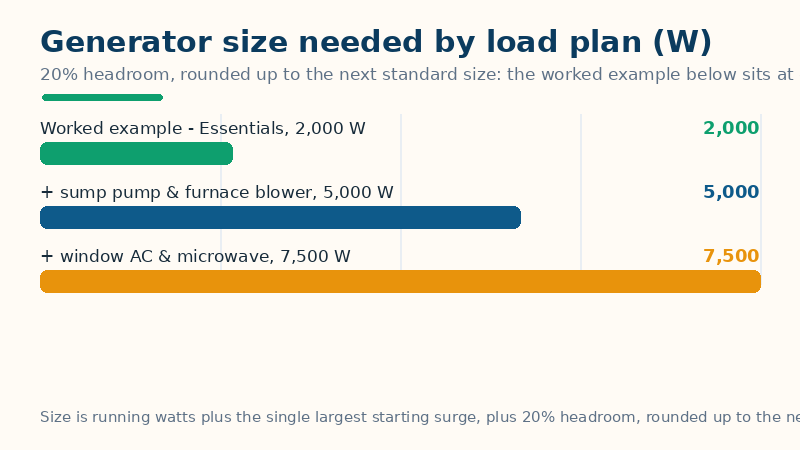
largest surge (W) = max(starting watts − running watts)peak (W) = running total + largest surgerecommended (W) = peak × (1 + headroom)The surge is the step most people miss. A refrigerator that draws 150 W while running can demand 1,200 W for the fraction of a second its compressor spins up — eight times its running figure. A furnace blower is worse in absolute terms: 800 W running, 2,350 W starting, a surge of 1,550 W. Resistive loads — heaters, kettles, microwaves, LED lights — have no surge at all: their starting watts equal their running watts, which is why a 1,500 W space heater is 1,500 W on both sides of the ledger. Only the largest surge is added, because motors start at different moments once everything is running; adding every surge together would oversize the generator by thousands of watts for a situation that never happens. Start the largest motor first, then add the rest one at a time, and the single-surge rule holds.
Worked example: refrigerator, freezer, lights, modem and chargers
Tick the five essentials — a standard refrigerator (150 W running, 1,200 W starting), a chest freezer (150 W, 900 W), ten LED bulbs (100 W), a modem and router (50 W) and phone chargers (25 W) — and the running total is 150 + 150 + 100 + 50 + 25 = 475 W. The surges are 1,050 W for the refrigerator, 750 W for the freezer and zero for the rest, so the largest surge is 1,050 W (the refrigerator). Peak = 475 + 1,050 = 1,525 W. With 20% headroom, 1,525 × 1.20 = 1,830 W, and the next standard size up is a 2,000 W generator — which covers the requirement with 170 W to spare. The calculator's table shows the same method as the load grows: add a sump pump (800 W running, 1,800 W starting) and a furnace blower (800 W, 2,350 W) and the running total becomes 2,075 W, the largest surge 1,550 W (the blower), the peak 3,625 W, the requirement 4,350 W, and the size 5,000 W. Add a window air conditioner (900 W, 2,200 W) and a microwave (1,000 W) as well and the running total is 3,975 W, the largest surge is still 1,550 W, the peak 5,525 W, the requirement 6,630 W, and the size 7,500 W. The usual rule of thumb follows from the same arithmetic: about 2,000 W for essentials, about 5,000 W with a sump pump and furnace blower, about 7,500 W with a window air conditioner and a microwave — and central air conditioning with everything else at once usually takes a whole-house unit above 10,000 W.
How to read your result, and its limits
Four cautions keep the number honest. First, typical wattages are not your wattages: motors vary a lot between models, so the nameplate on your own appliance beats any table, including this one — a refrigerator's starting watts can be anywhere from roughly 800 W to 2,200 W depending on the compressor. Second, central air conditioning is deliberately excluded: its compressor surge varies too much between units to size from a typical value, so if central air is on your list, size it from the unit's own locked-rotor amps on its nameplate, or ask the installer. Third, this is a sizing tool, not a runtime tool: it says nothing about how long a tank of fuel lasts — runtime depends on the fuel tank, the load, and whether the generator has an eco-throttle that drops its speed at part load. Fourth, never run a generator indoors or in a garage: carbon monoxide can kill, and no sizing calculation changes that — outdoors, at least 20 feet from the house, with the exhaust pointing away. For what the electricity itself costs once the power is back, the electricity cost calculator prices any appliance's use; for the battery bank that can carry the same essentials silently overnight, the solar battery size calculator sizes it in kilowatt-hours.
Common mistakes
- Sizing on running watts alone. A 475 W running load needs a 2,000 W generator, not a 500 W one — the 1,050 W refrigerator surge is what sets the size, and a machine rated below the peak will trip the moment the compressor starts.
- Adding every starting surge together. Motors start at different moments, so only the largest surge counts. Adding them all would turn the worked example's 1,525 W peak into 2,275 W and buy a generator a size too big for nothing.
- Forgetting the headroom. A generator run at its rated maximum is loud, thirsty and short-lived. The 20% headroom is what keeps it in the comfortable middle of its range, with room for one more small load later.
- Trusting an old wattage chart for a new appliance. A modern LED television draws roughly 60–120 W; the old worksheet figure for a television is a CRT-era number several times larger. Check the label on the appliance you actually own.
Related tools: Solar Panel Calculator — How many panels your roof needs — system size, panel count, roof area, cost and payback from your monthly use and local sun.
Frequently asked questions
What size generator do I need for a refrigerator and a few essentials?
About 2,000 watts. A standard refrigerator, a chest freezer, ten LED bulbs, a modem and phone chargers total 475 running watts, but the refrigerator's 1,050 W starting surge lifts the peak to 1,525 W, and 20% headroom takes the requirement to 1,830 W — the next standard size up is 2,000 W.
Why add only the largest starting surge, not every surge?
Because motors never all start in the same second. Once everything is running, compressors and pumps cycle at different moments, so the generator only ever has to absorb one surge at a time. Adding every surge together oversizes the machine by thousands of watts for a situation that never happens.
How much headroom should I add to a generator size?
20% is the standard allowance. It keeps the generator off its rated maximum — quieter, more fuel-efficient and longer-lived — and leaves room for one more small load later. This calculator applies 20% by default and lets you change it between 0% and 50%.
Can a 2,000 W generator run a window air conditioner as well?
Not with the essentials load on the same machine. Adding a 10,000 BTU window air conditioner to the 475 W essentials load gives a running total of 1,375 W and a largest surge of 1,300 W, a peak of 2,675 W and a requirement of 3,210 W with 20% headroom — the next standard size up is 3,500 W.