What heat flux is
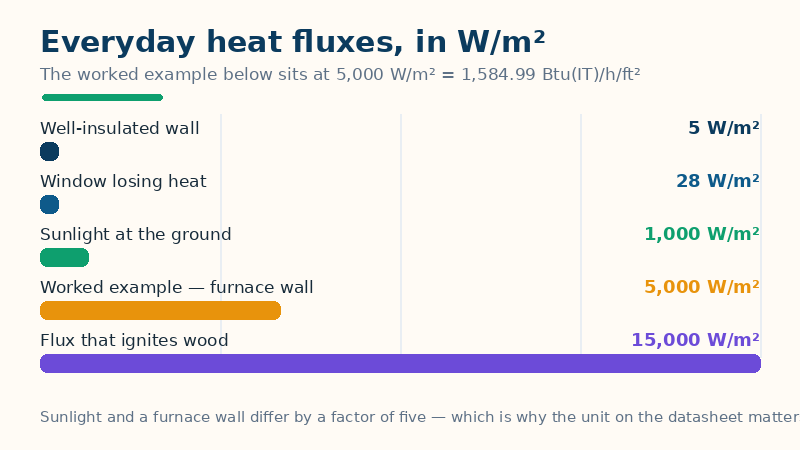
Heat flux is the rate at which heat flows through each unit of area — the watts crossing every square metre of a wall, a solar panel or a furnace lining. It is the quantity behind insulation ratings, solar-panel output and fire-safety limits: sunlight at the ground reaches about 1,000 W/m², heat leaking through a well-insulated wall is only a few W/m², and the flux that ignites wood sits around 12,000–20,000 W/m². The SI unit is the watt per square metre, but US engineering tables quote it in Btu (IT) per hour per square foot, older tables in kilocalories per hour per square foot, and fire-safety work in kilowatts per square metre, so the same flux arrives under half a dozen labels. This page restates any heat flux in all ten units at once, worked through watts per square metre with every factor defined, and answers the question the conversion alone cannot: through an area you enter, how much heat actually passes?
The formula
answer = watts per square metre ÷ (W/m² in one "to" unit)
total heat = watts per square metre × area
Three terms, all visible on the page. value is the number you enter. W/m² in one "from" unit is the definition of the unit you are converting from: 1 for the watt per square metre itself and for the joule per second per square metre, 1,000 for the kilowatt per square metre, 10,000 for the watt per square centimetre, 1,550.0031 for the watt per square inch, 1.163 for the kilocalorie (IT) per hour per square metre, 12.5184 for the kilocalorie (IT) per hour per square foot, 11,356.5267 for the Btu (IT) per second per square foot, 189.2754 for the Btu (IT) per minute per square foot, and 3.1545907 for the Btu (IT) per hour per square foot. answer is the result in the unit you asked for. area is the area you enter in square metres, and the total-heat line multiplies the flux by it, so the watts crossing a real surface fall out of the flux on the datasheet.
Worked example
Convert 5,000 watts per square metre to Btu (IT) per hour per square foot — the flux through a furnace wall, restated for a US manual — the way the tool does it.
Step 1 — get to watts per square metre. The input is already in watts per square metre, so the base value is 5,000 W/m² itself.
Step 2 — divide by the target factor. One Btu (IT) per hour per square foot is 3.1545907 W/m², so 5,000 ÷ 3.1545907 = 1,584.99.
Step 3 — read the display. The headline reads 1,584.99 Btu(IT)/h/ft², and the detail line shows the working: 5,000 W/m² = 1,584.99 Btu(IT)/h/ft² — worked through watts per square metre: 5,000 W/m² ÷ the Btu (IT) per hour per square foot factor. The full table for this example reads: 5,000 W/m², 5 kW/m², 0.5 W/cm², 3.2258 W/in², 5,000 J/s/m², 4,299.23 kcal(IT)/h/m², 399.41 kcal(IT)/h/ft², 0.4403 Btu(IT)/s/ft², 26.42 Btu(IT)/min/ft² and 1,584.99 Btu(IT)/h/ft². The total-heat line, at the default area of 2 m², reads 10,000 W (10 kW): 5,000 × 2 = 10,000 W, and 10,000 ÷ 1,000 = 10 kW.
Check it. Multiplying back, 1,584.99 Btu(IT)/h/ft² × 3.1545907 = 5,000 W/m² to the displayed rounding — the exact value multiplies back to 5,000 exactly, because the Btu (IT) definition is exact. The total line checks the same way: 10,000 W ÷ 2 m² = 5,000 W/m², the flux we started from.
Conversion table
The conversions solar datasheets, insulation manuals and fire-safety tables reach for most, each one the same two steps as the example:
| From | To |
|---|---|
| 1 W/m² | 0.317 Btu(IT)/h/ft² |
| 1 kW/m² | 317 Btu(IT)/h/ft² |
| 150 kW/m² | 47,549.75 Btu(IT)/h/ft² |
| 1 W/cm² | 10,000 W/m² |
| 1 W/in² | 1,550 W/m² |
| 1 Btu(IT)/h/ft² | 3.1546 W/m² |
| 100 Btu(IT)/h/ft² | 315.46 W/m² |
| 1 kcal(IT)/h/m² | 1.163 W/m² |
| 1,000 kcal(IT)/h/m² | 1,163 W/m² |
| 1 Btu(IT)/s/ft² | 11,356.53 W/m² |
| 1 Btu(IT)/min/ft² | 189.28 W/m² |
| 2,500 W/m² | 792.5 Btu(IT)/h/ft² |
Three everyday cross-checks for the scale, each one the same two steps: sunlight at the ground, 1,000 W/m², is 317 Btu(IT)/h/ft²; a window rated at 1.4 W/(m²·K) with 20 K across it loses 28 W/m², which is 8.876 Btu(IT)/h/ft²; and the flux that ignites wood, 15 kW/m², is 4,754.97 Btu(IT)/h/ft².
Reading the result, and its limits
Four distinctions keep this page honest. First, heat flux is not a heat transfer coefficient: W/m² is heat per area, while W/(m²·K) is heat per area per degree of difference, and the two only meet through a temperature difference — flux = coefficient × ΔT, as the window cross-check above shows. Second, Btu (IT) is not Btu (th): the international-table Btu is 1,055.05585262 joules and the thermochemical Btu is 1,054.35026444 joules, about 0.07% smaller, so tables that do not say which Btu they mean carry a small hidden error. Third, a flux is per area, so a total needs an area: 5,000 W/m² through 2 m² is 10,000 W, but through 0.5 m² it is only 2,500 W, and the total-heat line exists so that slip is visible. Fourth, the total-heat line assumes a uniform, steady flux: a surface that is hot in one corner and cool in another, or a flux that pulses, passes a different total than flux × area, and the line is exact only for the uniform steady flux the datasheet quotes.
Related tools: Energy Converter — Joules to calories, kcal to kJ, kWh to joules and BTU — every answer in all ten units, through the exact definitions; Power Converter — Horsepower to kW, kW to hp, watts and tons of refrigeration — every answer in all eight units, through the exact definitions; Temperature Converter — Convert °C, °F, K, °R and °Ré — every answer in all five scales, formulas shown.
Frequently asked questions
How do I convert W/m² to Btu/h/ft²?
Multiply by 0.31699833, which is 1 ÷ 3.1545907. A flux of 5,000 W/m² is 5,000 × 0.31699833 = 1,584.99 Btu(IT)/h/ft², the worked example on this page. To go the other way, multiply Btu(IT)/h/ft² by 3.1545907 to get W/m².
What is the difference between heat flux and a heat transfer coefficient?
Heat flux is heat per unit area, in W/m². A heat transfer coefficient is heat per unit area per degree of temperature difference, in W/(m²·K). The two meet through a temperature difference: flux = coefficient × ΔT, so a window rated 1.4 W/(m²·K) with 20 K across it loses 28 W/m².
Is a Btu (IT) the same as a Btu (th)?
No, and the difference matters at laboratory precision. One Btu (IT) is 1,055.05585262 joules and one Btu (th) is 1,054.35026444 joules — about 0.07% smaller. This page uses Btu (IT) throughout, and says so on every label, so the figure you convert is the figure the table meant.
Why does the total-heat line need an area?
A flux alone says nothing about how much heat passes in total — 5,000 W/m² through 2 m² is 10,000 W and through 0.5 m² is only 2,500 W. Enter the area and the page multiplies flux × area, so a wall total, a panel total or a furnace total falls out of the datasheet flux.
