A due date is a careful estimate, not an appointment
Almost no baby arrives on the date on the chart — the due date is the centre of a window of several weeks in which birth is normal, and its real job is to anchor everything else: scan dates, screening windows, and the week-by-week counting clinicians call gestational age. This calculator produces that estimate the standard way, from the first day of the last menstrual period (LMP) using Naegele's rule, with an adjustment for cycle length — or, if conception is known (IVF and closely tracked cycles), from the conception date directly. It then lays out what the date means today: how many weeks and days pregnant, which trimester, how far through the 40 weeks, and the milestone dates ahead. It is an educational estimate, not medical advice — a clinician, and especially an early ultrasound, can and often does revise it.
The formula, with every term defined
Naegele's rule: due date = first day of the last period + 1 year − 3 months + 7 days — which is the same span as last period + 280 daysCycle adjustment: add (your usual cycle length − 28) days, because Naegele assumed a 28-day cycle with conception 14 days after the period startedFrom conception: due date = conception date + 266 days (280 − 14 — gestational age counts from two weeks before conception)Gestational age = days since the last period (or its equivalent), written as weeks + remaining days: 140 days = 20 weeks 0 days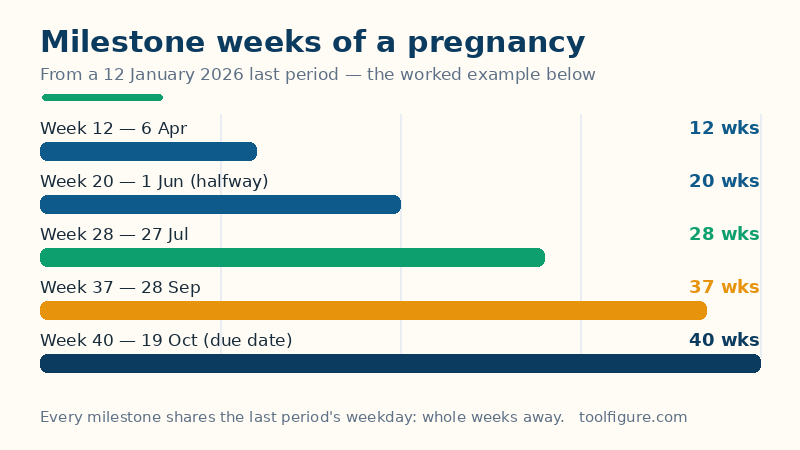
The oddest fact in pregnancy counting is in the third line: gestational age starts about two weeks before conception, because it is counted from the period, not the fertilisation. That is why a "40-week" pregnancy is 280 days from the LMP but only about 266 days — 38 weeks — from conception, and why someone is already "four weeks pregnant" around the day a period is first missed. The cycle adjustment exists because the rule's 14-days-to-conception assumption only holds for a 28-day cycle: with a regular 35-day cycle, conception typically falls around day 21, so the due date moves seven days later; with a 21-day cycle it moves seven days earlier.
Worked example: a last period of Monday 12 January 2026
The defaults above use a textbook cycle so every date can be checked on a calendar. First day of the last period: Monday 12 January 2026, cycle 28 days, so no adjustment. Adding 280 days gives an estimated due date of Monday 19 October 2026 — and Naegele's original recipe agrees exactly: 12 January plus 7 days is 19 January, minus 3 months is 19 October 2025, plus 1 year is 19 October 2026. The conception route lands on the same answer: conception two weeks after that period is Monday 26 January 2026, and 26 January + 266 days is also 19 October 2026. Two methods, one date — which is exactly the cross-check this page is built around.
Reading the pregnancy at the halfway point
Set the as-of date to Monday 1 June 2026 and the same example reads: 140 days since the last period, which is 20 weeks 0 days pregnant — the second trimester (weeks 14 to 27), exactly 50.0% of the way to 40 weeks, with 140 days remaining to the due date. The symmetry is a happy accident of the round numbers, but the shape is typical: the halfway scan most services schedule around week 20 really does sit at the pregnancy's midpoint. The milestone table under every result generalises this: week 12 (Monday 6 April 2026 in the example) closes the first trimester's main screening window, week 28 (Monday 27 July) opens the third trimester, week 37 (Monday 28 September) is where "early term" begins — a birth from here is no longer counted premature — and week 42 (Monday 2 November) is the far end of the usual window, past which most clinicians discuss induction.
Cycle length moves the date — by exactly the difference
| Last period | Cycle | Estimated due date |
|---|---|---|
| Mon 12 Jan 2026 | 21 days | Mon 12 Oct 2026 |
| Mon 12 Jan 2026 | 28 days | Mon 19 Oct 2026 |
| Mon 12 Jan 2026 | 35 days | Mon 26 Oct 2026 |
| Sun 1 Mar 2026 | 28 days | Sun 6 Dec 2026 |
Each seven days of cycle length moves the estimate by exactly seven days — the adjustment is a straight translation, because all that changes is the assumed conception day inside the same 280-day frame. Notice the second example too: a 1 March 2026 period with a 28-day cycle gives a 6 December 2026 due date, and period arithmetic makes every milestone fall on a Sunday, just as the January example's milestones all fall on Mondays — milestones always share the LMP's weekday, because they are whole numbers of weeks away from it.
How to read your result, and the limits — read these
The big date is the 40-week estimate. Treat the honest window as roughly 37 to 42 weeks: most babies arrive inside it, very few arrive on the exact day, and a date a few days either side is a normal birth, not an early or late one. The limits matter more on this page than on any other tool here. The estimate assumes a regular cycle and a correctly remembered LMP; irregular cycles, recent hormonal contraception, breastfeeding, or an uncertain date can each move the true figure by a week or more, and an early ultrasound measurement is generally considered more reliable than period dates — if a clinician gives you a revised due date, theirs is the one to plan around. This page cannot see anything about an individual pregnancy and offers no medical guidance: questions about symptoms, movements, or when to seek care belong to a midwife, doctor or local maternity service, promptly. For the plain calendar gap between any two dates, the days-between-dates calculator is the general tool; to count down the days remaining to the date above, the countdown calculator does it in one step.
Frequently asked questions
How is a due date calculated from the last period?
By Naegele's rule: take the first day of the last period, add seven days, subtract three months and add a year — the same span as adding 280 days (40 weeks). A last period of 12 January 2026 gives 19 October 2026. If your cycle is regularly longer or shorter than 28 days, add the difference: a 35-day cycle moves the estimate seven days later.
How accurate is a due date calculator?
It is a well-standardised estimate, not a prediction. Most babies are born between 37 and 42 weeks, and only a small minority arrive on the exact due date. Period-based dates also assume a regular 28-day pattern — an early ultrasound is generally treated as more reliable, and a clinician may revise the date this page gives you.
Why is pregnancy counted from before conception?
Because the convention predates any way to observe conception: gestational age is counted from the first day of the last period, roughly two weeks before fertilisation in a textbook cycle. That is why pregnancy is '40 weeks' from the period but about 38 weeks from conception, and why this calculator adds 266 — not 280 — days to a conception date.
What if my cycles are irregular?
Then a period-based estimate can be off by a week or more in either direction, and no calculator input fixes that. Use the conception mode if the conception date is known (for example from fertility treatment); otherwise treat the result as provisional until an early scan dates the pregnancy — and tell the clinician the cycle history, because they will ask.
What do the trimesters mean in weeks?
The convention used here: the first trimester runs to 13 weeks 6 days, the second from week 14 to 27 weeks 6 days, and the third from week 28 until birth. Week 37 opens what clinicians call early term — a birth from 37 weeks is no longer classed as premature, even though the due date itself is week 40.