Roots are questions, and every answer here proves itself
Most calculators treat the square root as a button. It is better understood as a question: what number, multiplied by itself, makes the number I started with? The square root of 144 is 12 because 12 × 12 = 144 — and that multiplication is not a decoration, it is the definition, the method and the check all in one. This calculator is built around that idea. It finds square roots, cube roots and nth roots, and runs the family in the other direction too — squares, cubes and powers — printing the multiplication check beside every result so you never have to take a root on faith. When a root is a whole number the check is exact and the page says so (144 is a perfect square); when it is not, the root is given to four decimal places and the check is honestly labelled approximate. For full expression work — brackets, trigonometry, factorials — the scientific calculator is the bigger tool; this page is the specialist for roots and powers.
The formulas, with every symbol defined
Square root: √x = the non-negative number r with r × r = xCube root: ∛x = the number r with r × r × r = x (negatives allowed)Nth root: x^(1/n) — the number whose nth power is xPowers run the family backwards: square x² = x × x · cube x³ = x × x × x · power x^y = x multiplied in a chain of y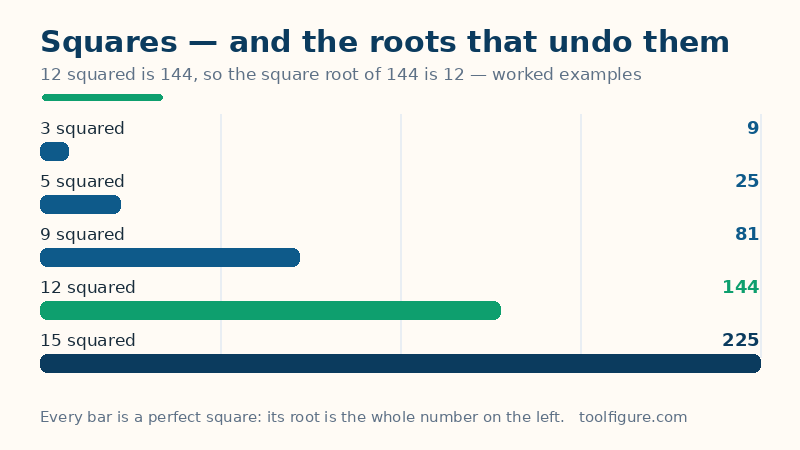
The vocabulary that causes the confusion, settled once. x is the number you start with; for roots it is sometimes called the radicand. n is the degree of the root — 2 for square roots (usually left unwritten), 3 for cube roots, and so on. A perfect square is a whole number whose square root is also whole: 1, 4, 9, 16, 25 and their kin. The one sign rule that matters: squaring any real number — positive or negative — gives a non-negative result, so a square root can never start from a negative number in real arithmetic; cubing keeps the sign, which is why cube roots of negatives exist quite happily (∛−27 = −3, because −3 × −3 × −3 = −27). The third formula quietly unifies the whole page: an nth root is the power 1/n, so roots and powers are one family read in two directions — exactly the relationship the results table exploits by showing your number five ways at once.
Worked example: the square root of 144
The defaults above ask for √144, and the answer is 12. The check is the whole argument: 12 × 12 = 144, exactly, so 144 is a perfect square and 12 is its exact root — no decimals, no approximation. Estimation brackets the answer before any computing happens, and the habit is worth stealing: 10² = 100 and 15² = 225, so √144 must sit between 10 and 15; 12² = 144 lands it. The bars below draw the ladder this example lives on — 3² = 9, 5² = 25, 9² = 81, 12² = 144, 15² = 225 — which is also the fastest way to estimate any root by eye: find which two rungs your number sits between. Two neighbours complete the picture in the results table: 144² = 20,736 (squaring grows fast) and ∛144 ≈ 5.2415, the number that multiplied by itself three times makes 144.
More verified roots and powers — including the ones that are not whole
| Question | Answer | The check |
|---|---|---|
| √2 | 1.4142 | 1.4142 × 1.4142 ≈ 2 — 2 is not a perfect square, so its root never terminates; 1.4142 is the four-decimal rounding |
| √50 | 7.0711 | Between 7² = 49 and 8² = 64, very close to the bottom — and exactly 5 × √2, since 50 = 25 × 2 |
| ∛27 | 3 | 3 × 3 × 3 = 27 — a perfect cube |
| ∛−27 | −3 | −3 × −3 × −3 = −27 — odd roots keep the sign, even roots cannot start negative at all |
| 4th root of 81 | 3 | 3^4 = 3 × 3 × 3 × 3 = 81 |
| 5th root of 32 | 2 | 2^5 = 32 |
| 15² and 25² | 225 and 625 | And back again: √225 = 15, √625 = 25 — the pair the chart below is drawn from |
Two patterns in that table repay attention. First, √50 = 5√2: because 50 = 25 × 2, its root splits into √25 × √2 = 5 × 1.4142 ≈ 7.0711 — the same simplify-the-root move school maths calls surds, and the reason some roots come out tidier than they look. Second, compare the even and odd rows for negatives: the 4th root of −81 has no real answer (nothing multiplied by itself four times is ever negative), while the 5th root of −32 is simply −2. Sign rules are not pedantry here; they are the difference between an answer existing and not existing, and the calculator states the reason in plain words when it refuses one instead of printing a silent NaN — the same honesty standard as the divisor guard in our percent change calculator.
Where roots actually get used
The square root is the finishing step of half the formulas in practical maths. It recovers a side from an area (a square plot of 144 m² is 12 m to a side) and a length from Pythagoras — a ladder problem ending in √50 is this page's second row. It is step 4 of the standard deviation formula on our standard deviation calculator, where the square root turns variance measured in "units squared" back into the units you actually measured. In money, reversing compound growth is a root in disguise: growing from 100 to 121 over two years is a yearly multiplier of √1.21 = 1.1, a 10% annual rate — the root doing the same undoing work as the reverse mode of the percent change calculator. And roots set the scale of everyday geometry: double a square's area and its side grows only by √2 ≈ 1.4142, which is why A3 paper is A4 scaled by that very factor. Whenever a formula squares something you know to find something you do not — an area, a variance, a grown amount — a root is how you walk it back.
Frequently asked questions
How do I find the square root of a number without a calculator?
Bracket it between perfect squares, then narrow in. For 50: 7² = 49 and 8² = 64, so the root is just above 7; 7.1² = 50.41 is slightly too big, 7.07² = 49.98 is close — the root is about 7.0711. This estimate-and-square method always works, and checking a claimed root is even easier: just square it.
Why does the calculator refuse the square root of a negative number?
Because no real number multiplied by itself ever gives a negative — a negative times a negative is positive, and zero times zero is zero. Square roots of negatives need imaginary numbers, which are a different number system with their own notation. Cube roots are different: cubing keeps the sign, so ∛−27 = −3 is a perfectly real answer.
What is a perfect square, and why does the page point it out?
A whole number whose square root is also a whole number: 144 (root 12), 81 (root 9), 225 (root 15). Perfect squares matter because their roots are exact — no rounding anywhere — which makes them the anchor points for estimating every other root, and a common exam check that you have read the question correctly.
What is the difference between a root and a power?
They are inverses — each undoes the other. A power builds up: 3^4 = 81. A root asks backwards: the 4th root of 81 is 3. Formally the nth root of x is x raised to the power 1/n, which is why this one calculator covers both directions, and why reversing compound growth over n years means taking an nth root.
How accurate is the result, and what does the check line mean?
Roots that are whole numbers are exact, and the check line multiplies them back to prove it. Roots that are not whole are shown to four decimal places (√2 = 1.4142), and their check lines are marked approximate because the rounded root, squared, lands a hair off the original. Internally the calculation keeps full precision; only the display is rounded.