Four operations, four different rules — that is the whole difficulty
Fractions confuse people for one honest reason: adding, subtracting, multiplying and dividing them each follow a different rule, and the rules for multiplying and dividing look easier than the rule for adding — which feels backwards until you see why. Adding and subtracting compare parts, so the parts must be the same size first: a common denominator. Multiplying just combines counts, so numerators multiply and denominators multiply, no common size needed. Dividing asks how many of one fraction fit inside another, which turns into multiplying by the flipped second fraction. This calculator applies the right rule for the operation you pick, then does the three finishing jobs every fraction answer needs: it simplifies to lowest terms, converts to a mixed number when the result is larger than one, and gives the decimal and percentage equivalents — the same conversion our percentage calculator is built around. The working line under the result shows the unsimplified step, so you can follow the method, not just copy the answer.
The fraction formulas
Add: a/b + c/d = (a x d + c x b) / (b x d)Subtract: a/b − c/d = (a x d − c x b) / (b x d)Multiply: a/b x c/d = (a x c) / (b x d)Divide: a/b ÷ c/d = (a x d) / (b x c) — multiply by the reciprocalSimplify: divide numerator and denominator by their greatest common divisor (GCD)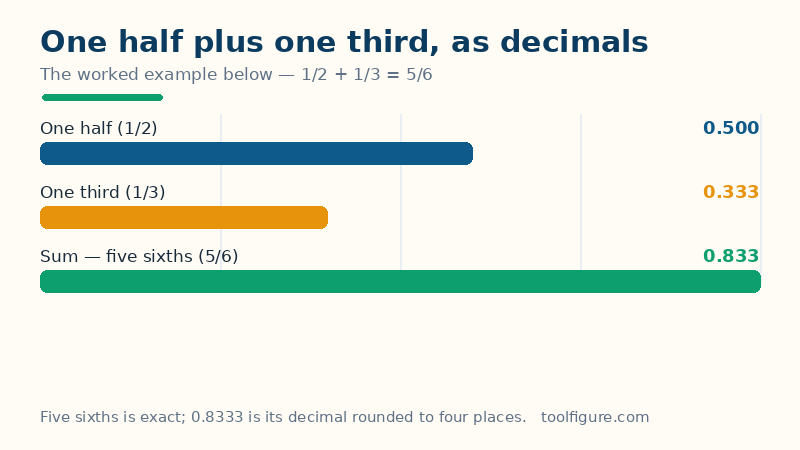
In every formula, a and c are the two numerators (the top numbers — how many parts you have), and b and d are the two denominators (the bottom numbers — how many equal parts the whole is cut into). A denominator can never be zero: cutting a whole into zero parts has no meaning, which is why the calculator refuses it instead of printing an error code. Simplifying uses the GCD — the largest number that divides both the top and the bottom exactly. 12/18, for instance, has a GCD of 6, so it simplifies to 2/3; the value never changes, only the size of the parts does. An improper fraction — top larger than bottom, like 15/8 — becomes a mixed number by dividing: 15 ÷ 8 is 1 with 7 left over, so 15/8 = 1 7/8.
Worked example: 1/2 + 1/3, step by step
Add 1/2 and 1/3. The denominators differ, so first give them a common denominator: 2 x 3 = 6. Rewrite each fraction in sixths: 1/2 = 3/6 and 1/3 = 2/6. Now the parts are the same size, so the numerators can be added: 3/6 + 2/6 = 5/6. The GCD of 5 and 6 is 1, so 5/6 is already in lowest terms. As a decimal it is 5 ÷ 6 = 0.8333 (rounded to four places — the exact decimal repeats forever), and as a percentage it is 83.33%. Notice what the wrong shortcut would have given: adding tops and bottoms straight (1+1)/(2+3) = 2/5 = 0.4, which is not even between the two fractions being added — a quick sanity check worth doing on any fraction sum: the answer must be larger than either fraction alone when both are positive. The bars below draw the same example: one half (0.5) plus one third (about 0.333) lands at five sixths (about 0.833).
The other three operations, on verified examples
| Calculation | Working | Simplified | Decimal |
|---|---|---|---|
| 3/4 − 1/6 | 18/24 − 4/24 = 14/24 before simplifying | 7/12 | 0.5833 |
| 2/3 × 3/5 | (2 × 3) / (3 × 5) = 6/15 | 2/5 | 0.4 |
| 3/4 ÷ 2/5 | 3/4 × 5/2 = 15/8 | 15/8 = 1 7/8 | 1.875 |
Each row rewards a second look. In the subtraction, the calculator's raw step is (3 x 6 − 1 x 4) / (4 x 6) = 14/24, and dividing top and bottom by their GCD of 2 gives 7/12 — the same answer the common-denominator-of-12 route gives, reached by a slightly different road; both are correct because simplifying at the end forgives a larger common denominator. In the multiplication, the 3 in the top of the answer and the 3 in the bottom cancel during simplifying (6/15, GCD 3, becomes 2/5) — cancelling a factor that appears on both sides before you multiply keeps numbers small, a habit worth building for hand work. In the division, flipping 2/5 into 5/2 is not a trick to memorise blindly: 3/4 ÷ 2/5 asks how many two-fifths fit into three-quarters, and the answer 1.875 — nearly two — is exactly what that question should produce. Checking a result against common sense like this is also how the figures behind our average calculator and GPA calculator stay honest.
Reading your result: fraction, decimal or percentage?
All three forms in the results table are the same number wearing different clothes, and each has a job. Keep the fraction when exactness matters — recipes, measurements and exam answers — because 5/6 is exact while 0.8333 is a rounding. Use the decimal to compare sizes at a glance (is 7/12 bigger than 0.58? The decimal settles it instantly) and for money, where our discount calculator lives in decimals and percents. Use the percentage when the fraction describes a share of something — a grade, a tip, a proportion of a budget. One caution belongs here: a repeating decimal like 1/3 = 0.333... can never be written out fully, so converting a fraction to a decimal and back can quietly change its value; when a chain of calculations matters, stay in fractions until the final step, exactly as this calculator does internally.
Frequently asked questions
How do you add fractions with different denominators?
Give them a common denominator first, then add the numerators. For 1/2 + 1/3 the common denominator is 6: rewrite as 3/6 + 2/6 = 5/6. The formula is a/b + c/d = (a x d + c x b) / (b x d), and the result is then simplified — 5/6 is already in lowest terms, equal to 0.8333 or 83.33%.
Why do you flip the second fraction when dividing?
Because dividing by a fraction asks how many of it fit into the first number, and that question equals multiplying by its reciprocal. So 3/4 ÷ 2/5 becomes 3/4 x 5/2 = 15/8 = 1 7/8 = 1.875. The flip is not a shortcut pasted on — it is what division of fractions means.
How do you simplify a fraction?
Divide the numerator and the denominator by their greatest common divisor — the largest number dividing both exactly. 12/18 has a GCD of 6, so it simplifies to 2/3. 14/24 (the raw result of 3/4 − 1/6 above) has a GCD of 2 and simplifies to 7/12. The value never changes, only the part size.
How do you turn an improper fraction into a mixed number?
Divide the numerator by the denominator: the whole-number part is the quotient and the remainder stays as the fraction. 15/8 divides to 1 remainder 7, so it is 1 7/8. If the remainder is zero the answer is a plain whole number. This calculator shows the mixed number alongside every improper result.
Can a denominator be zero?
No — a fraction with zero underneath is undefined, because it would mean dividing a whole into zero parts. The calculator refuses a zero denominator (and refuses dividing by a fraction with a zero numerator, which is the same problem in disguise) rather than printing a meaningless result.