How the age calculator works
This age calculator counts the exact calendar distance between your birth date and any other date — full years, then full months, then remaining days, borrowing days from the previous month so February and leap years come out right. It also gives your total days lived, the weekday you were born, and the days until your next birthday. Age is not just a subtraction of years. This calculator counts the exact calendar distance between two dates: full years first, then full months, then the remaining days — the same method used on official forms. When the day of the end date is smaller than the day you were born, it borrows the correct number of days from the previous month, which is why February and leap years are handled properly.
Age = years → months → days, borrowing days from the previous month when needed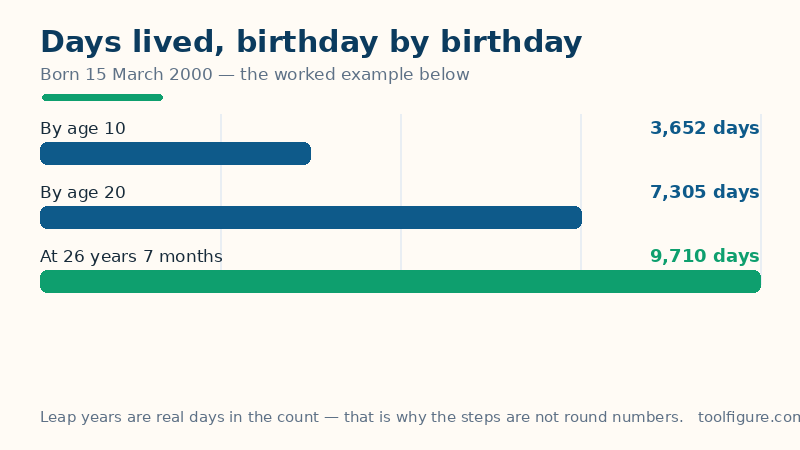
Worked example
Born on 15 March 2000, measured on 15 October 2026: that is 26 full years (to 15 March 2026), then 7 full months (to 15 October 2026), then 0 days — an exact age of 26 years, 7 months, 0 days, and 9,710 total days lived.
Age on a specific date
Change the second field to any date — a school cut-off, a job application's reference date, a retirement date — to find the exact age a person will be (or was) on that day. Forms that ask "age as of 1st September" need this, not a rough year subtraction.
Worked example — a UK school cut-off date
In England, school year groups and admissions are set by a child's age on 1 September. Take a child born on 3 September 2019: on 1 September 2026 this calculator gives 6 years, 11 months, 29 days — two days short of seven. The same child measured a week later is simply "7", but for the school rule the cut-off figure is the one that matters, and a rough year subtraction (2026 − 2019 = 7) would have given the wrong answer. The calculator also reports 2,555 total days lived and that the child was born on a Tuesday.
Worked example — a US sports league cut-off
Many US youth leagues set eligibility by age on 1 January or 1 August. A player born on 4 July 2010 is, on 1 January 2027, exactly 16 years, 5 months, 28 days old, with 6,025 total days since birth — comfortably inside an "under-17" bracket for that season, but the same player measured against a 1 August 2026 cut-off would have been 16 years and 28 days, which can be the difference between two age divisions. This is why leagues ask for the exact figure rather than the year of birth.
How to read your result
The large figure is your completed age — full years, then full months, then leftover days — which is the way passports, schools and official forms express age. Underneath, the table converts the same span into total days, hours and minutes (useful for milestones: your 10,000th day of life arrives at about 27 years and 4 months), and counts the days until your next birthday measured from the "age at" date you chose, not necessarily from today.
Limitations
The calculator works in whole calendar days and ignores the time of day you were born, so two babies born hours apart on the same date get identical results. It also cannot apply every country's legal-birthday convention: the 29 February case is covered in the questions below, and some jurisdictions count age from conception or increment everyone's age on New Year's Day (older East Asian systems). For legal purposes, the definition in the relevant law or form always wins.
Common mistakes
- Subtracting years only. 2026 − 2000 = 26, but you are only 26 once your 2026 birthday has passed; before it you are still 25.
- Counting both endpoints. Age measures completed time, so the day of birth is day 0, not day 1. Counting both ends inflates every result by a day.
- Assuming every month has 30 days. Borrowing days across February is exactly where hand calculations go wrong; the calculator borrows the real length of the previous month.
- Mixing date formats. 03/04/2010 is 3 April in the UK and March 4 in the US. The date fields above remove the ambiguity — use the calendar picker rather than typing.
Related tools: Days Between Dates Calculator — Total days, business days and weeks between two dates; Percentage Calculator — What is X% of Y, X is what % of Y, and % change — with steps; Word Counter — Live word, character and sentence counts, reading time and keyword density.
Frequently asked questions
How old am I if I was born in 2000?
In 2026 you turn 26 — but your exact age depends on whether your birthday has passed yet this year. Enter your full date of birth above for the exact years, months and days.
What if I was born on 29 February?
On non-leap years most countries treat 1 March (some use 28 February) as the legal birthday. This calculator counts calendar time exactly, so your age in days is always correct; your 'birthday' in a non-leap year falls on the date your country uses.
Does the calculator count the day I was born?
Age is measured as completed time since birth, so the day you were born is day 0. The 'total days' figure is the number of full days between the two dates.
Why do some forms ask for age on a specific date?
Schools, sports leagues, licences and pensions set eligibility by your age on one fixed reference date, which can differ from your age today by almost a year.
How do I get my baby's age in months or weeks?
Convert from the completed figure: 1 year and 5 months is 17 completed months. For weeks, the table's total days divided by 7 gives completed weeks — health visitors and midwives usually quote a baby's age in weeks up to about 3 months, then in months.
Why can my age change at a different moment in another country?
Because a birthday legally begins at midnight local time. Someone born on 1 January turns a year older in New Zealand roughly half a day before someone with the same birth date in California. This calculator works in whole calendar days, which is what forms and cut-off rules use.
The worked examples on this page were checked against this calculator on 18 October 2026.