The formula: your height plus a skill allowance
The calculation is a ladder, not a chart lookup, and the calculator shows the allowance it used so the answer can be checked by hand. Step 1, convert to inches: height in centimetres divided by 2.54 gives inches — the unit the rope guides are built in. Step 2, add the skill allowance: beginners add 36 inches, intermediate jumpers 24, advanced jumpers 12 and competitive speed jumpers 6. Step 3, restate the total in feet and inches and in centimetres. The allowance is the whole story: a beginner needs clearance, because a rope that clips the feet every third jump teaches nothing, while an advanced jumper wants the rope just long enough to clear, because every spare inch is drag that slows turnover. That is why one height honestly takes four lengths, and why a single chart value without a skill attached is a guess. The ladder is:
| Skill level | Allowance over height | Handle check (stand on the middle) |
|---|---|---|
| Beginner | + 36 in (91.4 cm) | Handles reach your armpits |
| Intermediate | + 24 in (61.0 cm) | Handles between chest and armpits |
| Advanced | + 12 in (30.5 cm) | Handles reach about chest height |
| Competitive | + 6 in (15.2 cm) | Handles at chest height, kept tight for speed |
The handle check is the part no chart can replace: stand with both feet in the middle of the rope, pull the handles straight upward, and see where they land. If they land where your skill row says, the length fits your frame whatever the chart says — arm length and posture differ, and the check catches what height alone cannot.
Worked example: 175 cm, intermediate
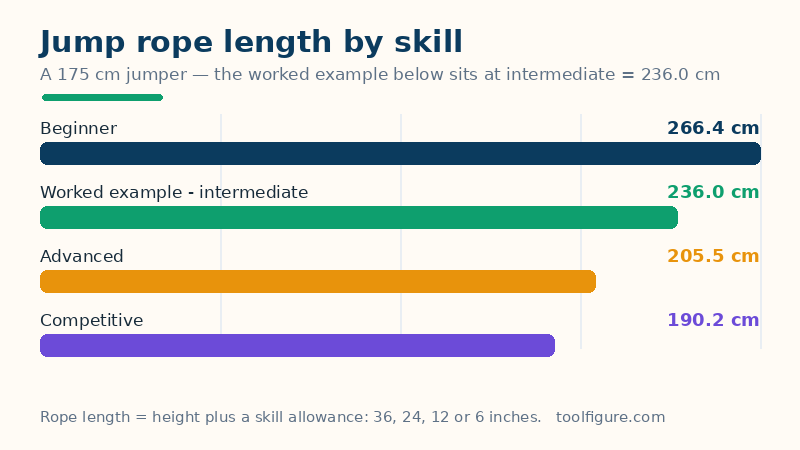
Take a jumper who is 175 cm tall and jumps at intermediate level. Step 1: 175 ÷ 2.54 = 68.9 in. Step 2: 68.9 + 24 = 92.9 in. Step 3: 92.9 inches is 7 ft 9 in, and 92.9 × 2.54 = 236.0 cm — so the answer is 7 ft 9 in (236.0 cm). The same height at every skill reads:
| 175 cm jumper | Total length | In centimetres | In feet and inches |
|---|---|---|---|
| Beginner (68.9 + 36 in) | 104.9 in | 266.4 cm | 8 ft 9 in |
| Intermediate (68.9 + 24 in) | 92.9 in | 236.0 cm | 7 ft 9 in |
| Advanced (68.9 + 12 in) | 80.9 in | 205.5 cm | 6 ft 9 in |
| Competitive (68.9 + 6 in) | 74.9 in | 190.2 cm | 6 ft 3 in |
Notice the spread: 30 inches separate the beginner and competitive lengths at the same height, which is exactly the gap between a rope that forgives mistakes and a rope built for speed. Intermediate jumpers at other heights read 160 cm → 87.0 in (221.0 cm, 7 ft 3 in), 180 cm → 94.9 in (241.0 cm, 7 ft 11 in) and 190 cm → 98.8 in (251.0 cm, 8 ft 3 in). The inches input agrees: 69 in at intermediate level is 69 + 24 = 93.0 in (236.2 cm, 7 ft 9 in), a fraction above the 175 cm answer because 69 inches is 175.3 cm, not 175 cm exactly.
How to read your result, and its limits
Three checks before cutting or buying. First, run the stand-on test: height alone cannot see your arm length or posture, so stand on the middle of the rope and check the handles against your skill row — if they land far from it, trust the test over the calculator. Second, buy adjustable when you are learning: a rope that can be shortened lets you start at the beginner length and take inches off as you improve, instead of buying a new rope at every step of the ladder. Third, match the rope to the work: heavy beaded ropes suit the beginner and intermediate allowances, where clearance matters more than speed, while thin speed cables belong at the advanced and competitive allowances, where a tight rope is the point — and a weighted rope that cannot be cut should be chosen from the maker's own size table, not this page. For the rest of the training, the pace calculator turns a run's time and distance into pace and predicted finish times, and the calorie calculator estimates the daily energy a training routine actually needs.
Related tools: One Rep Max Calculator — Estimate a one-rep max from any set, with both classic formulas and a percentage table.
Frequently asked questions
What length jump rope do I need for my height?
As a starting point, add the skill allowance to your height: a 175 cm intermediate jumper needs 236.0 cm (7 ft 9 in), while the same height as a beginner needs 266.4 cm (8 ft 9 in). Enter your own height and skill above and the calculator shows your length in feet, inches and centimetres.
Why do advanced jumpers use shorter ropes?
Because every spare inch is drag: a beginner needs clearance so the rope does not clip their feet, while an advanced jumper wants the rope just long enough to clear, for faster turnover. The allowance shrinks from 36 inches for a beginner to 6 inches for competitive speed work.
Does jump rope length include the handles?
The length on this page is end to end, handles included. The stand-on test measures the same thing: stand on the middle of the rope, pull the handles straight up, and they should reach your armpits as a beginner and about chest height as an advanced jumper.
What if I am between sizes?
Buy an adjustable rope and set it to the calculator's length: it can be shortened as you improve, instead of buying a new rope at every step of the ladder. And run the stand-on test before cutting — arm length and posture can move the right length by an inch or two either way.