The Environment Canada formula
The humidex is Canada's answer to the question the US heat index answers — how hot does humid air feel? — and the two are cousins, not twins: they start from the same two readings, temperature and humidity, but they combine them with different equations, so the same afternoon can score 41 on one scale and 106°F on the other. The humidex runs in three steps. Step 1 finds the dew point from temperature and humidity with the Magnus formula: α = ln(RH ÷ 100) + (17.625 × T) ÷ (243.04 + T), then dew point = (243.04 × α) ÷ (17.625 − α), with T in degrees Celsius. Step 2 turns that dew point into the vapour pressure of the air, e, in hectopascals: e = 6.11 × exp[5417.7530 × (1 ÷ 273.16 − 1 ÷ (273.16 + dew point))]. Step 3 adds the humidity adjustment to the air temperature itself:
Humidex = T + 0.5555 × (e − 10)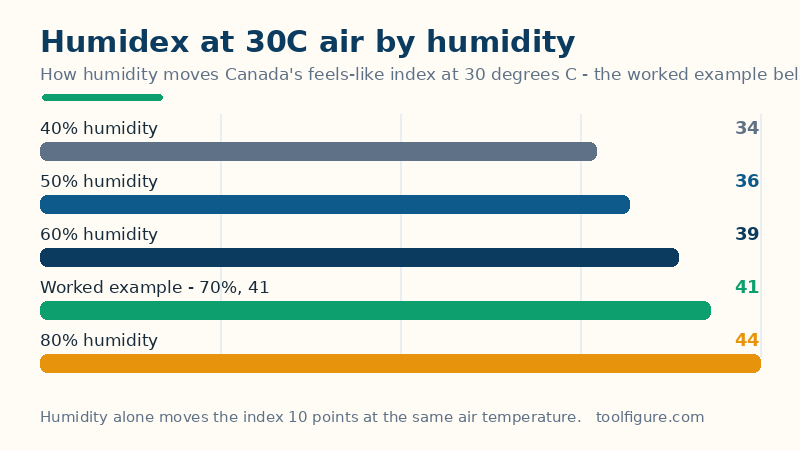
Here T is the air temperature in degrees Celsius and e is the vapour pressure from step 2. The subtraction of 10 hPa is the reference point: at a vapour pressure of exactly 10 hPa, the humidex equals the air temperature, and every hectopascal above it adds about 0.56 to the index. The result is dimensionless — it is an index number, not a temperature — but it is designed to read like one, so a humidex of 41 is described as feeling like 41°C. Fahrenheit inputs are converted to Celsius before step 1, and the index is restated on the Fahrenheit scale for display only.
Worked example: 30°C at 70% humidity
Step 1, the dew point: α = ln(0.70) + (17.625 × 30) ÷ (243.04 + 30) = −0.3567 + 1.9367 = 1.5800, so the dew point is (243.04 × 1.5800) ÷ (17.625 − 1.5800) = 383.99 ÷ 16.0450 = 23.93°C. Step 2, the vapour pressure: e = 6.11 × exp[5417.7530 × (1 ÷ 273.16 − 1 ÷ 297.09)] = 6.11 × exp(1.5976) = 6.11 × 4.941 = 30.19 hPa. Step 3: humidex = 30 + 0.5555 × (30.19 − 10) = 30 + 11.22 = 41.22, shown as 41 — 11.2 above the air temperature, in the great discomfort band (40–45), where Environment Canada advises avoiding exertion. At the same 30°C, the table on the calculator shows humidity doing all the work: 40% gives 34, 50% gives 36, 60% gives 39, the worked 70% gives 41 and 80% gives 44 — a 10-point spread from humidity alone. Two published cross-checks confirm the implementation: Environment Canada's own example, 21°C at 100% humidity, returns 29.43, shown as 29 — exactly the figure Canada's humidex page quotes — and a 30°C day with a 20°C dew point returns about 38. The Fahrenheit restatement of the worked example is 41 on the humidex scale, about 106.2°F.
How to read your result, and its limits
Four limits decide what the number can and cannot tell you. First, the bands are population guidance, not personal risk: under 30 is little discomfort, 30–39 some discomfort, 40–45 great discomfort with exertion to be avoided, and 46 and above dangerous, with heat stroke possible — but age, illness, medication, clothing and acclimatization move individual risk a long way inside any band. Second, it assumes shade: like the heat index, the humidex takes no account of direct sun, which can add roughly the equivalent of 15°F to how hot it feels, so plan shade and water for the sunny figure, not the shaded one. Third, it is published for warm weather: Environment Canada reports the humidex at 20°C and above, because below that humidity changes comfort only slightly — a winter humidex is arithmetic, not advice. Fourth, it is not interchangeable with the heat index: the two scales are fitted differently, so converting between them by a formula is meaningless — compare a humidex only with other humidex values, and a heat index only with other heat indices. For cold and windy days neither applies; that is the wind chill calculator's job.
Common mistakes
- Reading the humidex as a thermometer temperature. The air is 30°C in the worked example, not 41°C — 41 is how hard the body works to stay cool, expressed on a temperature-like scale. Saying "it is 41 degrees" without the word humidex misstates the weather.
- Comparing a humidex with a heat index. The worked afternoon scores 41 humidex and 106°F heat index. Neither converts into the other; they are two different indices fitted to two different models, and the honest comparison is band against band — both call this afternoon dangerous.
- Forgetting the sun. The index assumes shade. Working in full sun on a humidex-41 day means planning for something hotter still, and the shade figure alone will under-protect you.
- Treating a band edge as a cliff. 39 and 41 sit either side of the some-to-great-discomfort line, but the body does not notice the boundary: near an edge, take the higher band's precautions.
Related tools: Heat Index Calculator — How hot it really feels — the official NWS heat index from temperature and humidity, with the danger band; Dew Point Calculator — When moisture condenses — the dew point from temperature and humidity, with the spread and comfort band; Wind Chill Calculator — How cold it really feels — the official wind chill from temperature and wind speed, with the frostbite-risk band.
Frequently asked questions
What is the humidex, exactly?
The humidex is Environment Canada's index of how hot humid air feels to the average person, combining air temperature and relative humidity into one number. It was developed by Canadian meteorologists J. M. Masterton and R. B. Richardson in 1979 and is the feels-like figure used in Canadian forecasts and heat warnings.
How is the humidex different from the heat index?
Both combine temperature and humidity, but with different equations: the humidex builds from the dew point and vapour pressure, while the US heat index uses the Rothfusz regression. The same afternoon scores 41 humidex and 106°F heat index — the numbers are not convertible, only their danger bands are comparable.
Why does the calculator ask for humidity instead of the dew point?
Because forecasts publish temperature and humidity, not dew point. The calculator derives the dew point from those two readings with the Magnus formula first, then the vapour pressure, then the humidex — the same chain Environment Canada's own calculator runs.
Does the humidex account for wind or sunshine?
No: it assumes shade and still air. Wind and sun both change how heat feels, but neither is in the equation — for a combined temperature, humidity and wind figure, use the apparent temperature calculator, and treat full sun as adding further heat on top of any index.
