Every training zone is a percentage of one estimated number
Heart-rate training looks precise — five zones, each with its own beats-per-minute borders — but the whole structure hangs on a single estimate: your maximum heart rate, which almost nobody has measured directly. This page is honest about that foundation. It shows the two published age formulas side by side rather than picking one quietly, draws the zones as percentages of the classic figure, and then, if you give it a resting heart rate, adds Karvonen targets — the older, cleverer method that counts from where your heart actually starts in the morning instead of from zero. It belongs with the other training pages here — effort targets beside the pace calculator's finish times and the one rep max calculator's percentage loads — and with the same rule those pages follow: an estimate with its spread shown beats a single number pretending to be exact.
The method, with every term defined
Maximum (classic) = 220 − age · Maximum (Tanaka) = 208 − 0.7 × ageZone range = zone % × maximum · Karvonen target = resting + intensity % × ( maximum − resting )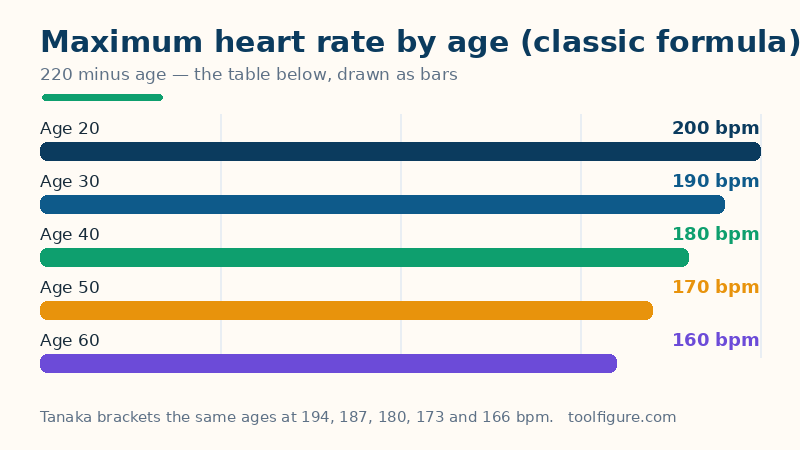
The classic formula (220 − age) is the famous one: simple, decades old, and fitted loosely, which is why the Tanaka formula — drawn from a much larger pooled dataset and published in 2001 — sits beside it; the two agree at exactly age 40 and drift apart on either side, Tanaka higher past 40 and lower before it. A zone is nothing but a slice of the maximum: Zone 2, the endurance-base band, is 60–70% of it. The heart rate reserve is the maximum minus your resting rate — the range your heart actually works across — and the Karvonen method takes percentages of that reserve and adds the resting rate back, so two people of the same age but different fitness get different targets: the fitter heart, idling lower, is aimed lower at the same honest effort.
Worked example: age 30, resting heart rate 70
The defaults above are a 30-year-old with a resting rate of 70 bpm. The classic maximum is 220 − 30 = 190 bpm; Tanaka gives 208 − 21 = 187 bpm — three beats apart, a fair picture of the uncertainty in any age formula. The zones, taken on the classic 190, are: Zone 1 95–114, Zone 2 114–133, Zone 3 133–152, Zone 4 152–171 and Zone 5 171–190 bpm. The reserve is 190 − 70 = 120 bpm, so the Karvonen targets run higher than the same percentages of maximum: 50% of reserve is 70 + 60 = 130 bpm, 60% is 142, 70% is 154, 80% is 166 and 90% is 178 bpm. That gap — 142 by Karvonen against 114 as 60% of maximum — is not an error in either method; it is the resting rate being counted, and it is why the two systems must never be mixed inside one training plan.
Maximum and Zone 2 by age, with the Karvonen cross-check
| Age (resting 70 bpm) | Classic max | Tanaka max | Zone 2 (60–70%) | Karvonen 70% |
|---|---|---|---|---|
| 20 | 200 | 194 | 120–140 bpm | 161 bpm |
| 30 — worked example | 190 | 187 | 114–133 bpm | 154 bpm |
| 40 | 180 | 180 | 108–126 bpm | 147 bpm |
| 50 | 170 | 173 | 102–119 bpm | 140 bpm |
| 60 | 160 | 166 | 96–112 bpm | 133 bpm |
Read the two maximum columns as a bracket, not a contest: at 20 they say the truth is probably somewhere in 194–200, at 60 somewhere in 160–166, and at 40 they shake hands at exactly 180 — the one age where the choice of formula does not matter. Zone 2 falls by roughly ten beats a decade, which is the arithmetic behind the familiar experience that a comfortable long-run pace keeps the same heart rate only by getting slower. The Karvonen column holds the resting rate at 70 for every age so the table stays comparable; in life a trained 50-year-old often rests in the 50s, which would pull every Karvonen target down while leaving the percentage-of-maximum zones untouched — the method rewarding fitness is precisely the one that notices it.
How to read your result — and its limits
Train to a zone range, never to a single beat: your heart rate drifts with heat, hills, fatigue and caffeine inside one session, and a range absorbs that honestly. Four limits belong with the page, and they matter more than the numbers. Age formulas are population averages: measured maximums in studies scatter roughly ten beats either side of any formula's line, so your true maximum may sit well outside both columns — a supervised maximal test or a hard, fully-recovered race effort measures it; a formula estimates it. Medication overrides arithmetic: beta blockers and several other common medicines deliberately cap heart rate, sometimes by 20–30 beats, and no age formula knows you take them — if you do, these zones do not apply and your clinician's targets replace them. Resting rate moves: illness, poor sleep, alcohol and overtraining all raise it for days at a time, which moves every Karvonen target with it; measure it rested, as the note above the form describes. And a wrist reading is not a chest reading: optical wrist sensors lag and drop beats at hard efforts, so a session that feels like Zone 4 while the watch says Zone 2 is usually the watch being late. This page is a training guide, not medical advice: chest pain, faintness or a racing heart that will not settle are reasons to stop and seek care, not to consult a zone table. What it guarantees is the arithmetic itself: given an age and a resting rate, every maximum, zone and target follows exactly as written above.
Frequently asked questions
What is my maximum heart rate by age?
The classic estimate is 220 minus your age — 190 bpm at 30, 180 at 40, 170 at 50. The Tanaka formula (208 − 0.7 × age), fitted on a larger dataset, gives 187 at 30, the same 180 at 40, and 173 at 50; the two agree exactly at 40 and bracket the likely truth on either side. Both are population averages: measured maximums scatter roughly ten beats either side, so treat either figure as the centre of a range, not as a personal measurement.
What heart rate zone should I train in?
Most endurance volume is usually built in Zone 2 — 60–70% of maximum, 114–133 bpm for this page's 30-year-old example — the effort where conversation is still possible in short sentences. Zones 4 and 5 (80–100%) are for short, deliberate hard sessions, not steady training, and Zone 1 is recovery. Whichever system you choose, zones by percentage of maximum or Karvonen targets, stay inside that one system: at 60% the two already differ by 28 bpm in the worked example.
What is the Karvonen formula, and why are its targets higher?
Karvonen targets count from your resting heart rate instead of from zero: target = resting + intensity × (maximum − resting). For a 30-year-old resting at 70, the reserve is 120 bpm, so a 70% Karvonen target is 70 + 84 = 154 bpm — well above 70% of maximum, which is 133. The targets are higher because the method credits the beats you are already using at rest; it also personalises the target, since a lower resting rate from better fitness lowers every Karvonen figure at the same age.
How do I measure my resting heart rate properly?
On waking, before getting up, coffee or conversation: lie still for a minute, then count your pulse for a full 60 seconds — at the wrist with two fingers beside the windpipe side of the tendon, not with your thumb, which has its own pulse. Repeat on two or three ordinary mornings and average the readings. A single morning after poor sleep, alcohol or hard training the day before reads high and will push every Karvonen target up with it, so the average of rested mornings is the number this page is built for.