Rounding is choosing the nearest allowed value — and the rule for ties is the point
Almost no real answer is allowed to keep all its digits. Money stops at hundredths, a headcount must be a whole number, and an estimate in a meeting is honest only to the nearest hundred. Rounding is the disciplined way to shorten a number: pick the grid (two decimal places, the nearest ten, the nearest thousand), find the allowed value closest to your number, and follow a stated rule when the number sits exactly halfway between two allowed values. That halfway case is not a footnote — it is where methods disagree, where money is won and lost in accounting systems, and where most rounding arguments start. This calculator therefore gives you five rules: standard school rounding (ties away from zero), bankers rounding (ties to the even neighbour), ceiling (always up), floor (always down) and truncation (just drop the digits) — and for whichever you choose, it shows your number rounded at every place in the table, so you can watch precision being traded for simplicity one grid at a time.
The rules, stated exactly
Standard rounding: keep the digits up to the chosen place, then look at the first dropped digit — 0 to 4 rounds down, 5 to 9 rounds upA tie is a dropped part of exactly 5 followed by nothing: standard rounding sends ties away from zero, bankers rounding sends them to the even neighbourCeiling: the next allowed value at or above the number · Floor: the next allowed value at or below it · Truncate: drop the extra digits and keep what remains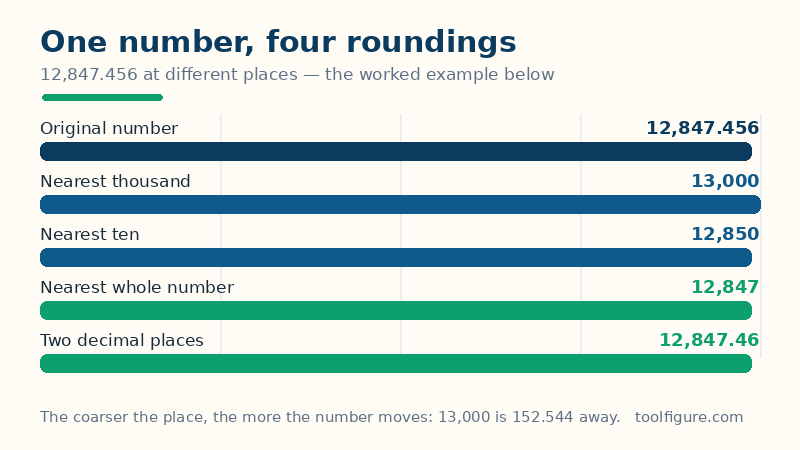
The vocabulary, pinned down. The place you round to is the finest digit you keep: two decimal places keeps hundredths, the nearest ten keeps everything from the tens digit leftwards and turns the rest to zeros. The first dropped digit makes the standard decision — but read it as shorthand for the whole dropped part: a dropped part of 0.056 against a grid step of 0.1 is more than half a step, so the number rounds up even though its first dropped digit is 5 and the digit after it is what breaks the tie. Ceiling and floor are named for direction, not size: ceiling goes toward positive infinity (the ceiling of −2.5 is −2), floor goes toward negative infinity (the floor of −2.5 is −3). Truncation goes toward zero, which is why truncating −3.99 gives −3 while flooring it gives −4 — the methods table below keeps them separate, because confusing floor with truncate is the most common programming bug in this whole subject.
Worked example: 12,847.456 on six grids
The defaults above round 12,847.456 to two decimal places, and the answer is 12,847.46: the first dropped digit is 6, comfortably more than half a hundredth, so the hundredths digit steps up from 5 to 6. The same number on every grid tells the full story, and each row has its own reason. To one decimal place it becomes 12,847.5, because the dropped part, 0.056, is more than half of the 0.1 grid step. To the nearest whole number it becomes 12,847 — the tenths digit is 4, less than half, so it rounds down. To the nearest ten it becomes 12,850 (the ones digit, 7, is more than half of ten). To the nearest hundred, 12,800 (the tens digit is 4). And to the nearest thousand, 13,000 (the hundreds digit is 8). Notice the pattern the bars above draw: the coarser the grid, the further the answer can travel from the original — 13,000 is 152.544 away from 12,847.456, while the two-decimal answer is only 0.004 away. Rounding is always this trade, made deliberately.
Ties: where the rules actually disagree
| Number (to a whole number) | Standard | Bankers | Ceiling | Floor | Truncate |
|---|---|---|---|---|---|
| 2.5 | 3 | 2 | 3 | 2 | 2 |
| 3.5 | 4 | 4 | 4 | 3 | 3 |
| −2.5 | −3 | −2 | −2 | −3 | −2 |
| 3.01 | 3 | 3 | 4 | 3 | 3 |
| 3.99 | 4 | 4 | 4 | 3 | 3 |
| −3.99 | −4 | −4 | −3 | −4 | −3 |
Read the first two rows together: standard rounding sends both 2.5 and 3.5 up, which over thousands of roundings biases totals upward. Bankers rounding sends 2.5 down to the even 2 and 3.5 up to the even 4, so ties cancel out on average — that is why it is the default in financial software and in the statistics behind our standard deviation calculator, and why it surprises people the first time 2.5 becomes 2. One more trap deserves its own sentence: 2.675 to two decimal places is 2.68, even though a computer stores 2.675 as a hair less than the exact value and naive software answers 2.67. This calculator corrects for that storage error before deciding, so the school answer is the answer you get — type 2.675 in above and check.
Reading a rounded answer — and when not to round at all
A rounded figure is a promise about precision, and it should be read as one. Reporting 13,000 for 12,847.456 claims knowledge only to the nearest thousand; reporting 12,847.46 claims the hundredths. Three habits keep rounding honest. First, round once, at the end: rounding every intermediate step lets small errors compound in one direction, which is why the calculators across ToolFigure keep full precision internally and round only the display — the same discipline our percentage calculator states on its own page. Second, match the grid to the purpose: cents for money actually owed, whole numbers for people, and a coarse grid like the nearest hundred only for estimates you would defend as estimates. Third, never round a divisor or a rate early — a rate rounded from 4.567% to 5% before a twenty-year projection is not a rounding any more, it is a different forecast. When the exact digits matter more than the tidy answer, stay exact: fractions like the ones on our fraction calculator never round at all.
Frequently asked questions
How do I round a number to two decimal places?
Keep the hundredths digit and decide it from the thousandths digit: 0 to 4 leaves it unchanged, 5 to 9 steps it up. So 12,847.456 becomes 12,847.46 (the thousandths digit is 6) and 12.843 becomes 12.84 (the thousandths digit is 3). Select two decimal places above and the calculator shows the decision for your number.
Why does bankers rounding send 2.5 to 2 instead of 3?
Because its tie rule is different: a number exactly halfway goes to whichever neighbour is even, so 2.5 goes down to 2 and 3.5 goes up to 4. Over many roundings the up and down ties cancel, removing the upward drift that always rounding ties away from zero creates — which is why banks, tax software and statistics packages use it.
What is the difference between floor and truncate for negative numbers?
Direction. Floor always goes toward negative infinity, so the floor of −3.99 is −4. Truncate goes toward zero — it just drops digits — so truncating −3.99 gives −3. For positive numbers the two agree, which is why the difference hides until the first negative value arrives; the methods table on this page shows them side by side.
Why do some calculators say 2.675 rounds to 2.67?
A storage quirk, not a maths rule. Computers hold most decimals in binary, and 2.675 is stored as approximately 2.67499999…, a hair below the tie, so software that rounds the stored value answers 2.67. The exact decimal 2.675 is a true tie and rounds to 2.68 under standard rounding. This calculator corrects for the storage error first, so you get 2.68.
Should I round before or after calculating?
After — always, when accuracy matters. Each rounding discards information, and rounding inputs or intermediate steps feeds slightly wrong numbers into every later step, so the errors stack. Calculate at full precision and round only the final answer for display. The exception is when a rule itself demands step-by-step rounding, such as some tax and invoice conventions — then follow the rule, not the habit.