Division that shows its working, one bring-down at a time
A calculator answer tells you what; long division tells you why, and for homework, exams and honest checking the why is the deliverable. The method is a loop of four small moves — divide what you have by the divisor, multiply the digit back, subtract to find what is left, and bring down the next digit of the dividend — repeated until no digits remain. This calculator performs exactly that loop on your numbers and prints every step, then answers the two questions the steps leave behind: what is the remainder, and what does the division come to as a decimal? If the decimal terminates, it says so. If it can never terminate — because a remainder starts repeating — the calculator marks the repeating block in brackets instead of chopping the answer off and pretending it ended. No step is hidden, and the final check line rebuilds the dividend from the answer, as every honest division should.
The formula behind the steps, with every term defined
dividend = divisor × quotient + remainder, always with 0 ≤ remainder < divisorDecimal continuation: while a remainder is left, multiply it by 10 and divide again — each pass writes one more decimal digitIf a remainder value appears twice, every digit since its first appearance repeats forever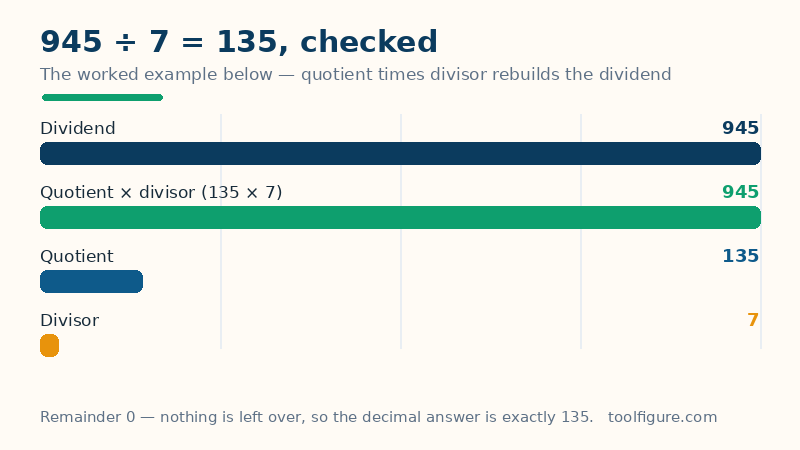
The dividend is the number being shared out; the divisor is the size of each share (or the number of shares — the arithmetic is the same); the quotient is how many whole times the divisor fits; the remainder is what is left over, and it must always be smaller than the divisor — if it is not, the divisor would have fitted once more and the quotient digit was too small, which is the single most common long-division mistake. The first formula is not just a summary, it is the check: multiply your quotient by the divisor and add the remainder, and you must get the dividend back exactly. That is the same relationship a fraction expresses — dividend ÷ divisor is the fraction dividend/divisor, and the remainder over the divisor is its fractional part, which is why this page and our fraction calculator are two views of one idea. The third line is the honest way to handle decimals like 1 ÷ 3: the remainder 1 recurs at every pass, so the digit 3 recurs, and 0.(3) says in four characters what no finite decimal can.
Worked example: 945 ÷ 7, step by step
The defaults above divide 945 by 7, and the answer is 135 with nothing left over. Here is the loop, exactly as the calculator performs it. Step 1: 7 does not fit into 9 more than once — 9 ÷ 7 = 1, write 1; 1 × 7 = 7, and 9 − 7 = 2 left. Step 2: bring down the 4, making 24 — 24 ÷ 7 = 3; 3 × 7 = 21, and 24 − 21 = 3 left. Step 3: bring down the 5, making 35 — 35 ÷ 7 = 5 exactly; 5 × 7 = 35, and 35 − 35 = 0. No digits remain and the remainder is 0, so the quotient is 135 and the division is exact. The check rebuilds the starting number: 135 × 7 = 945 — the bars above draw precisely that relationship. Every long division, however long, is this same loop; a six-digit dividend only means more turns of it, never a new idea.
More verified divisions — remainders, terminating decimals and a repeat
| Division | Quotient | Remainder | Decimal |
|---|---|---|---|
| 100 ÷ 8 | 12 | 4 | 12.5 |
| 17 ÷ 5 | 3 | 2 | 3.4 |
| 1,000 ÷ 16 | 62 | 8 | 62.5 |
| 847 ÷ 11 | 77 | 0 | 77 |
| 255 ÷ 12 | 21 | 3 | 21.25 |
| 1,234 ÷ 11 | 112 | 2 | 112.(18) |
Three of these repay a closer look. 100 ÷ 8 leaves remainder 4, and the decimal continuation turns that 4 into 40 tenths: 40 ÷ 8 = 5, remainder 0, so the answer terminates at 12.5 — a remainder is never a dead end, it is just the next place value waiting its turn. 17 ÷ 5 shows the same fact in fraction dress: quotient 3, remainder 2 means 3 and two-fifths, and 2/5 is exactly 0.4, so the decimal 3.4 and the mixed number agree — cross-check any row of this table that way. And 1,234 ÷ 11 is the repeating case: after the whole-number steps the remainder is 2; 20 ÷ 11 = 1 remainder 9; 90 ÷ 11 = 8 remainder 2 — the remainder 2 has come back, so the digits 1 and 8 repeat forever, written 112.(18). The check still holds for the whole part: 112 × 11 + 2 = 1,234. Whether a decimal terminates depends only on the divisor's factors: divisors built from 2s and 5s alone (8, 5, 16, 12 is 2×2×3 — yet 255 ÷ 12 terminated because the 3 cancelled with the dividend's factor 3) can still surprise, which is why this calculator detects the repeat from the remainders themselves instead of guessing from rules.
Which answer should you give: remainder, fraction or decimal?
All three are correct; the situation chooses. Give a remainder when the thing being shared cannot be split — 17 students in boats of 5 is 3 full boats and 2 students left, and 3.4 boats is nonsense. Give a decimal when the quantity is continuous — money, length, weight — and the sharing is real: 17 metres of ribbon in 5 equal pieces is genuinely 3.4 metres each. Give a fraction or mixed number when exactness matters and the decimal would repeat: 1,234 ÷ 11 is exactly 112 and 2/11, while 112.(18) is exact only because the bracket notation carries the infinite tail honestly, and any chopped version like 112.18 is an approximation that must not be fed into further calculations as if it were exact. Teachers ask for the form the lesson is about; the calculator gives you all three so you can convert deliberately rather than by habit — and the rounding calculator is the right next stop when a decimal answer must be shortened for presentation.
Frequently asked questions
How do I do long division step by step?
Repeat four moves: divide the current partial number by the divisor and write the digit, multiply that digit by the divisor, subtract to find what is left, and bring down the next digit of the dividend. For 945 ÷ 7: 9 ÷ 7 = 1 (remainder 2), bring down 4 for 24 ÷ 7 = 3 (remainder 3), bring down 5 for 35 ÷ 7 = 5 (remainder 0) — quotient 135. The calculator lists these steps for any whole numbers you enter.
What does the remainder mean, and how do I check it?
The remainder is what is left when the divisor has fitted as many whole times as it can; it must be smaller than the divisor. Check any division with dividend = divisor × quotient + remainder: for 100 ÷ 8, that is 8 × 12 + 4 = 100. If your remainder is ever as big as the divisor, the quotient digit was too small — the divisor fits at least once more.
How do I turn a remainder into a decimal answer?
Keep dividing past the decimal point: multiply the remainder by 10 and divide again, writing each new digit after the point. 100 ÷ 8 leaves 4, which becomes 40 tenths; 40 ÷ 8 = 5 with nothing left, so the answer is 12.5. If a remainder value repeats, the digits repeat with it — 1,234 ÷ 11 gives 112.(18), where the brackets mean 18 repeats forever.
Why does this calculator ask for whole numbers only?
Because the step-by-step layout is built for whole numbers, and decimals reduce to that case exactly: multiply both numbers by the same power of ten until they are whole. 4.5 ÷ 0.5 is 45 ÷ 5 = 9, and 7.2 ÷ 0.9 is 72 ÷ 9 = 8. Equal scaling never changes a quotient — it only makes the working presentable.
What is the difference between the quotient and the decimal answer?
The quotient is the whole-number part of the answer and comes with the remainder: 17 ÷ 5 has quotient 3 and remainder 2. The decimal answer absorbs the remainder by continuing the division: 3.4. They are the same division reported two ways — 3 remainder 2, 3 and 2/5, and 3.4 all describe 17 shared into 5 — and which one you report depends on whether the thing shared can be split.