How much should you save a month? It depends on three numbers
Every savings goal — a house deposit, a car, a wedding, an emergency fund, a year of travel — is really three numbers wearing a coat: how much you need, how much you already have, and when you need it. Divide what is missing by the months remaining and you have a rough answer. This calculator gives you the exact one, because it also counts the fourth, quieter helper: the interest your savings earn along the way. Enter your goal above and it works out the monthly amount to the cent — or switch the question around, enter the monthly amount you can actually afford, and see the date it delivers your goal. That second answer is often the more useful one, because it turns a vague intention into a date you can plan around. If the date is too late, the calculator shows you exactly how much extra per month pulls it closer.
The savings goal formula
Goal = P(1 + r)n + PMT x [((1 + r)n - 1) / r]Solved for the monthly saving: PMT = (Goal - P(1 + r)n) x r / ((1 + r)n - 1)P is what you have already saved, r is the monthly interest rate (the annual rate divided by 12), n is the number of months, and PMT is the monthly deposit, added at the end of each month. The first term is your starting money grown by interest; the second is every monthly deposit plus the interest each one earns for the months it sits in the account. When the rate is 0% the maths collapses to the obvious version: (goal - already saved) / months. The "how long" mode solves the same equation for n instead, using logarithms — the same growth engine our compound interest calculator explores year by year.
Worked example: a $25,000 goal in 5 years
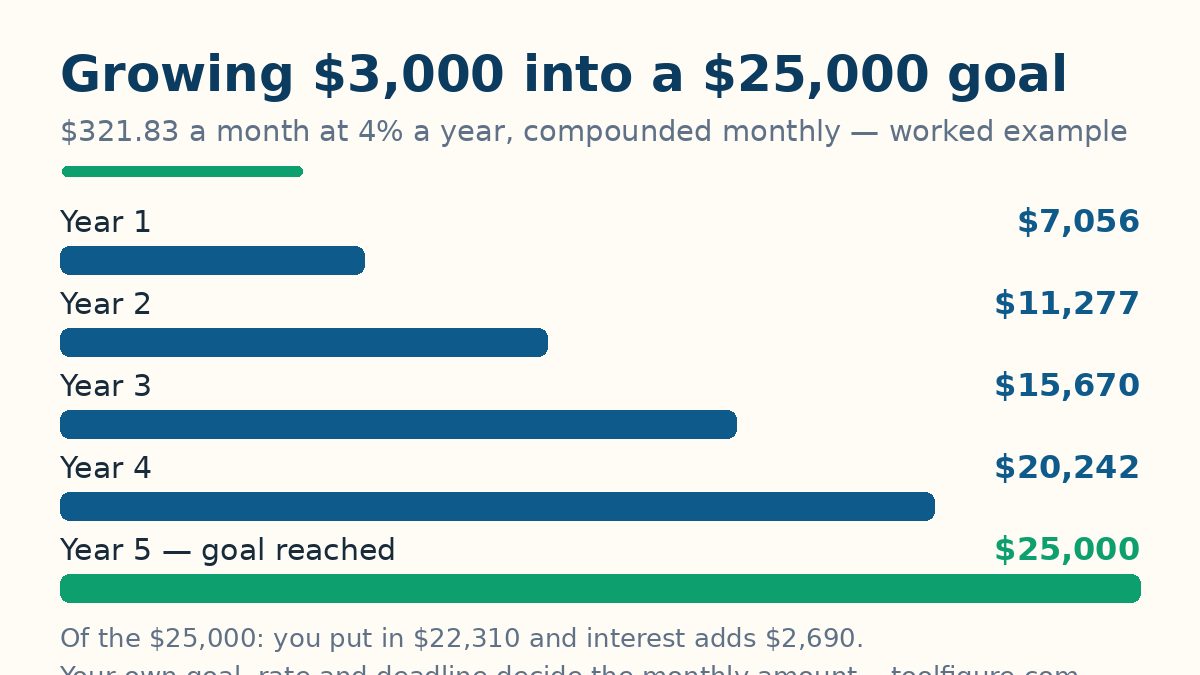
You want $25,000 in 5 years, you already have $3,000, and your savings account pays 4% a year. Your starting $3,000 grows on its own to about $3,663. The remaining gap, spread over 60 months with interest helping each deposit, needs $321.83 a month. By the deadline you will have put in $22,310 of your own money — the $3,000 start plus $19,310 of deposits — and interest contributes the other $2,690. Notice the split: interest is a welcome discount of about 11% off the goal, but your deposits do almost nine tenths of the work. That is typical for goals under ten years, and it is why the monthly amount, not the rate, is the lever that matters most at this timescale. Chasing an extra half percent of interest changes this answer by only a few dollars a month; saving an extra $25 changes the date by months.
The deadline is the expensive part
Same goal, same starting point, same 4% rate — only the deadline moves. In 3 years the monthly saving jumps to $566.19. In 5 years it is $321.83. Given 10 years, it falls to $139.41. Halving the time does not double the payment — it nearly doubles it and removes most of interest's help, because your deposits have fewer months to grow. The practical lesson cuts the other way too: starting a goal a single year earlier is worth far more than the deposits you add in that year. If a deadline is fixed — a wedding date, a lease ending, a course starting — run the shorter timeline honestly rather than hoping to "save more later", because later is exactly what the maths charges you for. And if the monthly figure comes out impossible, the calculator gives you three honest dials to turn: a smaller goal, a later date, or a bigger starting lump sum — perhaps from selling something or redirecting a paycheck bonus.
Where should the money sit while you save?
For a goal a few years away, the rate you enter should be one you can actually rely on: a savings account's stated APY is the natural input. Two cautions. First, APY is not guaranteed to stay fixed — many accounts pay a variable rate, so re-run your numbers once or twice a year and adjust the monthly amount by the few dollars it takes to stay on track. Second, money needed on a fixed near-term date generally does not belong anywhere its value can fall shortly before the date; a higher hoped-for return that arrives with risk can turn a reached goal into a missed one. Whatever rate you assume, keep it honest: at 0% this same goal needs $366.67 a month, so an optimistic rate only ever discounts your payment by about $45 here — believing in a rate you do not get leaves a real hole at the deadline.
Staying on track after the first month
The savers who reach goals like this usually do three things. They automate the deposit for the day after payday, so the money moves before it can be spent — the same pay-yourself-first logic behind judging any loan payment against take-home pay. They keep the goal in its own clearly named account, separate from everyday money, so progress is visible and raiding it feels like what it is. And they re-check the plan after any change — a raise is a chance to shorten the timeline, an expense shock a reason to extend the date on paper immediately instead of quietly falling behind. If your monthly amount feels tight, compare it with the payment on the borrowing alternative: saving $321.83 a month for something is almost always cheaper than financing it and paying interest to a lender instead of receiving it yourself. Planning a house deposit? Pair this page with the mortgage calculator to see what the deposit you are building toward will do to the monthly payment at the other end.
Frequently asked questions
How do I calculate how much to save each month for a goal?
Take your goal, subtract what your existing savings will grow to by the deadline, and spread what is left over the months remaining, allowing for interest on each deposit. The formula above does exactly that: a $25,000 goal in 5 years with $3,000 saved at 4% needs $321.83 a month — noticeably less than the $366.67 a month simple division suggests, because interest covers the difference.
Does this calculator work backwards — can it tell me when I will reach my goal?
Yes. Choose 'How long it will take', enter your goal, what you have saved and the monthly amount you can manage, and it solves the same formula for time instead. Saving $340 a month toward that $25,000 goal, for example, reaches it in about 4 years and 10 months.
What interest rate should I enter?
The APY of the account the money will actually sit in. If you are not sure the rate will hold — many savings rates are variable — enter a cautious figure or even 0%. The difference between an optimistic and an honest rate is small next to the effect of the monthly amount, and an honest rate cannot leave you short at the deadline.
Should my emergency fund goal use this calculator?
Yes — an emergency fund is a savings goal like any other, usually three to six months of essential spending. Work out that total, enter what you already have set aside, and pick a realistic deadline; the calculator returns the monthly amount. Because the fund must be there when needed, most people build it in a plain savings account rather than anywhere with risk.
What if the monthly amount it gives me is more than I can afford?
Then one of the three inputs has to move: a smaller goal, a later deadline, or a larger starting amount. Use the 'how long' mode with the monthly amount you genuinely can save to see your real date — a goal reached late beats a plan abandoned in month three because the payment was never realistic.