Why your paycheck is smaller than your salary suggests
A $65,000 salary sounds like $5,417 a month. It is not — because a salary is quoted gross, before anything is taken out, while your life is paid for with net (take-home) pay. Between the two sit federal income tax, state income tax where it applies, and FICA — the Social Security and Medicare taxes almost every US employee pays. This calculator shows that gap honestly, line by line, so you can budget, compare job offers and judge a loan or a mortgage payment against the money that actually reaches your bank account.
How this paycheck calculator works
Gross per paycheck = annual salary ÷ paychecks per yearEach tax = gross per paycheck × its percentageTake-home = gross − federal tax − state tax − FICA − other deductionsIt is a percentage-based estimator: you enter the tax percentages that apply to you, and it does the arithmetic exactly. That is deliberate. A real US payslip is produced by tax tables, your W-4 form, pre-tax benefits and sometimes city taxes — no simple web calculator can reproduce it to the cent, and any site that promises to is overstating. What this tool gives you is a fast, honest estimate you can adjust: change a percentage and watch the take-home move.
Worked example: $65,000 a year, paid every two weeks
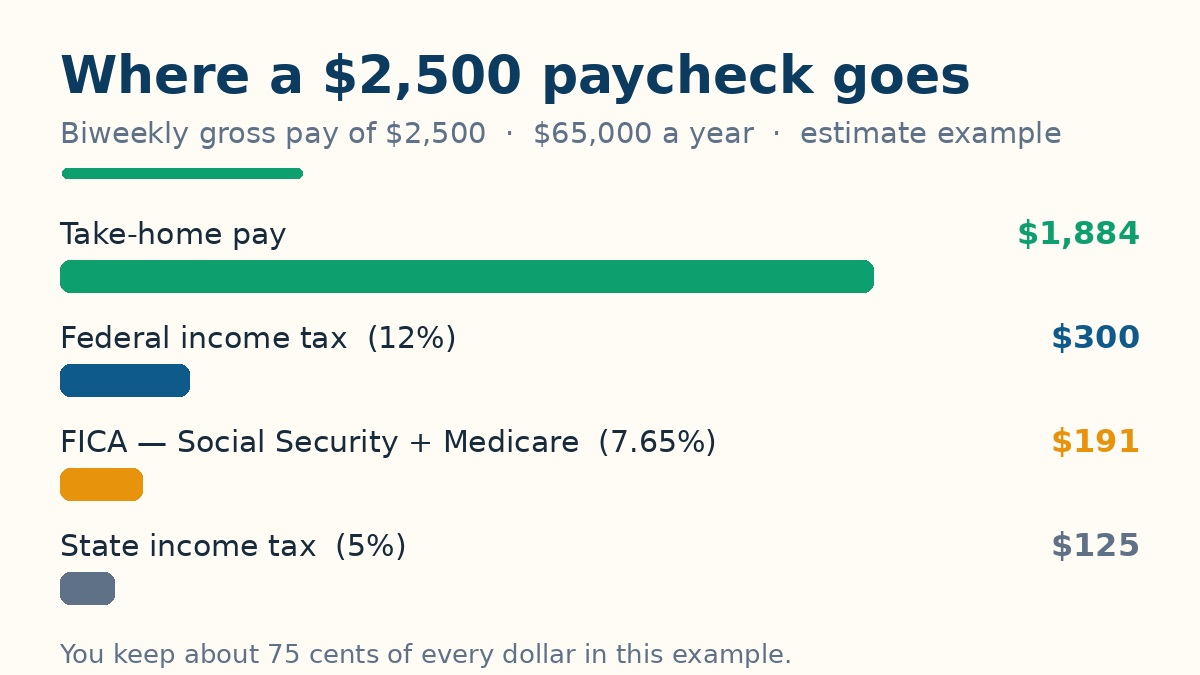
Salary $65,000 ÷ 26 paychecks = $2,500 gross per paycheck. Federal tax at an effective 12% takes $300, a 5% state tax takes $125, and FICA at 7.65% takes $191.25. Total deductions: $616.25. Take-home pay: $1,883.75 per paycheck — $48,977.50 a year, about $4,081 a month. In other words, roughly 75 cents of every dollar survives the trip from salary to bank account. Run your own salary above to find your own figure; if you are paid hourly instead, enter your wage and hours and it converts first — the same conversion our salary to hourly calculator explains in detail.
The three deductions, explained
Federal income tax is withheld from every paycheck based on your W-4 and the IRS tax tables. The percentage that matters here is your effective rate — total federal tax divided by total pay — not your tax bracket. A bracket is a marginal rate that applies only to the slice of income inside it, which is why a worker "in the 22% bracket" typically pays an effective rate well below 22%.
FICA is the easiest line to predict: 6.2% for Social Security (on wages up to an annual cap that is adjusted most years) plus 1.45% for Medicare — 7.65% combined for most employees. Your employer pays a matching 7.65% on top, which never appears on your payslip. Self-employed workers pay both halves (15.3%) as self-employment tax, so freelancers should enter 15.3 in the FICA field for a fairer estimate.
State income tax depends entirely on where you work. Several states — including Texas, Florida and Washington — charge no state income tax at all, so enter 0 if yours is one of them. Others charge flat or graduated rates; your last payslip's state line, divided by that paycheck's gross pay, gives you the percentage to enter.
Pay frequency changes the paycheck, not the pay
Paid every two weeks, you get 26 paychecks a year — which means two months a year contain three paychecks, a quirk that makes monthly budgeting from biweekly pay surprisingly tricky. Paid twice a month, you get 24 slightly larger paychecks and exactly two per month. The annual take-home is the same either way in this calculator; only the size and rhythm of each payment changes. If you budget monthly, the "net pay averaged per month" line in the results is the figure to plan around.
What this estimate does not include
City or county taxes (New York City is the famous example), wage garnishments, and the exact effect of pre-tax benefits. Health insurance premiums and 401(k) contributions are usually taken out before income tax, which slightly lowers the tax itself — enter them in the "other deductions" field for the total, and know that your real take-home may then be a little higher than the estimate because the tax lines were calculated on the full gross. Treat the result as a planning figure, and compare it with one real payslip to tune your percentages.
Frequently asked questions
Why is my take-home pay lower than my salary divided by 12?
Because salary is gross pay, quoted before deductions. Federal income tax, FICA (7.65% for most employees) and state tax where it applies all come out first. On a $65,000 salary with typical percentages, about $16,000 a year never reaches your account — the worked example above shows the full maths.
What percentage should I enter for federal tax?
Your effective rate: last year's federal tax (or a recent payslip's federal withholding) divided by your gross pay. Many middle-income single workers land roughly between 10% and 15%. Your tax bracket is a marginal rate and will overstate the deduction if you enter it directly.
What is FICA and why is it 7.65%?
FICA funds Social Security (6.2% of wages, up to an annual cap) and Medicare (1.45%, no cap). Most employees pay 7.65% in total and the employer matches it. Self-employed people pay both sides — 15.3% — as self-employment tax.
How many paychecks do I get a year?
Weekly pay means 52, every two weeks (biweekly) means 26, twice a month (semimonthly) means 24, and monthly means 12. Biweekly and semimonthly are often confused — they differ by two whole paychecks a year, which is why this calculator asks you to pick explicitly.
Does this calculator work for hourly workers?
Yes. Enter your hourly wage and hours per week instead of a salary and it first converts to an annual figure (wage × hours × 52 weeks), then applies the same deductions. Unpaid weeks off will lower your real annual pay below that conversion.