What PITI means
This mortgage calculator shows your true monthly payment, not just the loan part: principal and interest plus property tax, home insurance, PMI and HOA fees, each shown separately. On the worked example below, a $400,000 home with $80,000 down at 6.5% over 30 years costs about $2,573 a month once tax and insurance are added. Lenders describe the core mortgage payment as PITI: Principal, Interest, property Taxes and home Insurance. Many buyers are surprised that taxes and insurance add several hundred dollars a month on top of the loan payment — this calculator shows the whole figure from the start.
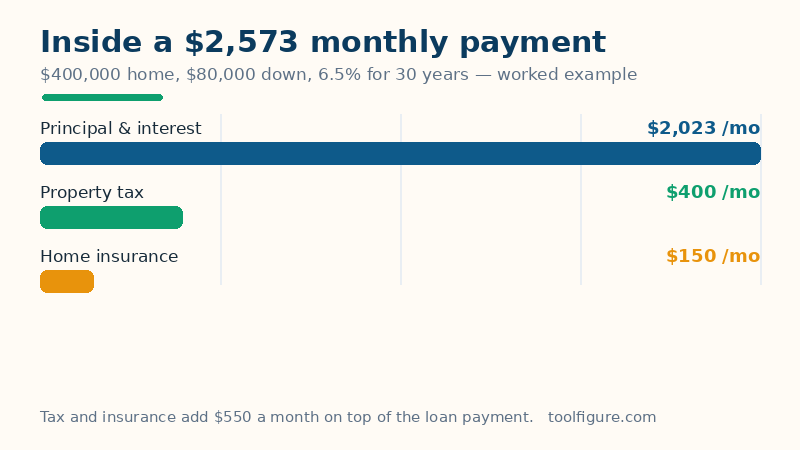
Worked example
A $400,000 home with $80,000 down at 6.5% for 30 years: principal & interest is about $2,023/month. Add typical tax ($400/month) and insurance ($150/month) and the real monthly cost is about $2,573 — before any HOA fees.
15 years vs 30 years
On that same $320,000 loan, a 15-year term raises the payment to roughly $2,788 but cuts total interest from about $408,000 to about $182,000. Run both terms above and compare the 'total interest' line — the difference is the true price of a lower monthly payment.
Worked example — a UK repayment mortgage
A £300,000 home bought with a £60,000 deposit leaves a £240,000 mortgage. At 4.8% over 25 years, principal and interest comes to £1,375 a month, and the total interest over the term is £172,558 — worth pausing on: the interest alone is not far off the deposit and the loan combined's little sibling. To mirror the UK running costs, enter a typical council tax bill of £1,800 a year in the property-tax field (£150 a month) and £300 a year of buildings insurance (£25 a month), with PMI and HOA at zero — the UK has no direct equivalents in most purchases. The full monthly figure is then £1,550. In practice British borrowers pay council tax to the council rather than through the lender, but for comparing homes the all-in number is the one your budget feels.
How to read the breakdown
The stacked bar and table split the payment into its parts, and the proportions matter. Principal and interest is the only part that changes the loan itself; tax and insurance are pass-through costs collected with the payment in the US escrow system. The summary line's total interest is the figure to compare across terms and rates — two offers with near-identical monthly payments can differ by tens of thousands in total interest, and the cheaper-looking one is not always the cheaper loan.
Limitations
The calculation assumes one interest rate for the entire term. That matches US fixed-rate loans well, but most UK mortgages fix for only 2–5 years before moving to a variable reversion rate, so treat a UK result as "the payment while the fix lasts", and re-run it at the reversion rate to see the possible jump. Arrangement and product fees, valuation and legal costs, early repayment charges and (for US buyers) the exact escrow adjustments are also outside the model — all reasons the lender's own illustration remains the authoritative document.
Common mistakes
- Budgeting for principal and interest only. Tax, insurance and service charges are real monthly costs. A payment that looks affordable as P&I alone can be £150–£400 a month heavier in full.
- Entering yearly figures in monthly fields (or the reverse). On this page, tax and insurance are per year and the calculator divides them by 12; PMI and HOA are already monthly. Mixing them up inflates or shrinks the total dramatically.
- Comparing a 25-year quote with a 30-year quote by payment alone. The longer term nearly always shows the lower payment and the higher total interest. Compare the total-interest line.
- Treating the fixed period as the whole story (UK). When a 2-year fix ends, the payment can jump by hundreds of pounds. Knowing the reversion-rate figure in advance is the difference between a plan and a surprise.
Related tools: Loan Calculator — Monthly payment, total interest, amortization schedule and extra-payment effect; Compound Interest Calculator — Future value with monthly contributions, yearly table and growth chart; Salary to Hourly Calculator — Annual salary to hourly wage, weekly, biweekly and monthly — both ways.
Frequently asked questions
What is PMI and when does it stop?
Private Mortgage Insurance protects the lender when the down payment is under 20%. On conventional loans it is usually removed once your balance reaches 80% of the home's value — ask your lender about their exact process.
How much house can I afford?
A common guideline keeps the full PITI payment under about 28% of gross monthly income, but the right figure depends on your other debts and savings. This calculator shows the payment; only you know your full budget.
Are property taxes really monthly?
You pay them yearly or through escrow, but lenders collect 1/12 every month with your payment — which is why they belong in a monthly comparison.
Does a bigger down payment always win?
It lowers the loan, the interest and can remove PMI — but it also ties up cash you may need for moving, repairs and emergencies. Compare both scenarios above.
What happens to my payment when my fixed rate ends?
Unless you remortgage onto a new deal, the loan usually moves to the lender's variable reversion rate, which is typically higher — the payment can rise sharply. Model it by re-running this calculator at the reversion rate with your remaining balance and term; that figure is the one to have a plan for.
Is it better to take a shorter term or to overpay a longer one?
Both cut total interest. A shorter term guarantees the higher principal payment every month; overpaying a longer term reaches a similar result with the flexibility to stop — but check the early-repayment or overpayment limits in your agreement first, since exceeding them can trigger charges that eat the saving.
The worked examples on this page were checked against this calculator on 18 October 2026.