The formula: age bands, then diameter from circumference
Indoor ball size is an age band: ages 7 and under take size 3, ages 8–12 take size 4, and ages 13 and over take the official size 5. Beach play has a single full-weight ball, slightly larger around than the indoor size 5, so under-13 beach players use the lighter indoor ball for their age. The one piece of arithmetic on the page is the diameter, worked out from the circumference midpoint because ball sizes are specified by circumference:
Diameter = circumference midpoint ÷ π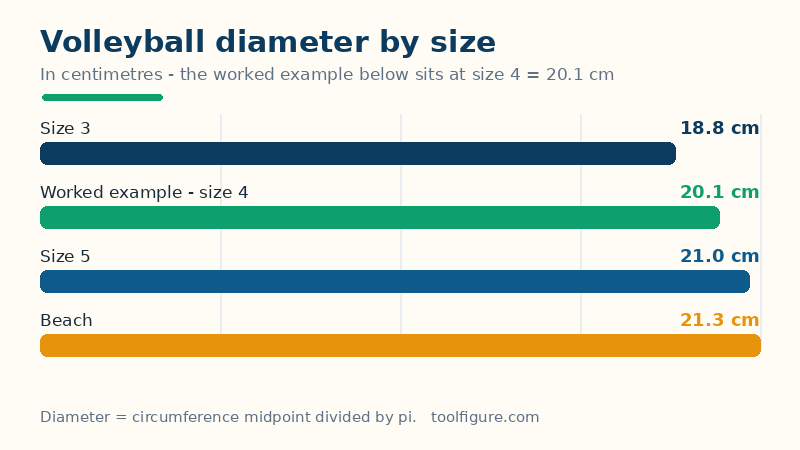
| Ball size | Circumference | Weight | Diameter |
|---|---|---|---|
| Size 3 (mini / training) | 58–60 cm (22.8–23.6 in) | 200–220 g (7.1–7.8 oz) | 18.8 cm |
| Size 4 (youth) | 62–64 cm (24.4–25.2 in) | 240–260 g (8.5–9.2 oz) | 20.1 cm |
| Size 5 (official indoor) | 65–67 cm (25.6–26.4 in) | 260–280 g (9.2–9.9 oz) | 21.0 cm |
| Beach size 5 | 66–68 cm (26.0–26.8 in) | 260–280 g (9.2–9.9 oz) | 21.3 cm |
Worked example: age 10, indoors
Age 10 falls in the 8–12 band, so the ball is size 4: 62–64 cm around (24.4–25.2 in), 240–260 g (8.5–9.2 oz), and its diameter is the circumference midpoint divided by pi: (62 + 64) / 2 = 63 cm, and 63 ÷ 3.1416 = 20.1 cm. A second check: a 15-year-old on the beach takes the beach size 5 — 66–68 cm (26.0–26.8 in), 260–280 g (9.2–9.9 oz), diameter 67 ÷ π = 21.3 cm — and a 6-year-old indoors takes size 3 — 58–60 cm (22.8–23.6 in), 200–220 g (7.1–7.8 oz), diameter 59 ÷ π = 18.8 cm.
How to read your result, and its limits
Three checks before buying. First, a ball that is too heavy teaches bad habits: a young player who cannot lift the ball stops passing properly and starts pushing it, which is why the youth sizes are lighter. Second, indoor and beach balls are not interchangeable: the beach ball is slightly larger, softer-feeling and inflated to lower pressure, so it behaves differently on a court. Third, leagues vary the youth ball: some youth leagues specify a lighter ball than the age band suggests, so the league's own rules beat any general chart.
Common mistakes
- Buying the official size 5 for a young child. A full-weight ball is too heavy for a small player to pass properly — size 3 under 8 and size 4 at 8–12 exist for exactly that reason.
- Using an indoor ball on sand. Beach balls are larger, softer and lower-pressure; an indoor ball on sand flies and bounces differently.
- Giving an under-13 a beach ball. There is no youth beach size — under-13 beach players train on the lighter indoor ball for their age.
- Judging by height instead of age. Ball size follows the age band, not how tall the player is — a tall 10-year-old still plays size 4.
Related tools: Basketball Size Calculator — The right basketball size from age and gender: sizes 1 to 7 with circumference, weight and diameter; Soccer Ball Size Calculator — The right soccer ball size from the player's age: league sizes 3, 4 and 5, plus skills balls 1 and 2; Baseball Glove Size Calculator — The right baseball glove size from age group and position: the published chart, looked up openly, with the catcher's circumference exception stated.
Frequently asked questions
What size volleyball for a 10-year-old?
Size 4 indoors: 62–64 cm around, 240–260 g, about 20.1 cm across. On the beach, a 10-year-old still uses the lighter indoor size 4, because beach balls are full-weight.
What size volleyball do adults use?
Size 5 indoors: 65–67 cm, 260–280 g, about 21.0 cm across — the official size for ages 13 and over. The beach size 5 is slightly larger at 66–68 cm.
Is a beach volleyball bigger than an indoor volleyball?
Slightly: 66–68 cm around against 65–67 cm for the indoor size 5, at the same 260–280 g weight, but inflated to lower pressure, so it feels softer and moves slower in the air.
What size volleyball for a 7-year-old?
Size 3, the mini/training ball: 58–60 cm around, 200–220 g, about 18.8 cm across. Size 4 starts at age 8.
