Weight for children, chest for adults
Life jacket guides agree on the split, and it is worth stating plainly because it is the opposite of how most clothing is sized. Children are sized by body weight: infant under 30 lb (under 14 kg), child 30–50 lb (14–23 kg), youth 50–90 lb (23–41 kg). The reason is safety, not convenience — a jacket that is too big for a child's weight can slide up over their head in the water, and age is a poor proxy for weight, so the guides say to weigh the child and match the band, not the birthday. Adults, at 90 lb (41 kg) and over, are sized by chest measurement: under 30 in is XS, 30–32 in is S, 32–36 in is M, 36–40 in is L, 40–44 in is XL, and 44 in and over is XXL. Two adults of the same weight can have very different frames, which is why weight stops deciding at the adult threshold and the tape takes over. Measure the chest under the arms, around the fullest part, with the tape level across the back and snug rather than pulled tight.
Under 90 lb: size = weight band (Infant < 30 lb · Child 30–50 lb · Youth 50–90 lb) · At 90 lb and over: size = chest band (XS < 30 in · S 30–32 · M 32–36 · L 36–40 · XL 40–44 · XXL 44+)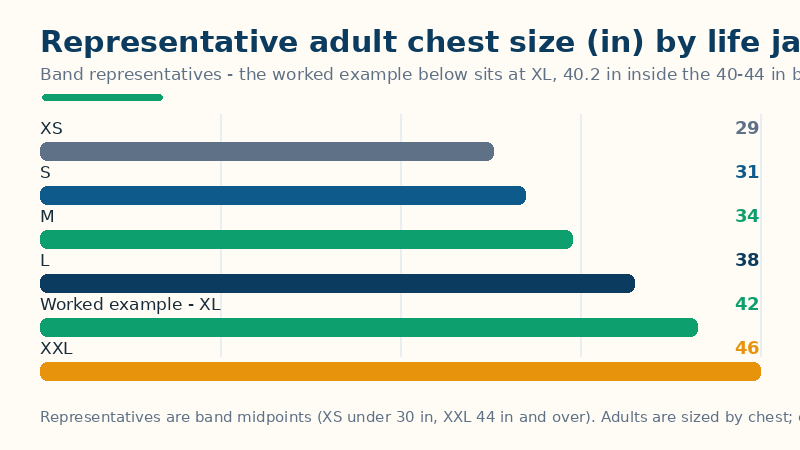
The bands meet at exact pounds, and the tool assigns a boundary to the larger band: a child at exactly 50 lb reads as youth, and an adult at exactly 40 in reads as XL. That is the safer side of each boundary for a jacket — a slightly large jacket that passes the fit test below is usable, while a jacket that cannot close is not — but the fit test, not the boundary rule, is the final word.
Worked example: 80 kg adult, 102 cm chest
An adult weighing 80 kg with a 102 cm chest needs an adult size XL. The working: 80 kg × 2.20462 = 176.4 lb, which is 90 lb and over, so this is an adult and the chest decides; 102 cm ÷ 2.54 = 40.2 in, which falls in the XL band, 40–44 in (102–112 cm). The same arithmetic at other measurements shows both rules in action:
| Person | Working | Size |
|---|---|---|
| 10 kg child | 10 × 2.20462 = 22.0 lb — under 30 lb | Infant |
| 20 kg child | 20 × 2.20462 = 44.1 lb — 30–50 lb | Child |
| 35 kg young person | 35 × 2.20462 = 77.2 lb — 50–90 lb | Youth |
| Adult, 85 cm chest | 85 ÷ 2.54 = 33.5 in — 32–36 in | M |
| Adult, 97 cm chest | 97 ÷ 2.54 = 38.2 in — 36–40 in | L |
| Adult, 112 cm chest | 112 ÷ 2.54 = 44.1 in — 44 in and over | XXL |
Notice the third and fourth rows together: a 35 kg young person and a light adult can weigh nearly the same, yet one is sized by weight and the other by chest — the 90 lb threshold is what switches the rule, not the number on the scale alone. And the chest rows show why the tape matters: 85 cm and 97 cm are only 12 cm apart, but they are two sizes apart, M versus L.
How to read your result, and its limits
Three checks before trusting the size. First, the lift test overrules the table: do up every zip, buckle and strap, lift your arms overhead, and have someone lift the jacket at the shoulders — it must not rise above your chin or ears. A jacket that rides up is too big or too loose, whatever the chart said. Second, measure over what you will actually wear: a jacket sized over a T-shirt may not close over a waterproof jacket and layers, and the guides say to size for the bulkiest clothing you will wear on the water — if it will not close comfortably, size up. Third, the maker's chart outranks this page for the jacket you buy: every manufacturer has its own sizing system, and the published charts vary slightly around the bands used here, especially at the edges — always compare the chest or weight against the label of the actual jacket, and confirm the fit in person before going near the water. This page also does not choose the jacket type — buoyancy, activity and local rules decide that — it only sizes the jacket once the type is chosen.
Common mistakes
- Sizing a child by age. The numbers on a child's vest can look like ages, but the weight range is what counts — weigh the child, then pick the band.
- Putting a child in an adult jacket. Even a small adult jacket is cut for an adult torso and can slide up over a child's head in the water — children need a child's jacket in their weight band.
- Sizing an adult by weight alone. Two adults of the same weight can need different sizes because their chests differ — at 90 lb and over, the chest measurement decides.
- Skipping the lift test. A jacket that looks right on the hanger can still ride up once the straps are done up and the arms go overhead — test it before you trust it.
Related tools: Scuba Weight Calculator — Your starting scuba lead weight from body weight, wetsuit, water type and tank — with the buoyancy check that settles it; Wetsuit Size Calculator — The right wetsuit size from your height and weight, plus the suit thickness for your water temperature: one consolidated chart, honestly stated; Backpack Size Calculator — Your backpack size in two parts: frame size from torso length, and litres from trip length, packing style and season.
Frequently asked questions
What size life jacket do I need?
It depends on weight first: under 30 lb is infant, 30–50 lb is child, 50–90 lb is youth. At 90 lb and over you are an adult, and size comes from your chest — for example, a 102 cm (40.2 in) chest is adult XL. Then confirm with the lift test: done up, it must not rise above your chin or ears.
Are children's life jackets sized by weight or age?
By weight, not age. Weigh the child and pick the size whose range they fall into — under 30 lb infant, 30–50 lb child, 50–90 lb youth. Where two sizes share a weight range, measure the chest and take the size whose weight range the child sits inside.
How do I measure my chest for a life jacket?
Wrap a soft tape measure under your arms, around the fullest part of your chest, keeping it level across your back. Keep it snug, not pulled tight, and measure over the clothing you will actually wear on the water — if the jacket will not close over layers, size up.
What is the life jacket lift test?
Do up every zip, buckle and strap, lift your arms overhead, and have someone lift the jacket at the shoulders. It must not ride up over your chin or ears. If it does, the jacket is too big or too loose — size down or tighten the straps and test again.
