Why one ring gets four different numbers
Ring sizing never had a single inventor, so four systems grew up side by side and none of them converts into another by arithmetic. The United States numbers rings from 3 to 13 and beyond, Britain and Australia letter them from F to Z, Europe labels them with a number close to the inside circumference in millimetres, and Japan numbers them on its own scale. A US 7 is a UK N½, an EU 55 and a JP 14 — four labels for one physical ring, an inside diameter of 17.3 mm and a circumference of 54.3 mm. The only formula on this page is the one that ties the two measurements together: circumference = diameter × π. Everything else is a lookup in the published standard table below, which is why the converter can also work backwards: measure a ring you already own, and the table turns that measurement into a size in every system.
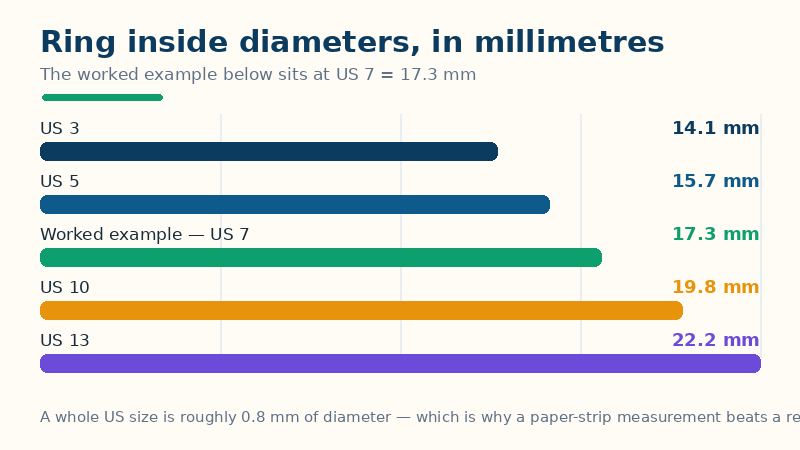
Worked example: a US 7
Take a ring sold as US 7. Reading across its row gives UK N½, EU 55 and JP 14, with an inside diameter of 17.3 mm and a circumference of 54.3 mm (17.3 × 3.14159 = 54.35, shown as 54.3). Note the EU label carefully: it reads 55 while the circumference reads 54.3. EU numbers are nominal labels inherited from older rounding, not exact measurements, so the label and the millimetres disagree by a fraction of a millimetre on most rows — the millimetres are the trustworthy column, and the label is what you type at checkout. The same reading in reverse: a ring whose inside diameter measures 18.1 mm is a US 8 (UK P½, EU 57, JP 16), a circumference of 62.2 mm is a US 10 (UK T½, EU 61, JP 20), and an EU 61 on a foreign listing is that same US 10.
The standard table
| US | UK | EU | Japan | Diameter (mm) | Circumference (mm) |
|---|---|---|---|---|---|
| 3 | F | 44 | 4 | 14.1 | 44.3 |
| 4 | H | 47 | 7 | 14.9 | 46.8 |
| 5 | J½ | 50 | 9 | 15.7 | 49.3 |
| 6 | L½ | 53 | 11 | 16.5 | 51.8 |
| 7 | N½ | 55 | 14 | 17.3 | 54.3 |
| 8 | P½ | 57 | 16 | 18.1 | 56.9 |
| 9 | R½ | 59 | 18 | 19.0 | 59.7 |
| 10 | T½ | 61 | 20 | 19.8 | 62.2 |
| 11 | V½ | 63 | 22 | 20.6 | 64.7 |
| 12 | X½ | 66 | 24 | 21.4 | 67.2 |
| 13 | Z | 70 | 26 | 22.2 | 69.7 |
Half sizes exist in the real world between these whole-number rows — a US 7.5 sits between the US 7 and US 8 rows — but the published whole-size table has no row for them, so the converter names the nearest rows instead of inventing one. The same rule covers measurements that fall between rows: a diameter within 0.4 mm of a row snaps to that row, and anything further out is answered by naming the nearest row rather than inventing a size in between.
How to measure, and the limits
Three checks before ordering. First, measure in the evening: fingers swell through the day and with heat, so a morning measurement can read a half size small; wrap a strip of paper around the base of the finger, mark the overlap, and measure the strip in millimetres — that is the circumference, and dividing it by π gives the diameter. If you already own a ring that fits, measure its inside diameter instead, which removes finger swelling from the answer entirely. Second, between two sizes, take the larger one, and for a wide band (over about 6 mm) go a half size up from a thin-band fit, because a wide band covers more of the finger and grips sooner. Third, brands round differently: the table here is the commonly published standard, but individual jewellers round a row by a fraction of a millimetre either way, so a size that is right on this table can still be tight from one maker — the maker's own chart is the final word, and a professional fitting beats any paper measurement for an expensive ring. Children's sizes and the very small and very large ends of the scale are outside this table; a size outside US 3–13 needs the jeweller's extended chart.
Related tools: Shoe Size Converter — US, UK, EU and Japan shoe sizes — every system at once, men and women; Clothing Size Converter — Men's and women's clothing sizes between US, UK and EU — with the measurements behind them; Height Converter — Convert feet and inches to cm — and cm back — with the exact factor and a worked example.
Frequently asked questions
Why is there no formula between US and UK ring sizes?
Because the systems were built independently on different scales: the US numbers rings, the UK letters them, Europe labels them near the circumference in millimetres, and Japan uses its own numbering. There is no arithmetic that turns one into another, only the published table this page looks up — which is why the millimetre columns are the reliable cross-check.
What if my size is a half size like US 7.5?
Half sizes sit between the whole-number rows of the standard table. The converter names the nearest rows (US 7 and US 8 for a 7.5) instead of inventing a row, and the practical rule is to take the larger size — or a half size up for a wide band — and to measure the inside diameter in millimetres as the tie-breaker.
Should I use the diameter or the circumference to measure?
Either, because they are the same measurement through π: circumference = diameter × π. A paper strip around the finger gives circumference directly; a ring you already own gives diameter directly with a ruler. If the two disagree, trust the measurement taken from the ring that actually fits.
Do ring sizes differ between brands?
Yes, by a fraction of a millimetre per row, which is enough to matter on a tight fit. The table here is the commonly published standard, but every jeweller rounds slightly differently and wide bands fit tighter than thin ones, so check the maker's own chart before ordering an expensive ring.
