The formula: none — a two-measurement chart, stated in full
Goalkeeper glove sizing has no formula to solve, because gloves are sized by the hand, not by the player. The published guides agree on two measurements, taken on the dominant hand held flat with the fingers together: width across the knuckles, thumb excluded, and length from the wrist crease to the tip of the longest finger. Each measurement points to a size on its own chart, and when the two disagree the larger size wins — that rule is stated on every guide that publishes both charts, and it is the rule this calculator applies. The table below is the chart, in full, for sizes 3 to 11.
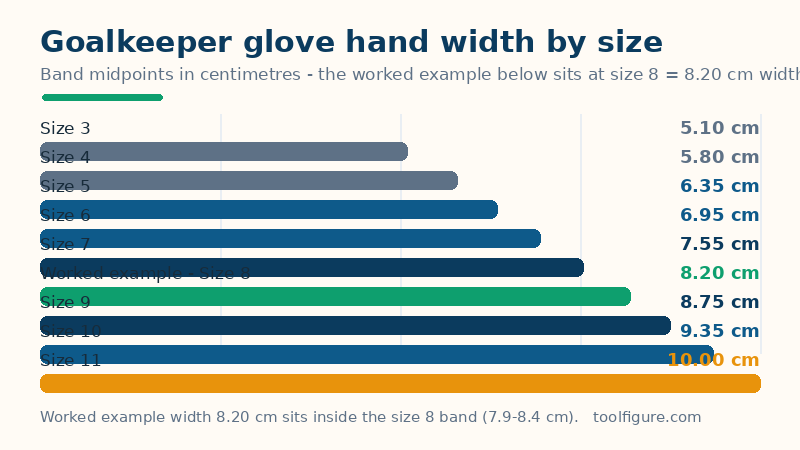
| Size | Hand width (cm) | Hand length (cm) |
|---|---|---|
| 3 | 4.7–5.5 | 13.0–14.5 |
| 4 | 5.6–6.0 | 14.5–15.3 |
| 5 | 6.1–6.6 | 15.3–16.0 |
| 6 | 6.7–7.2 | 16.1–16.9 |
| 7 | 7.3–7.8 | 17.0–17.6 |
| 8 | 7.9–8.4 | 17.7–18.4 |
| 9 | 8.5–9.0 | 18.5–19.2 |
| 10 | 9.1–9.6 | 19.3–20.3 |
| 11 | 9.7–10.3 | 20.4–21.0 |
Spot checks against the table: a width of 7.5 cm sits in the 7.3–7.8 cm band, so width size 7; a length of 19.0 cm sits in the 18.5–19.2 cm band, so length size 9; a width of 6.4 cm is size 5 and a length of 16.5 cm is size 6. The same two numbers in inches are 7.5 cm = 2.95 in and 19.0 cm = 7.48 in, which is why the calculator shows both units — some makers still print their charts in inches.
Worked example: 8.2 cm wide, 18.0 cm long
A hand 8.2 cm wide and 18.0 cm long takes size 8. Width 8.2 cm (3.23 in) sits in the 7.9–8.4 cm band, so width size 8; length 18.0 cm (7.09 in) sits in the 17.7–18.4 cm band, so length size 8; both measurements agree, so there is no larger-wins decision to make. The same calculator at width 7.5 cm and length 19.0 cm returns size 9 — width size 7 against length size 9, and the larger wins — which is exactly the case the single-measurement charts get wrong. Buying a roll finger cut in the worked example means ordering size 9, because roll finger cuts run snug and the guides put them one full size up; standard and negative cuts run true to the measured size.
How to read your result, and its limits
Three checks before ordering. First, measure both hands and use the larger: hands differ, and a glove bought for the smaller hand pinches the larger one. Second, leave a finger's room at the fingertips: the glove should end about half a centimetre past the fingertips, so a glove that already touches the ends when new will feel short once the palm breaks in. Third, remember that cut changes fit: the size is a starting point, and a roll finger cut, a flat palm and a negative cut all sit differently on the same hand — that is why the calculator asks for the cut. Age charts exist (size 4 for ages 6–7, size 6 for ages 10–11, size 8 for small adults, size 11 for extra-large adults), but they are averages only: two ten-year-olds on the same team can need different sizes, so measure the hand rather than trusting the age row. Sizes above 11 exist in some makers' ranges, but 11 is the top of this chart — a hand wider than 10.3 cm or longer than 21.0 cm is outside it, and the calculator says so rather than inventing a size.
Common mistakes
- Measuring width around the palm. Circumference and straight width are different numbers: this chart uses straight width across the knuckles, thumb excluded. A circumference measurement matched to this chart gives a size too large.
- Using only one measurement. Width alone or length alone misses the disagreement case — width size 7 with length size 9 needs size 9, and a width-only chart would sell a glove a full size too small.
- Buying by age or by shirt size. Age rows are averages; hand size is what the glove fits. A tall child with small hands and a short adult with large hands break every age chart.
- Forgetting the cut. A roll finger cut in the measured size feels tight; the guides are explicit that it goes one size up, and the calculator applies that rule only when that cut is selected.
Related tools: Soccer Ball Size Calculator — The right soccer ball size from the player's age: league sizes 3, 4 and 5, plus skills balls 1 and 2; Baseball Glove Size Calculator — The right baseball glove size from age group and position: the published chart, looked up openly, with the catcher's circumference exception stated; Glove Size Converter — Palm circumference to glove size — numeric and letter sizes.
Frequently asked questions
What size goalkeeper gloves do I need?
Measure your dominant hand flat, fingers together: width across the knuckles (thumb excluded) and length from the wrist crease to the longest fingertip. Match both to the chart — sizes 3 to 11 — and take the larger size when they disagree. Most adult men land on size 9 or 10.
Should I size up for roll finger gloves?
Yes, one full size up. Roll finger cuts run snug, so a measured size 8 buys a size 9 in a roll finger cut. Standard and negative cuts run true to the measured size.
What if my width and length give different sizes?
Take the larger size. A glove that is a touch roomy breaks in; one that is too tight does not stretch, and it pinches the fingers on every catch.
Do children use the same goalkeeper glove chart?
Yes — sizes 3 to 6 cover juniors, and the same two measurements apply. Age rows (size 4 for ages 6–7, size 6 for ages 10–11) are averages only, so always measure the child's hand rather than guessing from age.
