A max you estimate is a max you can train from today
Your one-rep max — the most weight you can lift once, with sound form — is the number most strength programmes are written in percentages of. Testing it directly is a poor way to find it: a true max attempt is fatiguing, technically risky for newer lifters, and on a bad day it measures the day rather than the lifter. So programmes estimate it from an ordinary hard set instead, using formulas fitted to how strength falls off as reps accumulate. This calculator runs the two most widely used of those formulas side by side — because they do not always agree, and seeing the spread between them is more honest than one number presented as fact — then builds the percentage table a training week is actually loaded from. It sits with the energy side of the same training log: the calorie calculator for what the work costs to fuel, and the pace calculator for the running that shares the week.
The two formulas, with every term defined
Epley: 1RM = weight × ( 1 + reps ÷ 30 )Brzycki: 1RM = weight × 36 ÷ ( 37 − reps )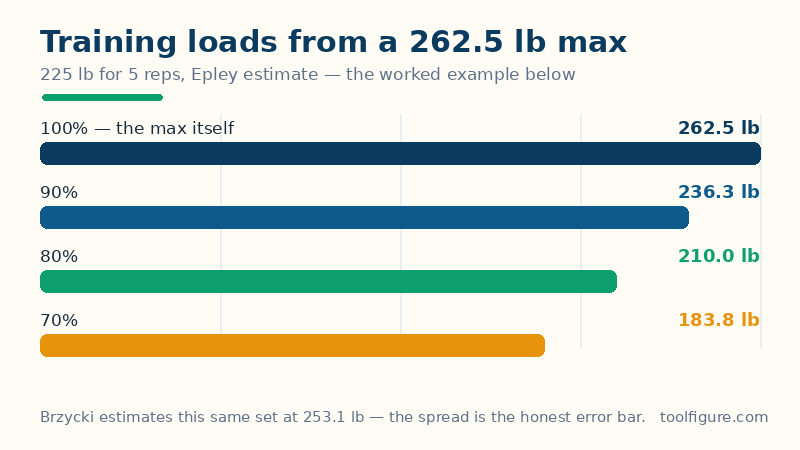
Weight is the load lifted — bar and plates together — and reps is the number of full repetitions completed before failure or the end of the set, ideally a set stopped at most one rep short of failure. Each formula turns the reps into a multiplier on the weight: Epley adds a thirtieth of the weight per rep, Brzycki divides by a shrinking denominator, which is why Brzycki grows faster at high rep counts and cannot be used at 37 reps at all. The two were fitted independently to real lifting data (Epley's formula dates to 1985, Brzycki's to 1993), and they cross at exactly 10 reps: below 10, Epley estimates the higher max; at 10 they agree to the digit; above 10, Brzycki estimates higher. Neither is a measurement — both are the centre of a cloud of real results, and individual lifters sit either side of them depending on the lift and their training history.
Worked example: 225 lb for 5 reps
The defaults above take the classic gym test set: 225 lb lifted for 5 full reps. Epley multiplies by 1 + 5 ÷ 30 = 1.1667, giving 225 × 1.1667 = 262.5 lb. Brzycki multiplies by 36 ÷ (37 − 5) = 36 ÷ 32 = 1.125, giving 253.1 lb. The spread is 9.4 lb and the average of the two is 257.8 lb — read the honest answer as 'a max near 255 to 265', not a single figure to the decimal. The percentage table the calculator builds from the Epley headline is where the estimate earns its keep: 95% is 249.4 lb, 90% is 236.3 lb, 85% is 223.1 lb, 80% is 210.0 lb, 75% is 196.9 lb, 70% is 183.8 lb, 65% is 170.6 lb and 50% is 131.3 lb — the bars in the chart. A programme calling for work at 80% is asking for 210 lb from this lifter, whatever their max 'really' is.
More sets, checked the same way
| Set | Epley 1RM | Brzycki 1RM | Average |
|---|---|---|---|
| 225 lb × 5 reps — worked example | 262.5 lb | 253.1 lb | 257.8 lb |
| 100 kg × 8 reps | 126.7 kg | 124.1 kg | 125.4 kg |
| 60 kg × 10 reps | 80.0 kg | 80.0 kg | 80.0 kg |
| 315 lb × 3 reps | 346.5 lb | 333.5 lb | 340.0 lb |
| 135 lb × 12 reps | 189.0 lb | 194.4 lb | 191.7 lb |
Read the table as the formulas' character in miniature. At 3 and 5 reps, Epley sits above Brzycki; at exactly 10 reps the two meet — 60 kg × 10 gives 80.0 kg from both, because 1 + 10/30 and 36/(37 − 10) are the same multiplier, 4/3 — and by 12 reps Brzycki has crossed above. The gaps stay modest throughout the range that matters: the widest here is 13.0 lb on a 340 lb max at 3 reps, about 4 percent. That is the realistic precision of any rep-based estimate, and it is why the percentage table rounds no finer than a tenth — and why sensible programmes prescribe a range ('around 80%') rather than a plate-exact load.
How to read your result — and its limits
Use the headline for the percentage table and the spread between the formulas as your error bar: plan heavy work from the lower figure if the lift is technical or your form breaks down under load. Four limits belong with the page. The input set decides everything: a set stopped with two reps still in the tank is a weight-times-reps fact about a lighter effort — add those unspent reps to your count honestly, or the estimate understates you. Accuracy fades with reps: between 2 and 10 reps both formulas track tested maxima closely for most lifters; past 10, endurance and pain tolerance enter the set, past 15 the estimate is a rough guide at best, and this page stops at 30. The lift matters: the formulas were fitted largely on upper-body pressing; deadlifts and squats often estimate a little high, small isolation lifts a little low. And an estimate is not an invitation: nothing here is coaching or medical advice, and a first attempt at a genuinely maximal load belongs in a rack, with a spotter or safeties, on a day you are rested — the entire point of estimating is that most training never needs that day. What the page guarantees is narrower and checkable: given the weight and reps, both formulas and every percentage are worked exactly as written above.
Frequently asked questions
How accurate is a one-rep max estimated from reps?
For sets of 2 to 10 reps taken close to failure, the classic formulas usually land within a few percent of a tested max — on this page you can see that precision directly, because the two independent formulas rarely differ by more than about 4% in that range (13.0 lb on a 340 lb estimate at 3 reps). Past 10 reps the spread widens and individual variation dominates: treat high-rep estimates as a planning guide, and re-test with a shorter, heavier set when the number matters.
Which formula should I use — Epley or Brzycki?
For most training purposes, either — they agree exactly at 10 reps and sit close either side of it, Epley higher below 10 reps and Brzycki higher above. This page headlines Epley because it is the most widely used in programme templates, and shows Brzycki and the average beside it so you can see the disagreement rather than hide it. If you track progress over time, consistency matters more than the choice: estimate with the same formula every time.
I lifted a weight for exactly 1 rep — what is my max?
That weight. A completed single is a tested max, not an estimate, which is why this calculator returns the weight itself for a 1-rep entry instead of inflating it with a multiplier — the raw Epley formula would claim 3.3% more than you demonstrably lifted. Use percentage loads from that tested figure for the next block, and re-test or re-estimate as the training progresses.
How do I use the percentage table in training?
As the loading language of a programme: a day written as 5 × 5 at 75% means five sets of five reps at 75% of your max — 196.9 lb for the worked example's 262.5 lb estimate. Heavier percentages (90% and up) suit low reps and full recovery between sets; the 60 to 75% band is where most repeatable volume lives. Round the table's figures to the plates you actually own — the nearest loadable weight is always close enough.
Why does the calculator stop at 30 reps?
Because beyond that the thing being measured has changed. A 30-rep set is limited by endurance, breathing and local fatigue far more than by maximal strength, and Brzycki's formula is already bending sharply upward there — its denominator (37 − reps) heads toward zero at 37 reps, where it would divide by nothing. A hard set of 5 to 10 reps gives a far better estimate than any long set, however carefully it is counted.