One payment is a sum — a series of payments is an annuity
The present value calculator values a single sum due in the future. Most real money does not arrive as a single sum: it arrives as a series — a monthly deposit into savings, a pension contribution, a stream of equal instalments. A series of equal payments at equal intervals is an annuity, and it has two honest values, not one. Its future value asks what the whole series grows to by the last payment, interest included. Its present value asks the reverse: what single sum today, growing at the same rate, would exactly replace the series. This page computes both from the same inputs, and separates the interest from the money paid in, so neither figure is a black box.
The formulas, with every term defined
Future value = PMT \u00d7 ((1 + r) ^ n \u2212 1) \u00f7 rPresent value = PMT \u00d7 (1 \u2212 (1 + r) ^ \u2212n) \u00f7 rwhere PMT = the regular payment, r = annual rate \u00f7 payments per year, n = years \u00d7 payments per year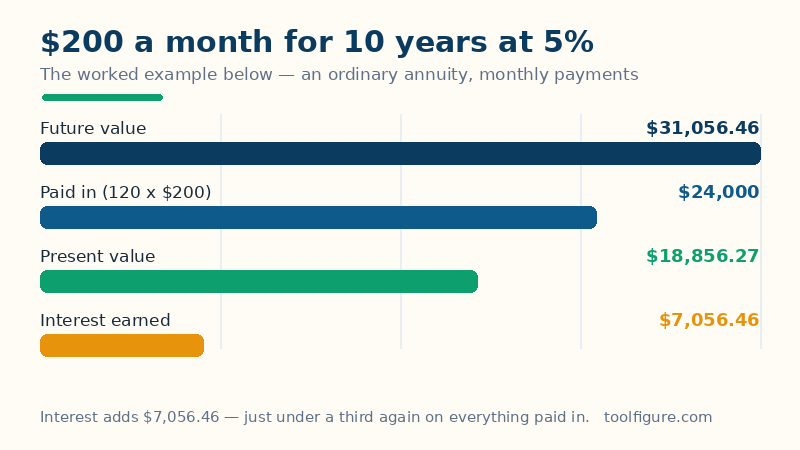
Read it in words. Each payment earns interest for the time it sits in the series: the first monthly payment compounds for almost the whole term, the last one — paid at the very end, in an ordinary annuity — earns nothing at all. Adding up those individual futures is a geometric series, and the first formula is that sum tidied into one line. The second formula is the same series read backwards in time: each payment is discounted by the wait until it arrives, exactly as the present value page discounts a single sum, and the discounts add up. The two answers are tied by the growth factor: future value = present value \u00d7 (1 + r)^n, a check you can run on any row of the table below. At a 0% rate both formulas divide by zero on paper, so the calculator takes the honest shortcut the limit implies: with no interest, both values are simply the payments added up.
Worked example: $200 a month for 10 years at 5%
The defaults above enter a payment of $200, paid monthly (12 times a year), an annual rate of 5% and a term of 10 years. That is n = 120 payments at a period rate of r = 5% \u00f7 12 = 0.4167% a month. The payments themselves total 120 \u00d7 $200 = $24,000. The future value formula gives $200 \u00d7 ((1.004167)^120 \u2212 1) \u00f7 0.004167 = $31,056.46 — so interest added $7,056.46, just under a third again on top of everything paid in. The present value formula gives $200 \u00d7 (1 \u2212 (1.004167)^\u2212120) \u00f7 0.004167 = $18,856.27: a single $18,856.27 today, growing at 5%, would exactly fund that decade of $200 payments. And the tie-check holds: $18,856.27 \u00d7 (1.004167)^120 = $18,856.27 \u00d7 1.6470 = $31,056.46, the chart near the top drawn as bars.
How the values move: term, rate and payment size
| Case | Paid in | Future value | Present value |
|---|---|---|---|
| Worked example — $200/mo, 5%, 10 years | $24,000.00 | $31,056.46 | $18,856.27 |
| $100/mo, 5%, 10 years | $12,000.00 | $15,528.23 | $9,428.14 |
| $200/mo, 5%, 5 years | $12,000.00 | $13,601.22 | $10,598.14 |
| $200/mo, 5%, 20 years | $48,000.00 | $82,206.73 | $30,305.06 |
| $500/mo, 6%, 20 years | $120,000.00 | $231,020.45 | $69,790.39 |
| $1,000/yr, 4%, 5 years | $5,000.00 | $5,416.32 | $4,451.82 |
| $1,000/mo, 8%, 15 years | $180,000.00 | $346,038.22 | $104,640.59 |
| $200/mo, 0%, 10 years | $24,000.00 | $24,000.00 | $24,000.00 |
Three patterns repay attention. Everything scales with the payment: halving the payment to $100 a month halves both values exactly — an annuity has no fixed costs hiding in it, which is why the $100 row is precisely half the worked example. Time is the powerful variable, not the rate: doubling the term from 10 to 20 years less than triples the future value (interest starts earning interest on a growing pile), while the present value rises by only about 61% — payments far in the future are heavily discounted, so distant years add growth but little present worth. And the two values answer different questions: the $500-a-month row is worth $231,020.45 as a finished pot but only $69,790.39 as a lump sum today — neither is \u201cthe true value\u201d; each is the true answer to its own question, which is why pension buyouts, structured settlements and savings plans must always say which one they are quoting. The compound interest calculator covers the neighbouring case of one lump sum plus optional monthly additions.
Reading an annuity figure honestly — the limits
Four cautions belong with any figure here. This is an ordinary annuity — payments at the END of each period. Rent, leases and some insurance series are paid at the START (an annuity due): multiply both values by (1 + r) to convert — on the worked example the future value becomes $31,056.46 \u00d7 1.004167 = $31,185.86. Using the wrong timing understates every figure by one period of interest. The rate is held constant for the whole term, as every annuity formula assumes; a real savings rate or market return moves, and the result moves with it — treat the output as the value at that rate, not a promise. Taxes, fees and inflation are not in the figures: the present value discounts for interest only, not for rising prices (the inflation calculator shows what a steady rate does to buying power over the same span). And a present value is only as good as its discount rate: the same series is worth more at a lower rate and less at a higher one, which is why two firms can value the same payment stream differently without either one lying — they have chosen different rates, and the rate is the assumption to argue about.
Frequently asked questions
What is an annuity, in plain words?
A series of equal payments made at equal intervals — $200 a month into savings, a yearly premium, a stream of instalments. This page values the whole series two ways: its future value (what it grows to, interest included) and its present value (what single sum today would replace it). On the worked example, 120 payments of $200 at 5% grow to $31,056.46 and are worth $18,856.27 as one sum today.
What is the difference between future value and present value?
Timing. Future value pushes every payment forward to the end of the term, adding the interest each one earns. Present value pulls every payment back to today, discounting each by the wait until it arrives. They are linked exactly: future value = present value \u00d7 (1 + r)^n. On the worked example, $18,856.27 \u00d7 1.6470 = $31,056.46 — the two answers are one series seen from opposite ends of its life.
What changes if payments are made at the start of each period?
Every payment sits for one extra period, so both values rise by the factor (1 + r) — the series becomes an annuity due. On the worked example the future value rises from $31,056.46 to $31,185.86, one month of interest (0.4167%) on the whole series. Rent is the everyday annuity due: it is paid before the month it covers, not after.
Why is the present value less than the total paid in?
Because a payment arriving in nine years is not worth its face amount today. At 5%, $200 due in 10 years is worth about $122 today; discount all 120 payments that way and the worked example's $24,000 of payments are worth $18,856.27 now. That gap is not a loss or a fee — it is the price of time, and it is exactly the interest a lump sum would need to earn to fund the series.
Can I use this for a retirement income stream?
For the arithmetic, yes — valuing a level income stream is precisely a present-value-of-annuity question, and the $250-a-month, 6%, 30-year case works out to a present value of $41,697.90 against a future value of $251,128.76. What the formula cannot do is judge the offer itself: a real pension or buyout also carries inflation linking, survivor terms, tax and the payer's strength, none of which are in any annuity formula — value the stream here, then judge the terms with advice.