A converter that is honest about where the rate comes from
Every currency conversion is one multiplication. The hard part was never the maths — it is the rate: the number a search engine shows you is the mid-market rate, an average of what banks trade at, and almost nobody actually gets it. Your bank adds a margin, your card network adds its own, and an exchange shop adds a fee on top, so the figure that matters is the rate on your quote — and that is the rate this converter takes. Type in the amount, the two currencies and the rate your provider is offering, and the page does the multiplication in the open, shows the inverse rate for the trip back, and — if you enter the fee or margin as a percentage — shows exactly how much of the converted money that fee eats and what rate you effectively received. Nothing is fetched, cached or presented as today's rate, in the same spirit as the unit converter stating its exact factors: the numbers are yours, the arithmetic is checkable.
The formulas, with every term defined
Converted amount = amount × exchange rateInverse rate = 1 ÷ exchange rate · Amount after a fee = converted amount × (1 − fee% ÷ 100)Effective rate = exchange rate × (1 − fee% ÷ 100)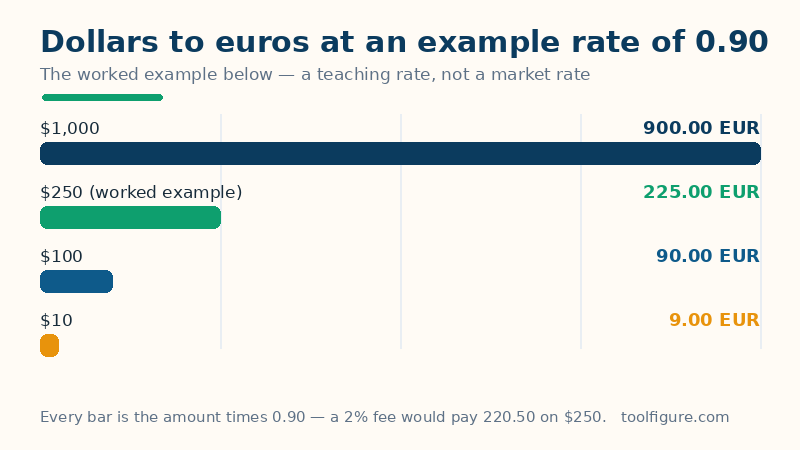
Read it in words. The exchange rate here is quoted one specific way: how many units of the to-currency one unit of the from-currency buys. If a quote is given the other way round — how much of your money one unit of theirs costs — that is the inverse rate, and the page prints it alongside so the two directions can never be silently confused; multiplying by a rate when you should have divided by it is the classic conversion error, and the inverse is the check that catches it. The fee line matters because providers hide cost in two different places: an explicit percentage, or a worse rate. Entering the margin as a fee converts the second kind into the first, so two quotes become comparable: the effective rate is the single number that summarises what you truly received per unit sent.
Worked example: $250 into euros at an example rate of 0.90
The defaults above enter 250 US dollars, an example rate of 0.90 euros per dollar, and no fee. The conversion is 250 × 0.90 = €225.00. The inverse rate is 1 ÷ 0.90 = 1.1111 dollars per euro — and it round-trips: €225.00 ÷ 0.90 = $250.00 exactly. The reference table under the result scales linearly, as it must: $1 → €0.90, $10 → €9.00, $100 → €90.00 and $1,000 → €900.00. Now add the fee the example leaves at zero: at a 2% fee the same conversion pays 225.00 × (1 − 0.02) = €220.50. The fee itself is €4.50, and the effective rate is 0.90 × 0.98 = 0.8820 — so a "2% fee" quote and a flat rate of 0.882 with no fee are the same deal wearing different clothes, which is exactly the comparison this page exists to make. At 1% the payout is €222.75; at 5% it falls to €213.75.
What different fee levels do to the same $250
| Fee | Fee cost | You receive | Effective rate |
|---|---|---|---|
| 0% | €0.00 | €225.00 | 0.9000 |
| 1% | €2.25 | €222.75 | 0.8910 |
| 2% | €4.50 | €220.50 | 0.8820 |
| 5% | €11.25 | €213.75 | 0.8550 |
Two reading notes. First, the fee column grows with the amount while the rate column does not, which is why comparing providers on a small test amount and then sending a large one is a trap — compare effective rates, not test payouts. Second, a fixed charge (a flat $5 wire fee) is not a percentage: to compare it honestly, work out what percentage it is of your amount — $5 on $250 is 2%, on $2,500 it is 0.2% — and enter that.
Reading a conversion honestly — the limits
Three cautions belong with any converted figure. This page does not know today's rate, and says so. Rates move all day; the 0.90 in the example is a round teaching number, not a market quote. Get the live figure from the provider you will actually use, at the moment you will use it, and enter that. The rate you are quoted is rarely the rate you can check elsewhere: the gap between a headline mid-market rate and a provider's customer rate is where most conversion cost hides, which is why the effective-rate line — not the headline — is the number to compare across banks, cards and exchange services. And a conversion is not a quote: the receiving bank may deduct its own charges, some transfers are converted twice (sent currency → a middle currency → the final one, paying the margin twice), and a card purchase may settle at the rate on the posting date, not the purchase date. Enter the rate and fees your own paperwork shows, and this page will tell you exactly what they add up to — nothing more, and nothing hidden.
Frequently asked questions
Why do I have to enter the exchange rate myself?
Because the rate that matters is the one your provider offers you, and no honest page can know it. Sites that display a rate are showing the mid-market average, which banks and card networks then mark up — the money you receive is worked out at their rate, not that one. Entering your own quote makes the answer the real answer, and the fee field exposes any margin on top.
What does the inverse rate mean?
The same exchange read in the opposite direction. At 0.90 euros per dollar, the inverse is 1 ÷ 0.90 = 1.1111 dollars per euro. Use it when a quote is given the other way round, or to check a return conversion: €225.00 converted back at the inverse returns exactly $250.00. Multiplying when you should divide — or the reverse — is the most common currency mistake, and the inverse rate is printed precisely so you can catch it.
Is the 0.90 rate in the example today's dollar-to-euro rate?
No. It is a round teaching number chosen so the worked example can be checked by hand — 250 × 0.90 = 225. This converter never fetches or claims a live rate. For a real conversion, replace 0.90 with the rate on your own bank quote, card terms or exchange-service receipt.
How do I compare two providers with different rates and fees?
Put each offer through the fee field and compare the effective rate — the rate after the percentage fee or margin is taken. A provider offering 0.90 with a 2% fee (effective rate 0.8820, €220.50 from $250) is worse than one offering a flat 0.89 with no fee (€222.50), even though 0.90 looks like the better headline. The table on this page shows the fee cost in money, not just in percent, for the amount you are actually sending.
Why does the amount I receive differ from what online converters show?
Usually three reasons, all visible once you use your own rate: the provider's rate includes a margin over the mid-market rate shown online; a percentage fee or flat charge is deducted on top; and the receiving side may take its own fee or convert through a middle currency. None of those make the online figure wrong as an average — they make it the wrong figure for your transfer.