Why rooms always take more paint than the wall suggests
Ask how much paint a room needs and the honest answer is a small chain of arithmetic, every link of which is a place people go wrong: the walls are bigger than the floor plan implies, doors and windows come off that area, the second coat doubles the paint (not the room), and the tin's coverage figure is a smooth-wall promise that real walls only sometimes keep. This calculator walks the whole chain in the open — gross wall area, minus openings, times coats, divided by coverage — counts primer as its own purchase, and shows the final round-up to whole tins, which is where the last surprise usually hides.
The formulas, with every term defined
Gross wall area = 2 × (room length + room width) × ceiling heightPaintable area = gross wall area − (doors × 21 sq ft) − (windows × 15 sq ft) [+ ceiling = length × width, if included]Paint needed = paintable area × number of coats ÷ coverage per gallon · Primer = paintable area × primer coats ÷ coverageAmount to BUY = the needed amount rounded UP to whole gallons (or litres)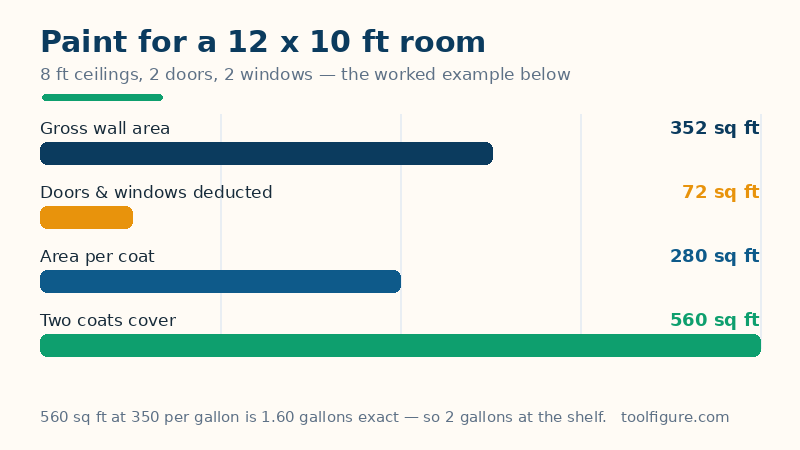
The opening sizes are the quoting convention, not a guess: a standard interior door with its frame is taken as 21 square feet (about 1.9 m² in metric mode, a 0.9 × 2.1 m door) and a typical window as 15 square feet (about 1.4 m²). Coverage defaults to 350 sq ft per US gallon — the middle of the 300–400 range most wall paints print — or 10 m² per litre in metric mode; if your tin says something else, type its figure in, because coverage is the single most honest number on the label. Primer is counted separately because it is bought separately, usually cheaper, and skipped entirely on previously painted walls in good condition.
Worked example: a 12 × 10 ft bedroom, 8 ft ceilings
The defaults above give: the four walls total 2 × (12 + 10) × 8 = 352 sq ft gross. Two doors (2 × 21 = 42) and two windows (2 × 15 = 30) deduct 72 sq ft, leaving 280 sq ft to paint per coat. Two coats at 350 sq ft per gallon need 280 × 2 ÷ 350 = exactly 1.60 gallons — so 2 gallons to buy, with most of a gallon's worth of the second tin left for touch-ups. The one primer coat needs 280 ÷ 350 = 0.80 gallons, so 1 gallon of primer. At $35 a gallon for everything, the shelf total is (2 + 1) × $35 = $105. The bar chart above draws the shrinkage: 352 gross, 72 deducted, 280 painted, 1.6 gallons exact.
Other rooms, worked the same way
| Room | Area per coat | Paint, 2 coats | Buy |
|---|---|---|---|
| Bedroom 10 × 10 ft, 8 ft ceiling, 1 door, 1 window | 284 sq ft | 1.62 gal | 2 gal |
| Bedroom 12 × 10 ft, 8 ft, 2 doors, 2 windows (worked example) | 280 sq ft | 1.60 gal | 2 gal |
| Living room 15 × 12 ft, 9 ft ceiling, 2 doors, 3 windows | 399 sq ft | 2.28 gal | 3 gal |
| Bathroom 8 × 5 ft, 8 ft ceiling, 1 door, no window | 187 sq ft | 1.07 gal | 2 gal |
| Worked example with the ceiling included | 400 sq ft | 2.29 gal | 3 gal |
| Metric room 4 × 3 m, 2.5 m ceiling, 1 door, 1 window | 31.67 m² | 6.33 litres | 7 litres |
Two lessons sit in that table. The bathroom shows the round-up at its harshest: 1.07 exact gallons still means opening a second gallon — small rooms are the least efficient paint jobs there are, and a quart tin for the overage is often the cheaper buy. The living room shows the opposite case: 2.28 gallons buys 3, and the leftover three-quarters of a gallon is your touch-up stock for years. If the same project starts with a pour, the concrete calculator is this page's sibling — same discipline of measured quantity plus an open allowance. For the wall you are painting around, the standard door and window sizes above are deliberately ordinary: measure any oversized opening yourself and adjust the count (a double-width window is two windows, for area purposes).
How to read your result, and the limits — read these
Coverage is a range wearing a single number's clothes. The same paint that covers 350 sq ft on sealed, previously painted drywall may manage 250–300 on fresh plaster, bare wood or heavy texture, because the first coat partly soaks in rather than sitting on the surface — that thirst is exactly what the primer coat is for, and on new drywall it is not optional in any practical sense. Strong colour changes (dark over light, or the reverse) can need a third coat whatever the arithmetic says; the calculator caps at honest coat counts and the extra-coat button is there for that reason. The standard door and window deductions cut the other way for glass-heavy rooms: a wall that is half window deducts far more than 15 sq ft per opening here, so for sunrooms and sliding-door walls, measure the glass and subtract it by adjusting the window count. Finally, the cost line prices full tins at one price — primer usually costs less than finish paint, and quart tins cost more per gallon than gallons do, so treat the total as a shelf estimate, not a receipt.
Frequently asked questions
How much paint do I need for a 12×10 room?
With 8 ft ceilings, two doors and two windows: the walls are 352 sq ft gross, 280 sq ft after openings, so two coats at standard 350 sq ft-per-gallon coverage need exactly 1.60 gallons — buy 2 gallons, plus 1 gallon of primer if the walls need a primer coat. Include the ceiling and the same room needs 2.29 gallons, so 3 to buy.
Does one gallon of paint really cover 350 square feet?
On smooth, previously painted walls in good condition, yes — that is the figure most manufacturers print, inside a stated range of about 300–400 sq ft per gallon. On new drywall, bare wood, rough texture or a strong colour change, expect coverage nearer 250–300 sq ft and budget the extra coat or the larger purchase; the coverage field above exists so the number on YOUR tin, not the default, drives the result.
Do I need primer, and is it counted separately?
On new drywall, bare wood, stained or patched walls, and when changing between very different colours, yes — primer seals the surface so the finish coats cover evenly, and it is cheaper than wasting finish paint as a sealer. It is counted separately here because it is a separate, usually cheaper purchase: one primer coat over the worked example's 280 sq ft needs 0.80 gallons, so one gallon. On sound, previously painted walls in a similar colour, primer is commonly skipped — set its coats to 0.
Should I subtract doors and windows from the wall area?
Yes, at standard sizes — about 21 sq ft for a door and frame and 15 sq ft for a typical window — because you do not paint them, and across a whole room they commonly remove 15–25% of the wall area. The exception is a room with unusually large openings, such as a sliding glass door wall: there the standard deduction understates the glass, so count a double-width opening as two.
Why does the calculator round up to whole gallons?
Because paint is sold whole: 1.60 gallons of need is met by opening a second gallon, not by buying six-tenths of one. The exact figure still matters — it tells you how much will be left over (nearly half a gallon in the worked example, worth keeping for touch-ups) and whether a quart tin would cover a small overage more cheaply than a full gallon, as in the bathroom row of the table above.