Business days are the calendar with the weekends removed — and one more step
Deadlines at work are rarely set in calendar days. "Ten business days to respond", "delivery in five working days", "notice of fifteen business days" — each of those phrases quietly deletes every Saturday and Sunday, and usually every public holiday too. This calculator does that job in both directions. In count mode it takes two dates and returns the business days between them, with an explicit field to deduct the public holidays that fall on weekdays inside your span. In add and subtract modes it steps a date forward or backward by a number of business days and returns the working deadline itself — the date a "10 business days from Monday" promise actually lands on.
The formula, with every term defined
Business days in a span = the Monday-to-Friday days after the start date, up to and including the end dateWorking days = business days − public holidays that fall on a Monday to Friday inside the spanAdd N business days = step forward one calendar day at a time, counting only Monday-to-Friday landings, until N have been counted; the landing date is the result (subtract steps backward the same way)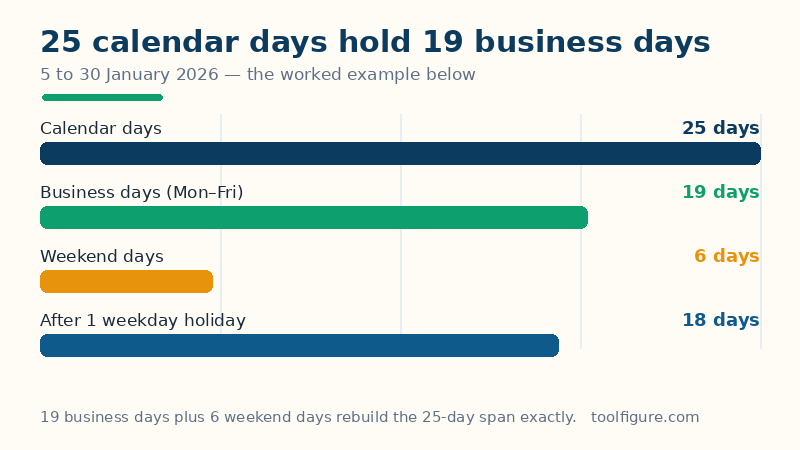
A business day here means Monday to Friday — the definition used by most employers, courts and delivery services in the US and UK; workplaces on a different weekend should read the limitations note below. The counting rule matches the rest of this site's date tools: the start date itself is never counted, because a period that starts on Monday is measured from Tuesday — the same convention behind the days-between-dates calculator. The holiday deduction only accepts holidays on weekdays, for an honest reason: a public holiday that falls on a Saturday removes no working day, so deducting it would double-count the weekend. Add mode is built to be the exact inverse of count mode — add 10 business days to a date, then count between the two dates, and you get 10 back.
Worked example: counting — Monday 5 January to Friday 30 January 2026
The defaults above describe a near-month of January work. The calendar span from Monday 5 January 2026 to Friday 30 January 2026 is 25 calendar days. Counting only Monday-to-Friday days after the 5th, up to and including the 30th, gives 19 business days; the remaining 6 are weekend days — 19 + 6 = 25, so the split rebuilds the span exactly, as the bar above draws it. Now deduct holidays: if one public holiday falls on a weekday inside that span, enter 1 in the holiday field and the working total falls to 18 business days. That single field is the difference between this tool and a plain weekday count — January spans in many countries cross New Year holidays, and a leave balance or a supplier deadline that ignores them is wrong by exactly the number of weekday holidays it skipped.
Worked examples: adding and subtracting business days
| Job | Calendar days it takes | Result |
|---|---|---|
| Mon 5 Jan 2026 + 10 business days | 14 | Mon 19 Jan 2026 |
| Fri 9 Jan 2026 + 5 business days | 7 | Fri 16 Jan 2026 |
| Wed 15 Apr 2026 + 10 business days | 14 | Wed 29 Apr 2026 |
| Fri 16 Jan 2026 − 10 business days | 14 | Fri 2 Jan 2026 |
The pattern in the table is the one to internalise: from a weekday start, 5 business days always take exactly 7 calendar days and 10 take exactly 14, because each block of 5 working days drags one weekend behind it. The first and last rows are inverses — add 10 to Monday 5 January and you land on Monday 19 January; subtract 10 from Friday 16 January and you land on Friday 2 January — and counting between 5 and 19 January in count mode returns exactly 10, which is how the two modes audit each other. Weekday starts keep their weekday when the step is a multiple of 5; steps that are not multiples of 5 move the weekday forward by the remainder, skipping any weekend in the way.
More verified counts
| Span | Calendar days | Business days | Weekend days |
|---|---|---|---|
| Mon 5 Jan → Fri 16 Jan 2026 | 11 | 9 | 2 |
| Mon 5 Jan → Fri 30 Jan 2026 | 25 | 19 | 6 |
| Wed 1 Apr → Thu 30 Apr 2026 | 29 | 21 | 8 |
The April row is a useful budgeting check: a full working month is usually 20 to 23 business days before holidays, never a round 20 by right — April 2026 holds 21 in this counting rule (the 1st itself is the start and is not counted; counting the whole calendar month's weekdays including the 1st would give 22). Anyone who staffs a project on "20 business days a month, every month" will be quietly short by the end of a quarter; counting real spans, as here, is the fix.
How to read your result, and the limits
In count mode the big figure is working days after your holiday deduction; the table keeps the undeducted business days visible so the deduction itself can be audited. In add and subtract modes the big figure is a date — check its weekday: a business-day step can only ever land on a Monday to Friday (except the zero step, which returns your start date unchanged). Limits, stated plainly: holidays are deducted as a count you supply, not looked up, because holiday calendars differ by country, state and employer — count the weekday holidays inside your span and enter that number. Add and subtract modes do not skip holidays, only weekends; if a result week contains a holiday, step one extra business day and note why. Business days mean Monday to Friday here: workplaces where the weekend is Friday–Saturday need the count adjusted by hand. For a countdown to a future date in all units at once, use the countdown calculator; to add calendar days rather than business days, use the date calculator.
Frequently asked questions
What counts as a business day?
Monday to Friday. Saturdays and Sundays are never counted, and in count mode you can also deduct the public holidays that fall on weekdays inside your span. A holiday that falls on a weekend is not deducted — it removes no working day.
If something is due in 10 business days from Monday 5 January 2026, when is it due?
Monday 19 January 2026. Ten business days take 14 calendar days from a weekday start, because two weekends are stepped over on the way. Use add mode above to run the same job for any start date.
Does the count include the start and end dates?
The start date is not counted and the end date is, when it falls on a weekday — the period is measured from the day after it starts. That matches how processing times and notice periods are normally counted, and it is the same rule the other date tools on this site use.
Why does this page ask me to count holidays myself?
Because there is no single holiday calendar: national, regional and company holidays all differ, and the same date can be a holiday in one state and a working day in another. You count the weekday holidays inside your span; the calculator deducts exactly that many — no hidden list, no wrong-country surprises.
What is the difference between this and the days-between-dates calculator?
That tool reports every unit for a span — total days, weeks, hours and a business-day split. This tool is the business-day specialist: it deducts weekday holidays in count mode, and it works backwards as well, adding or subtracting business days to find the deadline date itself.