Two famous methods, one honest difference
If you owe money on several fronts at once, the minimum payments keep every account alive — but they do not decide where your spare money goes, and that decision is where the snowball and avalanche methods part ways. Both methods work the same way underneath: pay the minimum on everything, then throw every spare dollar at ONE target debt until it is gone, then roll its freed payment into the next target. They differ only in how the target is chosen. The snowball method targets the smallest balance first, whatever its interest rate — the win comes fast, and each cleared debt is proof the plan is working. The avalanche method targets the highest interest rate (APR) first, whatever its balance — no debt is allowed to keep charging you top rate while cheaper debts get your spare money. Enter your debts above and this calculator simulates both methods month by month on your exact figures — interest charged, minimums paid, spare money rolled on — and reports the months to debt-free, the total interest and the payoff order for each, so the trade-off stops being a slogan and becomes two numbers you can compare.
How the simulation works
Each month: interest = balance x (APR / 100 / 12) is added to every debtThen: minimums are paid on all debts; the rest of the budget goes to the target debtSnowball target = smallest balance · Avalanche target = highest APR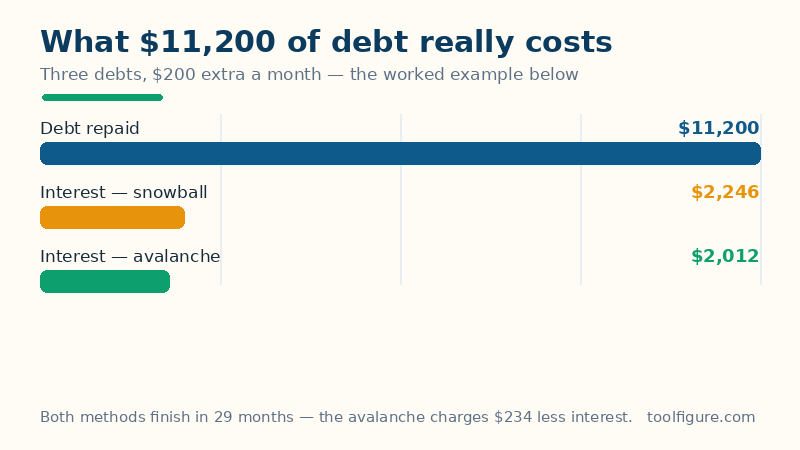
Your total monthly budget is fixed throughout: the sum of all the minimum payments plus the extra amount you enter. That detail matters — when a debt is cleared, its minimum does not vanish from the plan, it joins the spare money aimed at the next target. That rolling effect is the engine both methods are named for, and it is why the finishing months of a payoff plan move so much faster than the starting months. The maths for any single debt is the same amortisation as our loan calculator; what this page adds is the order in which several debts are attacked, and what that order costs or saves.
Worked example: $11,200 across three debts, $200 extra
You owe a $1,200 personal loan at 8% (minimum $40), a $4,000 credit card at 24% (minimum $100) and a $6,000 car loan at 12% (minimum $130) — $11,200 in total, $270 a month of minimums. You can pay $200 extra, a $470 monthly budget. The snowball clears the small personal loan first (month 6), then the card (month 19), then the car — debt-free in 29 months, at a cost of $2,245.51 in interest. The avalanche attacks the 24% card first (gone in month 16), then the car (month 28), and lets the cheap personal loan run to the end — also debt-free in 29 months, but the interest is $2,011.65. Same finishing month, $233.86 less interest: that is the avalanche's entire argument, in one example. And both methods crush the alternative of paying minimums only, which drags on for about 63 months and costs roughly $5,600–$5,700 in interest — the $200 extra is worth more than the choice of method, a point the next section comes back to.
Which method should you actually choose?
The avalanche never costs more interest than the snowball on the same debts — that is arithmetic, not opinion. If the two finish in the same month, as in the example above, the choice is easy. The snowball's case is behavioural, and it is a real one: a plan abandoned in month four saves no interest at all. If your smallest debt can be cleared within a few months, that early win can be worth the modest extra interest it costs — you can see exactly how modest, or how large, the difference is on your own debts in the table above before you commit. Two situations genuinely change the answer. First, a promotional 0% balance whose rate is about to jump: clear it before the jump whatever either method says, because its future APR is the highest you own. Second, any debt in arrears or collections: stabilise that first, since fees and legal risk outrank interest optimisation. Whatever you choose, write the order down and automate the payments the day after payday — the same pay-first discipline that makes a paycheck stretch — and redirect every cleared debt's payment onward instead of letting it leak into spending. Money freed by a finished plan is also the natural seed for a savings goal: the month after the last debt dies, the same payment can start building an emergency fund instead.
Frequently asked questions
What is the difference between the snowball and avalanche methods?
Both pay the minimum on every debt and aim all spare money at one target. Snowball targets the smallest balance first, for the fastest early win. Avalanche targets the highest APR first, which minimises the total interest. On the worked example — $11,200 across three debts with $200 extra a month — both finish in 29 months, but avalanche costs $2,011.65 in interest against snowball's $2,245.51.
Which debt payoff method saves the most money?
Avalanche, always on pure maths: paying the highest rate first means less interest is charged every month the plan runs. The saving can be small (a few hundred dollars when the debts are similar) or large (thousands when a big balance carries a very high APR). Snowball wins only if its early victories are what keep you on the plan — a finished snowball beats an abandoned avalanche.
How much difference does an extra monthly payment make?
Usually more than the choice of method. In the worked example, paying only the $270 of minimums takes about 63 months and roughly $5,600–$5,700 of interest. Adding $200 a month cuts that to 29 months and about $2,000–$2,250 of interest under either method — the extra payment does most of the work, and the method tunes what is left.
Should I ever pay a low-interest debt first?
Yes, in two common cases: a promotional 0% rate that is about to expire and jump to a high APR, and any debt that is behind on payments, where fees and consequences matter more than interest order. Outside those cases, letting a low-rate debt run while you attack expensive debt is exactly what the avalanche method does deliberately.
What happens to a payment when one debt is cleared?
It rolls into the next target — that is the mechanism both methods are built on. Your total monthly budget stays the same; the cleared debt's minimum simply joins the spare money aimed at the remaining target, which is why debts fall faster and faster toward the end of the plan. The calculator assumes you keep paying the same total every month until everything is gone.