APY vs APR: why two numbers describe the same account
Banks quote two different percentages, and the difference is not a trick — it is compounding. APR (annual percentage rate) is the simple stated rate: 5% APR means the account pays 5% over a year if interest is added only once. APY (annual percentage yield) is what you actually earn when interest is added more often and then itself starts earning interest. The more often interest lands in your account, the higher the APY climbs above the APR. That is why US savings accounts are required to advertise APY: it is the honest, comparable number. Enter any APR above, pick how often it compounds, and this calculator returns the true APY, the future value of your money, and — in the comparison table — exactly how much each compounding frequency is worth on your own figures, so you can see the gap instead of guessing it.
The APY formula
APY = (1 + r / n)n − 1Future value = P × (1 + r / n)n × tContinuous compounding: APY = er − 1 · Future value = P × er × tr is the APR as a decimal (5% = 0.05), n is how many times a year interest is added, P is your starting amount and t is the years. Read the first formula in plain words: each period pays r/n, and there are n of those periods in a year, so your money is multiplied by (1 + r/n) a total of n times — and everything after the first addition includes interest on earlier interest. Continuous compounding is the mathematical limit of adding interest ever more often, which is why the daily and continuous rows in the table above sit so close together. Our compound interest calculator uses the same engine with monthly contributions added; this page isolates the rate itself so you can compare accounts fairly.
Worked example: $10,000 at 5% APR, compounded monthly
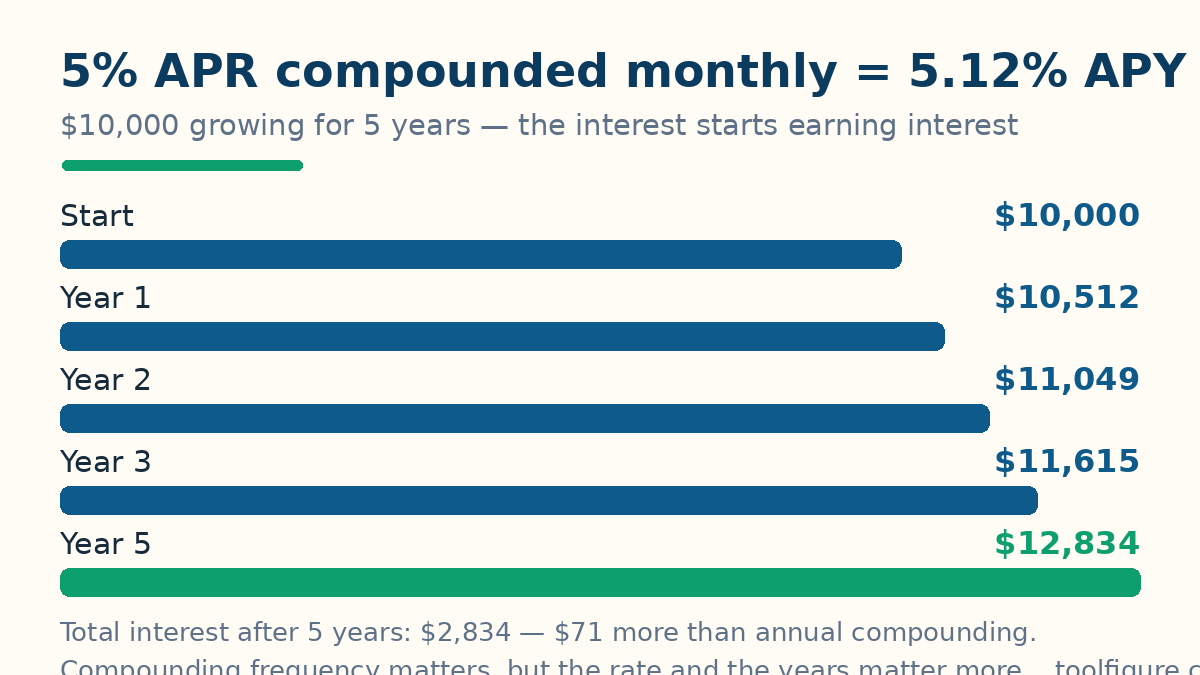
Put $10,000 in an account paying 5% APR, compounded monthly. Each month pays 5% ÷ 12 = 0.4167%. APY = (1 + 0.05/12)12 − 1 = 5.12%. After 5 years the balance is $12,833.59 — $2,833.59 of interest, none of it from extra deposits. Now change only the frequency: compounded annually, the same 5% is a 5.00% APY and the five-year balance is $12,762.82. Monthly compounding is worth $70.77 more on $10,000 over five years. Real, but modest — keep that scale in mind when a bank markets daily compounding as if it were a fortune. Daily compounding lifts the APY to 5.13% and the balance to $12,840.03: just $6.44 more than monthly over the whole five years.
How much does compounding frequency really matter?
| Compounding at 5% APR | APY | $10,000 after 5 years |
|---|---|---|
| Annually | 5.00% | $12,762.82 |
| Semiannually | 5.06% | $12,800.85 |
| Quarterly | 5.09% | $12,820.37 |
| Monthly | 5.12% | $12,833.59 |
| Daily | 5.13% | $12,840.03 |
| Continuous | 5.13% | $12,840.25 |
Two lessons fall out of that table. First, most of the gain arrives early: moving from annual to monthly captures almost all of what frequency can give you, and everything beyond monthly is rounding. Second, the rate itself dwarfs the frequency: a 5.25% APR compounded annually (a 5.25% APY) beats a 5% APR compounded daily (5.13% APY) every time. So compare accounts by APY — that is what it is for — but never choose a lower APY just because its compounding sounds fancier. And remember the other two levers from our savings goal calculator: a larger amount and more years both multiply the result far more powerfully than frequency ever can. At 5.12% APY, $10,000 becomes $16,470 in ten years instead of $12,834 in five — time nearly doubles the interest while frequency was arguing over single dollars.
APY on savings, APR on borrowing — do not mix them
A common confusion: the APR on a loan and the APY on savings are quoted under different conventions, and lenders are not required to show you an APY-style figure. A loan's APR includes certain fees and is an annualised cost, but interest on most loans is charged on a declining balance as you repay — the maths in our loan calculator. For savings and CDs, always line accounts up by APY, check whether the rate is fixed or variable, and check for minimum-balance tiers: a headline APY that only applies above $25,000, or only for an introductory few months, is not the APY your money will actually earn. This calculator assumes one fixed rate and no deposits or withdrawals after the start, which is exactly right for comparing a CD or a lump sum — and a planning estimate, not a promise, for a variable-rate account.
Frequently asked questions
What is the difference between APR and APY?
APR is the stated yearly rate before compounding within the year. APY is the effective yield after compounding: interest added during the year itself earns interest. At 5% APR compounded monthly, the APY is 5.12% — that 0.12% gap is the interest on the interest.
How do I convert APR to APY?
Use APY = (1 + r/n)^n − 1, where r is the APR as a decimal and n is the compounding periods per year. For monthly compounding at 5%: (1 + 0.05/12)^12 − 1 = 5.12%. The calculator above does it for annual, semiannual, quarterly, monthly, weekly, daily and continuous compounding.
Is daily compounding much better than monthly?
No — the difference is tiny. At 5% APR on $10,000 over 5 years, daily compounding earns $12,840.03 against monthly's $12,833.59: about $6 more in five years. A slightly higher rate or a longer term matters far more than the frequency once you are at monthly or better.
Why does my bank advertise APY instead of APR for savings?
Because for savings accounts in the US, APY disclosure is required so customers can compare accounts on equal terms. Two accounts with the same APR but different compounding pay different amounts; APY exposes that. For loans, the APR convention is used instead — the two are not directly comparable.
Does APY include fees or taxes?
No. APY reflects only the interest rate and compounding frequency. Account fees, minimum-balance penalties and taxes on interest all reduce what you actually keep, which is why a slightly lower APY with no fees can beat a higher APY on a fee-heavy account.