How GPA is calculated
GPA = total quality points ÷ total credits, where quality points = grade points × credits for each course.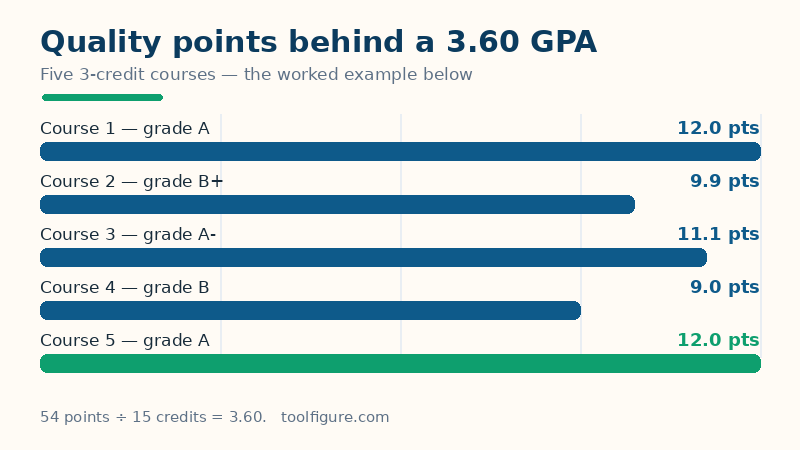
This GPA calculator turns your course grades and credit hours into a semester GPA on the standard 4.0 scale, weighting each grade by its credits — an A in a 4-credit course earns 16 quality points, the same A in a 1-credit seminar earns 4. Add your previous GPA and credits and it works out your cumulative GPA too. A GPA is a weighted average, and the weighting is the part people miss. Each grade is first converted to points on the 4.0 scale below, then multiplied by the course's credit hours — so an A in a 4-credit course earns 16 quality points while the same A in a 1-credit seminar earns 4. Add the quality points from every course, divide by the total credits, and the result is your GPA. That is why a weak grade in a high-credit course does more damage than the same grade in a one-credit elective, and why your GPA can never be worked out by simply averaging the letters on your transcript.
The 4.0 scale used here
| Grade | Points | Grade | Points |
|---|---|---|---|
| A+ / A | 4.0 | B− | 2.7 |
| A− | 3.7 | C+ | 2.3 |
| B+ | 3.3 | C | 2.0 |
| B | 3.0 | C− / D+ / D | 1.7 / 1.3 / 1.0 |
Colleges vary slightly — some do not use A+, some cap weighted courses differently. This is the most common unweighted 4.0 scale.
Worked example
Say you take five courses in one semester, each worth 3 credits, and earn A, B+, A−, B and A. Convert each grade to points: 4.0, 3.3, 3.7, 3.0 and 4.0. Because every course carries the same 3 credits, the quality points are (4.0 + 3.3 + 3.7 + 3.0 + 4.0) × 3 = 54. Your total credits are 5 × 3 = 15, so GPA = 54 ÷ 15 = 3.60. Notice what the weighting did quietly: the B (3.0) dragged the average down by exactly as much as each A pulled it up, because all five courses weigh the same. Change any one of them to a 4-credit course and its grade would count a third more than the rest — try it above by editing the credit values.
Worked example — a UK student's letter-graded modules
UK degrees are normally awarded as classifications (First, 2:1, 2:2) rather than a GPA, but exchange students, and anyone applying to a US employer or graduate school, often needs their letter-graded modules expressed on the 4.0 scale. Suppose five modules carry grades and credits of A (20 credits), B+ (20), A− (10), B (10) and A (20). Quality points: 4.0×20 + 3.3×20 + 3.7×10 + 3.0×10 + 4.0×20 = 80 + 66 + 37 + 30 + 80 = 293. Total credits = 80, so GPA = 293 ÷ 80 = 3.66. Notice the two 20-credit A grades doing twice the work of the 10-credit A− — on a UK transcript, as on a US one, the big modules decide the outcome.
How to read your result, and the cumulative line
The big figure is this term's GPA alone. If you also filled in your previous cumulative GPA and credits, the detail line underneath combines them correctly — weighted by credits, never by simply averaging the two GPAs. For example, a previous 3.40 over 60 credits plus the 3.60 semester above (54 quality points over 15 credits) gives (3.40 × 60 + 54) ÷ 75 = 3.44 overall: one strong term lifted the cumulative figure by only 0.04, because 60 older credits outweigh 15 new ones.
Limitations
Schools do not all use the same scale. Some award 4.3 for an A+, some exclude plus/minus grades, and honours or AP courses may be weighted to a 5.0 scale — this calculator uses the common unweighted 4.0 scale shown in the table, so confirm your own institution's rules before reporting the figure officially. Pass/fail courses are normally excluded entirely, and the treatment of a repeated course (replacement, averaging, or both attempts counting) is set by your school, not by the maths.
Common mistakes
- Averaging the letters. Turning A, B, A into "about a B+" ignores credits. A 1-credit A and a 4-credit B average to 3.2, not 3.5.
- Thinking an F's credits vanish. An F earns 0 points but its credits still count in the divisor — that is what makes it so damaging, and what makes replacing it (where allowed) so powerful.
- Rounding each course first. Keep full precision until the final division; rounding intermediate steps can move the second decimal place, which is sometimes the place that matters.
- Counting 0-credit courses. Labs or seminars worth no credits contribute nothing either way. Leave them out rather than entering them with credits guessed.
Related tools: Percentage Calculator — What is X% of Y, X is what % of Y, and % change — with steps; Age Calculator — Exact age in years, months, days — and days until your next birthday; Salary to Hourly Calculator — Annual salary to hourly wage, weekly, biweekly and monthly — both ways.
Frequently asked questions
What is the difference between semester and cumulative GPA?
Semester GPA covers one term only. Cumulative GPA is the weighted average of everything you have completed — enter your previous GPA and credits above to combine them correctly.
Is a weighted GPA different?
Yes: weighted scales award extra points for honours/AP/IB courses (often up to 5.0). This calculator uses the standard unweighted 4.0 scale most colleges report.
How much can one bad grade hurt?
It depends on credits. One F in a 3-credit course among 15 credits pulls a 4.00 semester down to 3.20 — which is why retaking or protecting high-credit courses matters.
Can I raise my cumulative GPA a lot in one term?
The more credits you already have, the less one term moves the average — the maths above shows exactly how much, so you can plan realistically.
How do I convert percentage grades to the 4.0 scale?
Schools publish their own conversion, but one widely used US mapping is: 93–100% = A (4.0), 90–92% = A− (3.7), 87–89% = B+ (3.3), 83–86% = B (3.0), 80–82% = B− (2.7), then C+, C and C− in similar three-point bands, 60–66% ≈ D range, and below that F. Convert each course's percentage to a letter with your school's table, then enter the letters above.
If I retake a failed course, which grade counts?
It depends entirely on your institution. Some replace the F with the new grade in the GPA, some average the two attempts, and some count both separately. Check the academic regulations, then model your situation here by entering only the grades your school will actually count.
The worked examples on this page were checked against this calculator on 18 October 2026.