Height sets the length, sleep position sets the width
A sleeping pad must be at least as long as you are — head and feet both on insulation, neither on the cold ground — and makers sell pads in five lengths that step with height. The published height bands run: 100–150 cm, Kids Regular at 152 cm (60 in); 151–165 cm, Women's Regular at 168 cm (66 in); 166–180 cm, Men's Regular at 183 cm (72 in); 181–190 cm, Men's Large at 196 cm (77 in); 191–203 cm, Men's Extra Large at 203 cm (80 in). Every band's pad is longer than every height in the band, so the size to buy is simply the band your height falls in — there is no rounding to do. Width is a separate choice and follows how you sleep, not how tall you are: makers sell three widths, narrow at 51 cm (20 in), medium at 64 cm (25 in) and wide at 76 cm (30 in). A back sleeper fits the narrow width; a side sleeper, whose hips and shoulders need room to settle, fits the medium width; an active or sprawling sleeper fits the wide width. Most makers offer 20 in or 25 in widths first, with 30 in on the wider models.
Size by height: 100–150 cm Kids Regular 152 · 151–165 cm Women's Regular 168 · 166–180 cm Men's Regular 183 · 181–190 cm Men's Large 196 · 191–203 cm Men's Extra Large 203 cm — Width: back 51 cm (20 in) · side 64 cm (25 in) · sprawling 76 cm (30 in)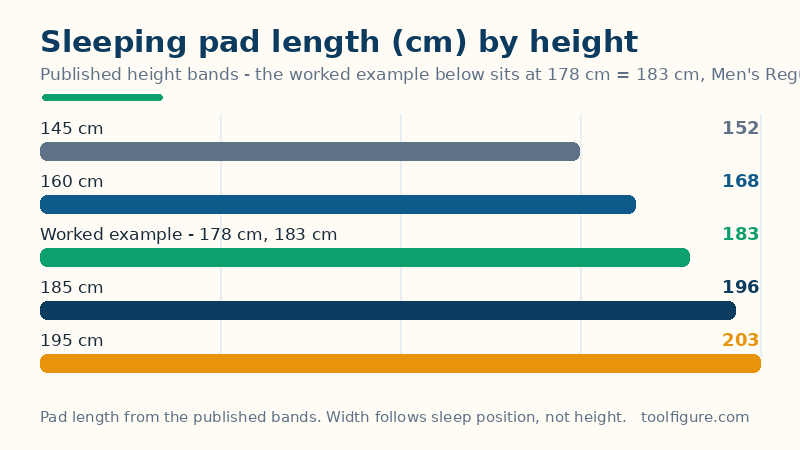
A height exactly on a band boundary belongs to the lower band's size as published: 150 cm still buys Kids Regular, while 151 cm buys Women's Regular; 180 cm still buys Men's Regular, while 181 cm buys Men's Large. The size names are a guide, not a standard — brands cut differently — which is why the page prints the pad length beside every name and why the check below says to compare the maker's dimensions against your height, not just to trust the name.
Worked example: 178 cm tall, side sleeper
A camper who is 178 cm tall and sleeps on their side should buy a Men's Regular pad, 183 cm (72 in), in the medium width of 64 cm (25 in). The working: 178 cm falls in the 166–180 cm band, whose size is Men's Regular at 183 cm. The pad is 183 − 178 = 5 cm longer than the sleeper, which is 5 ÷ 2.54 = 2.0 in of spare length. The side-sleeper width is the medium width, 64 cm (25 in). The same lookup at other heights shows the sizes stepping, not sliding:
| Height | Sleep position | Size to buy | Pad length | Width |
|---|---|---|---|---|
| 145 cm | Back | Kids Regular | 152 cm (60 in) | 51 cm (20 in) |
| 160 cm | Side | Women's Regular | 168 cm (66 in) | 64 cm (25 in) |
| 178 cm | Side | Men's Regular | 183 cm (72 in) | 64 cm (25 in) |
| 185 cm | Back | Men's Large | 196 cm (77 in) | 51 cm (20 in) |
| 195 cm | Sprawling | Men's Extra Large | 203 cm (80 in) | 76 cm (30 in) |
Notice the second and third rows together: the 160 cm and 178 cm sleepers both take the medium width because both sleep on their sides, but their lengths differ — Women's Regular and Men's Regular — because width follows position while length follows height. And notice the last row: the 195 cm sprawling sleeper's pad is 203 cm, only 8 cm longer than they are, yet it is the largest size makers sell — taller sleepers should check the maker's actual dimensions, since some brands stop at 196 cm.
How to read your result, and its limits
Three checks before trusting the size. First, the centimetres decide, not the name: a Women's Regular from one brand and a Men's Regular from another can differ by centimetres, so compare the published pad length against your height and take a pad at least as long as you are. Second, length is not warmth: the R-value is chosen by season, not by height — about 2 for summer, 3–4 for three seasons, 5 or more for winter — and a long pad with too low an R-value still sleeps cold, because the ground steals heat from below. Third, this page sizes full-length pads: the ultralight 3/4 rule — a pad about a quarter of your height shorter, with a pillow or pack under your head — is a deliberate weight trade for thru-hiking, not a sizing recommendation, and torso-length pads leave the legs on the ground by design. Tapered mummy pads narrow toward the feet, so a side sleeper who needs the medium width should check the width at the hips, not just the widest point.
Common mistakes
- Buying a pad shorter than you are to save weight, on a first pad. Feet or head on bare ground lose heat all night — the 3/4 rule is a trade for experienced ultralight walkers, not a saving for a first buy.
- Choosing width by height. A tall back sleeper fits the narrow width and a short sprawling sleeper needs the wide one — width follows how you move at night, not how tall you are.
- Trusting the size name across brands. Size names are not a standard: compare the published pad length in centimetres against your height before buying.
- Ignoring the R-value. A pad that fits perfectly but is rated for summer still sleeps cold in spring — match the R-value to the season as well as the length to your height.
Related tools: Sleeping Bag Size Calculator — Your sleeping bag size from height and sleep position — the minimum length, the size that covers it, and the comfort rating for your coldest night; Tent Size Calculator — Your tent size from sleepers and comfort — the floor area you need and the rating that covers it — with the packs-inside allowance; Hammock Size Calculator — Your hammock size from height — the minimum length, the 10, 11 or 12 ft size to buy, the width and the hanging distance.
Frequently asked questions
What size sleeping pad do I need?
It comes from your height: 100–150 cm buys Kids Regular (152 cm), 151–165 cm Women's Regular (168 cm), 166–180 cm Men's Regular (183 cm), 181–190 cm Men's Large (196 cm) and 191–203 cm Men's Extra Large (203 cm). For example, 178 cm buys a Men's Regular pad, 183 cm (72 in).
How long should a sleeping pad be compared to your height?
At least as long as you are, head and feet both on insulation. The published bands all give a pad longer than every height in the band — a 178 cm sleeper's 183 cm pad leaves 5 cm (2.0 in) of spare length.
What width sleeping pad should I buy?
It follows how you sleep, not how tall you are: back sleepers fit the narrow 51 cm (20 in) width, side sleepers the medium 64 cm (25 in) width, and active or sprawling sleepers the wide 76 cm (30 in) width.
What R-value sleeping pad do I need?
The R-value is insulation, chosen by season rather than by size: about 2 for summer, 3–4 for three seasons and 5 or more for winter. A pad that fits perfectly but is rated for summer still sleeps cold in spring, because the ground steals heat from below.
