The formula: weight first, then the band, then the ability pick
The calculation is a lookup with a stated pick inside the band, and the calculator shows the band it landed in so the answer can be checked by hand. Step 1, convert to pounds: weight in kilograms divided by 0.45359237 gives pounds — the unit the published charts are built in. Step 2, find the band: the rider's weight falls in exactly one band of the standard published chart, and the band gives a board length (a single length for the two lightest bands, a range for the rest). Step 3, pick inside the band by ability: beginners take the top of the band, because more surface area means more stability and easier control; intermediate riders take the midpoint; advanced riders take the bottom, because a shorter board spins faster, feels lighter and rides more aggressively. For the open-ended top band (over 200 lb), the answer is 140 cm and up for every ability, with beginners advised a few centimetres longer. The full chart is:
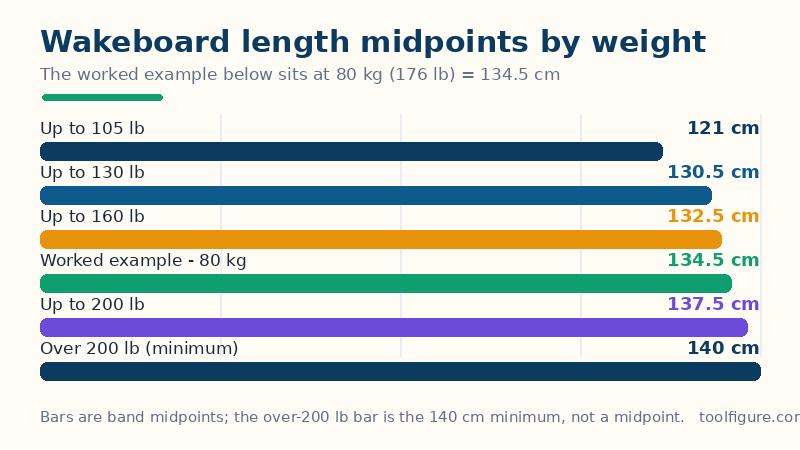
| Rider weight (lb) | Rider weight (kg) | Board length | Intermediate pick |
|---|---|---|---|
| Up to 85 | Up to 38.5 | 119 cm (46.9 in) | 119 cm |
| Up to 105 | Up to 47.6 | 121 cm (47.6 in) | 121 cm |
| Up to 130 | Up to 58.9 | 130–131 cm (51.2–51.6 in) | 130.5 cm (51.4 in) |
| Up to 160 | Up to 72.5 | 132–133 cm (52.0–52.4 in) | 132.5 cm (52.2 in) |
| Up to 180 | Up to 81.6 | 134–135 cm (52.8–53.1 in) | 134.5 cm (53.0 in) |
| Up to 200 | Up to 90.7 | 136–139 cm (53.5–54.7 in) | 137.5 cm (54.1 in) |
| Over 200 | Over 90.7 | 140 cm and up (55.1 in and up) | 140 cm and up |
A weight exactly on a band boundary takes that band — 160 lb reads the up-to-160 lb band, not the next one — and the kilogram column is pounds times 0.45359237, rounded down to one decimal place, so a kilogram figure never crosses into the next band. Cable riding shifts the pick, not the band: cable boards run a few centimetres longer than boat boards for the same weight, so a cable rider takes the upper end of the band whatever their ability, and a boat rider chasing pop takes the lower end.
Worked example: 80 kg, intermediate
Take a rider who weighs 80 kg and rides at intermediate level. Step 1: 80 ÷ 0.45359237 = 176.4 lb. Step 2: 176.4 lb falls in the up-to-180 lb band, so the board length is 134–135 cm (52.8–53.1 in). Step 3: intermediate takes the midpoint, 134.5 cm (53.0 in) — a beginner at the same weight takes 135 cm and an advanced rider takes 134 cm. The same answer comes out of the pounds input: 176 lb falls in the same band and reads the same 134–135 cm, so the two units can never disagree by more than rounding. Other riders on the same chart read:
| Rider | Band | Length | Intermediate pick |
|---|---|---|---|
| 30 kg (66.1 lb) | Up to 85 lb | 119 cm (46.9 in) | 119 cm |
| 40 kg (88.2 lb) | Up to 105 lb | 121 cm (47.6 in) | 121 cm |
| 50 kg (110.2 lb) | Up to 130 lb | 130–131 cm (51.2–51.6 in) | 130.5 cm |
| 60 kg (132.3 lb) | Up to 160 lb | 132–133 cm (52.0–52.4 in) | 132.5 cm |
| 70 kg (154.3 lb) | Up to 160 lb | 132–133 cm (52.0–52.4 in) | 132.5 cm |
| 90 kg (198.4 lb) | Up to 200 lb | 136–139 cm (53.5–54.7 in) | 137.5 cm |
| 100 kg (220.5 lb) | Over 200 lb | 140 cm and up (55.1 in and up) | 140 cm and up |
Notice how flat the chart is in the middle: 60 kg and 70 kg read the same band, and 80 kg is only one band up — because board length grows slowly with weight once the board is long enough to float the rider, and the ability pick inside the band matters as much as the band itself.
How to read your result, and its limits
Three checks before buying. First, check the maker's own chart for the board you actually want: this page consolidates the standard published chart, but manufacturers tune length by model — rocker, flex and width all shift the right size by a centimetre or two, and the board's own label outranks this page. Second, height sets your stance, not your board: taller riders stand wider, which is why some guides mention height at all, but the board itself does not know how tall you are — it knows your weight pushing it through the water, which is why weight decides the band and several guides say height is not a sizing factor. Third, foot size can push the width: as a rough gauge, a foot larger than a men's size 12 wants a wider board or one size up, and bindings must fit the boots before the length matters at all — and if one board must serve a whole family, size it for the heaviest rider, since a board that is too small for the heaviest rider sinks for everyone. For the rest of the kit, the surfboard volume calculator sizes a board from weight and skill, and the wetsuit size calculator sizes a suit from height and weight.
Related tools: Snowboard Size Calculator — A recommended snowboard length range from your height, ability level and riding style, with the full height table.
Frequently asked questions
What size wakeboard do I need?
As a starting point, size by weight: an 80 kg intermediate rider reads 134–135 cm with a midpoint pick of 134.5 cm. Enter your own weight and ability above and the calculator shows your band and your pick inside it.
Does height matter for wakeboard size?
Only secondarily: weight decides the band, because the board must float the rider, and several published guides say height is not a sizing factor at all. Height sets stance width — taller riders stand wider — which is a bindings setup question, not a length question.
Should I choose a longer board for cable riding?
Yes, a few centimetres longer: cable boards run longer than boat boards for the same weight, for softer landings and easier presses, so a cable rider takes the upper end of the band whatever their ability.
What size wakeboard should a beginner choose?
The top of their weight band: more surface area means more stability and easier control. An advanced rider at the same weight takes the bottom of the band, for a board that spins faster and feels lighter.
