Four steps: heat needed, heater efficiency, energy in, cost
The whole calculation starts with physics and ends with a price list. First the heat the water actually needs: a gallon of water weighs 8.34 pounds, and it takes one BTU to raise one pound of water by one degree Fahrenheit, so gallons times 8.34 times the temperature rise is the day's useful heat in BTU. Then the heater: no heater delivers all the energy it takes in, so the useful heat is divided by the heater's UEF — the Uniform Energy Factor, heat delivered divided by energy in — to get the energy the heater actually consumes. Electric energy is counted in kilowatt-hours (3,412 BTU to the kWh) and gas in therms (100,000 BTU to the therm), and each is multiplied by its price:
useful heat a day (BTU) = gallons × 8.34 × (hot °F − cold °F)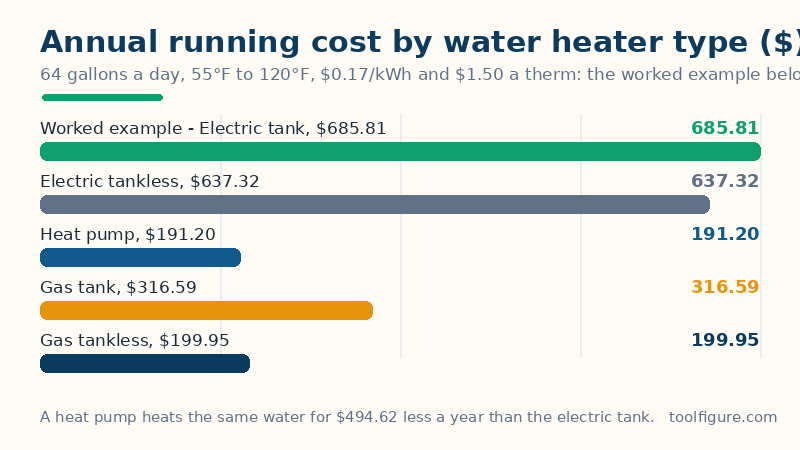
useful heat a year (kWh) = useful heat a day × 365 ÷ 3,412electricity in (kWh) = useful heat a year ÷ UEFgas in (therms) = useful heat a day × 365 ÷ UEF ÷ 100,000annual cost ($) = energy in × price per kWh or per thermThree numbers in those lines carry the whole comparison. The UEF values on this page are the typical ratings for each type: 0.92 for a standard electric tank, 0.99 for an electric tankless, 3.3 for a heat pump water heater, 0.60 for a standard gas tank and 0.95 for a gas tankless. A tank's UEF already includes its standby loss — the 20% to 45% of a tank's energy that the Department of Energy says goes to keeping stored water hot while nobody uses it — which is why the tankless, with no stored water to keep hot, beats the tank on efficiency even before its higher UEF is counted. And a heat pump's UEF is above 1 because it moves heat from the surrounding air instead of making it with a heating element, the same trick the heat pump savings calculator prices for space heating.
Worked example: 64 gallons a day, 55°F to 120°F
A family of four uses about 64 gallons of hot water a day — the Department of Energy's planning figure — heated from 55°F cold water to a 120°F setting, a rise of 65°F. The useful heat is 64 × 8.34 × 65 = 34,694 BTU a day, which over a year is 34,694 × 365 ÷ 3,412 = 3,711 kWh of heat. The five heaters turn that heat into five very different bills. An electric tank at UEF 0.92 needs 3,711 ÷ 0.92 = 4,034 kWh of electricity, costing $685.81 a year at $0.17/kWh ($57.15 a month). An electric tankless at UEF 0.99 needs 3,749 kWh and costs $637.32. A heat pump at UEF 3.3 needs only 1,125 kWh and costs $191.20 — a $494.62 a year saving against the electric tank. A gas tank at UEF 0.60 needs 211.1 therms and costs $316.59 at $1.50 a therm, and a gas tankless at UEF 0.95 needs 133.3 therms and costs $199.95 — a $116.64 a year saving against the gas tank, close to ENERGY STAR's published figure of about $95 a year for a family of four. The same maths at other household sizes: 40 gallons a day (one or two people) costs $428.63 a year on an electric tank and $119.50 on a heat pump, and 80 gallons a day (five or more people) costs $857.26 on the tank and $238.99 on the heat pump. The gap between the cheapest and the dearest heater grows with every gallon, which is why the heater choice matters most in the biggest households.
How to read your result, and its limits
Four cautions keep the number honest. First, the cold water temperature moves with the seasons: 55°F is the US average, but northern winter water can arrive near 40°F, which lifts the temperature rise from 65°F to 80°F and the energy by almost a quarter — enter your own winter figure if you are sizing for the cold months. Second, UEF is a rating, not a measurement of your house: a tank in a cold garage loses more standby heat than one in a warm utility room, a heat pump in a cold basement moves less heat than one in a warm one, and a tankless that is undersized for two showers at once delivers lukewarm water rather than the saving on this page. Third, this page prices running cost only: a heat pump water heater costs two to three times as much installed as a standard electric tank, and a gas tankless costs roughly twice a gas tank installed, so the saving has to pay back the premium — at $494.62 a year the heat pump usually pays back in two to four years, while the gas tankless at about $95 to $117 a year takes far longer on energy alone and only wins outright when it also avoids a second tank replacement. Fourth, the gas price and the electricity price are not comparable directly: a therm holds about 29.3 kWh of heat, so $1.50 a therm is about $0.051 per kWh of heat before efficiency — which is why gas looks cheap in the table even at a lower UEF, and why the fuel you already have matters as much as the machine. For the panels that can supply the electricity side of the bill, the solar panel calculator sizes the array; for the cost of the electricity itself, the electricity cost calculator prices any appliance by watts and hours; and for the space-heating cousin of the same heat pump, the heat pump savings calculator compares heat pumps against gas, oil and electric heat.
Common mistakes
- Sizing a tank by its gallons instead of its first-hour rating. A 50-gallon tank delivers more than 50 gallons in its first hour because it reheats while it drains. The Department of Energy sizes tanks by the first-hour rating against the household's busiest hour — about 12 gallons per person in that hour — not by the tank's capacity alone.
- Forgetting the standby loss. A tank spends 20% to 45% of its energy keeping stored water hot between uses. Any comparison that prices only the water actually used understates a tank's cost by that share — which is exactly why the UEF, which already includes standby, is the number to compare, not the nameplate watts.
- Comparing gas and electric on energy alone. A gas tank at UEF 0.60 looks wasteful beside an electric tank at 0.92, but gas at $1.50 a therm is about $0.051 per kWh of heat against $0.17 for electricity — so the gas tank costs $316.59 a year where the electric tank costs $685.81. Price per unit of heat is the comparison; efficiency alone is not.
- Expecting a tankless to pay back on energy alone. The gas tankless saves about $95 to $117 a year in the worked example, but costs roughly $2,000 more installed than a gas tank. On energy alone that is a twenty-year payback — it only wins when the longer life avoids buying a second tank, or when endless hot water is worth paying for on its own.
Frequently asked questions
How much does a water heater cost to run per year?
It depends on the heater and the hot water used. For a family of four at 64 gallons a day, 55°F to 120°F, $0.17/kWh and $1.50 a therm: an electric tank costs $685.81 a year, an electric tankless $637.32, a heat pump $191.20, a gas tank $316.59 and a gas tankless $199.95.
Is a tankless water heater cheaper than a tank?
To run, yes; to own, not always. In the worked example the gas tankless saves $116.64 a year over the gas tank — ENERGY STAR puts the published saving for a family of four at about $95 a year — but a tankless costs roughly $2,000 more installed, so on energy alone the payback is about twenty years. It wins outright mainly when its longer life avoids buying a second tank.
What is UEF on a water heater?
The Uniform Energy Factor: the heat a heater delivers divided by the energy it takes in, measured under a standard test. A standard electric tank is about 0.92, a gas tank about 0.60, a tankless about 0.95 to 0.99, and a heat pump water heater about 3.3 — above 1 because it moves heat from the air instead of making it. A tank's UEF already includes its standby loss.
How much hot water does a family use?
The Department of Energy's planning figure is about 64 gallons a day for a family of four — roughly 12 gallons per person in the busiest hour, which is the number that sizes the tank's first-hour rating. One or two people use about 40 gallons a day and five or more about 80, and the yearly cost on this page scales with every gallon.