The formula: wingspan divided by 2.5
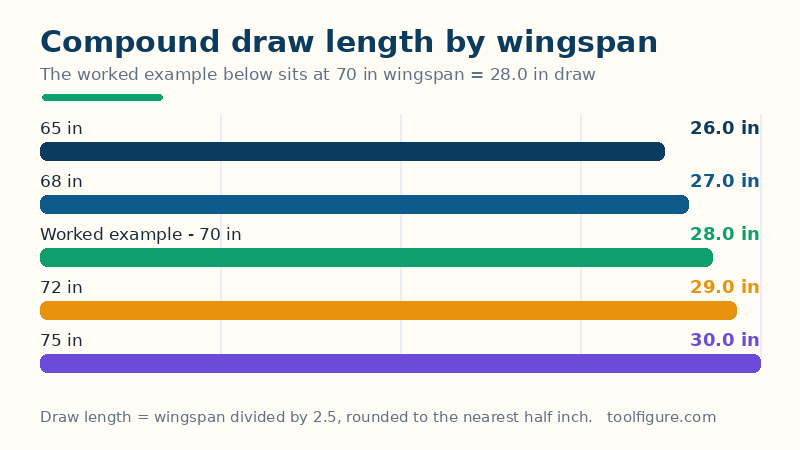
The calculation is one division with two honest adjustments, and the calculator shows each of them so the answer can be checked by hand. Step 1, convert to inches: wingspan in centimetres divided by 2.54 gives inches — the unit bows are set in. Step 2, divide by 2.5: draw length runs from the centre line to one side, and the standard starting rule divides the full fingertip-to-fingertip span by 2.5, not by 2. Step 3, round to the half inch: bows adjust in half-inch steps (a new module, or a stop position), so the raw figure is rounded to the nearest half inch, halves rounding up — a raw 27.2 becomes a 27.0 setting, a raw 28.8 becomes 29.0. Step 4, the bow-type adjustment: recurve and traditional archers add half an inch for the deeper anchor and back-tension position those styles use, while compound archers take the number as calculated. The table is:
| Wingspan | Raw (÷ 2.5) | Compound draw | Recurve draw | Recurve bow length |
|---|---|---|---|---|
| 65 in | 26.00 in | 26.0 in | 26.5 in | 66 in |
| 68 in | 27.20 in | 27.0 in | 27.5 in | 66 in |
| 70 in | 28.00 in | 28.0 in | 28.5 in | 68 in |
| 72 in | 28.80 in | 29.0 in | 29.5 in | 68 in |
| 75 in | 30.00 in | 30.0 in | 30.5 in | 70 in |
Recurve bow length follows the draw, not the archer's height or strength: under 26 in takes a 62 in bow, 26 to 28 in takes 66 in, over 28 to 30 in takes 68 in, and over 30 in takes 70 in. A bow too long wastes the limbs' working range; a bow too short sharpens the string angle enough to pinch the tab fingers at anchor. A compound bow's size question is different — its draw comes from the cam module, so the axle-to-axle length is a hunting-versus-target tradeoff, not a draw-length lookup, which is why the calculator gives compound archers a module setting instead of a bow length. The centimetre input agrees: 178 cm is 70.1 in, and 70.1 ÷ 2.5 = 28.03, which rounds to the same 28.0 in.
Worked example: 70 in wingspan, compound
Take an archer whose wingspan measures 70 in, shooting compound, 70 in tall. Step 1 is already in inches. Step 2: 70 ÷ 2.5 = 28.00 in. Step 3: already a half inch, so the setting stays 28.0 in (71.1 cm). Step 4 does not apply to a compound bow, so the module setting is 28.0 in, and the safe arrow length starts at 28.0–29.0 in — draw length to one inch over, marked at full draw before cutting. The same archer on a recurve draws 28.5 in after the half-inch adjustment, takes a 68 in bow, and starts arrows at 29.5–30.0 in. The height cross-check reads 70 ÷ 2.5 = 28.0 in here, agreeing exactly — but that agreement is luck, not a rule: measured wingspans run longer than height for most adults, which is why the height figure is printed as a comparison and never averaged in.
How to read your result, and its limits
Three checks before buying. First, measure the wingspan properly: stand square to a wall, arms straight out at shoulder height, palms flat, and have someone else take the tape fingertip to fingertip — a self-measurement with arms drooping or bent reads short, and every inch short of wingspan costs 0.4 in of draw. Second, start arrows long: cut nothing on the calculator's word — shoot a full-length shaft, mark it at full draw, and only then cut, because the arrow must clear the rest with room to spare at your real anchor. Third, confirm at full draw: the calculator cannot see your posture, your anchor, your release aid or the bow's geometry, and a draw that looks right on paper but collapses your back tension at anchor is the wrong draw whatever the arithmetic says. For the rest of the kit, the golf club length calculator sizes clubs from height and wrist-to-floor, the cricket bat size calculator sizes a bat from height, and the hockey stick length calculator sizes a stick from height with the chin-to-nose rule.
Frequently asked questions
What is my draw length if my wingspan is 70 inches?
28.0 inches on a compound bow (70 ÷ 2.5 = 28.00, already a half inch), and 28.5 inches on a recurve after the half-inch recurve adjustment, with a 68-inch bow. Enter your own wingspan and bow type above and the calculator shows your setting with its safe arrow length.
Why is draw length wingspan divided by 2.5?
Because draw length runs from the centre line to one side while wingspan runs fingertip to fingertip across the full span: the standard starting rule divides the full span by 2.5, not by 2. It is a starting estimate for buying a bow, not a measurement of the bow at full draw.
Why do recurve archers draw half an inch longer?
Because the recurve and traditional anchor sits deeper, with more back tension, than a compound anchor: the convention adds roughly half an inch for comfortable anchor and back tension, while compound archers take the wingspan figure as calculated.
Is height divided by 2.5 just as good?
No: height-based charts land a full inch or more short for many archers, because measured wingspans run longer than height for most adults. The calculator prints the height figure only as a cross-check — the wingspan figure rules, and the setting should still be confirmed at full draw in a shop.
