A chance is a count, stated four ways
Probability begins as bookkeeping: count the outcomes that count as success, count every outcome there is, and divide. Everything else on this page is translation — the same chance restated as a reduced fraction, a decimal, a percentage and odds, because different readers trust different dialects and errors hide when only one is shown. The second half of the tool handles the question one event cannot: when two independent events are in play, what are the chances that both happen, that at least one happens, that exactly one happens, or that neither does? Those four answers must cover every possibility between them, so the page prints their sum as a check row — it is 100% by construction, and seeing it close is how you know the split was done honestly. Where counting the outcomes themselves is the hard part — lottery combinations, poker hands — the combination calculator does that counting; this page starts once the counts are known.
The formulas, with every term defined
Probability of an event = Favourable outcomes ÷ Total equally likely outcomesProbability it does not happen = 1 − Probability it happensOdds in favour = Favourable outcomes : Unfavourable outcomes (then reduce by their greatest common divisor)Two independent events: Both = P(A) × P(B) · Neither = (1 − P(A)) × (1 − P(B)) · At least one = 1 − Neither · Exactly one = P(A)(1 − P(B)) + (1 − P(A))P(B)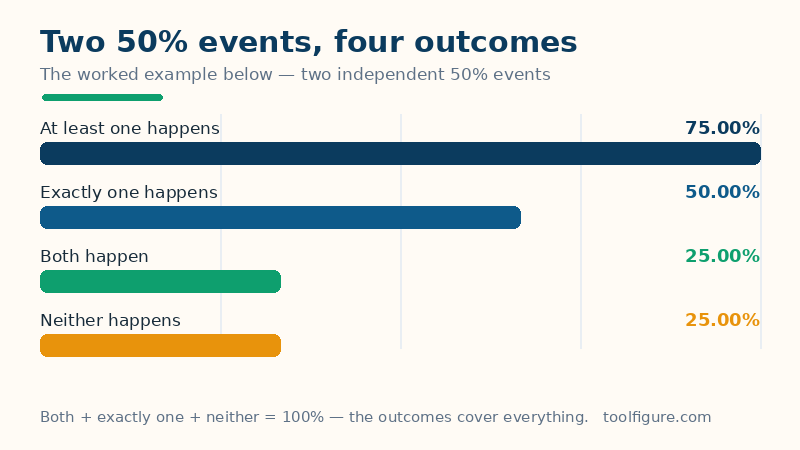
Favourable outcomes are the outcomes you are counting as the event happening — rolling a six is 1 favourable outcome on a die, drawing a red card is 26 in a deck. Total outcomes is every outcome the situation can produce, and the formula only works when they are equally likely: that assumption is true of fair dice, coins and shuffled decks, and false of weather, traffic and human choices, whose probabilities come from records and models rather than counting. Odds are not another probability — they compare success against failure directly, which is why a probability of 1/6 becomes odds in favour of 1 : 5, not 1 : 6; confusing the two is the most common error in this whole subject, and the table below keeps them side by side so the difference stays visible. Independent means one event's outcome leaves the other's probability untouched — two separate coin flips are independent, two cards drawn from the same deck without replacing the first are not.
Worked example: one die, and two 50% events
The defaults above enter the classic single event: rolling a six on one fair die — 1 favourable outcome out of 6. The probability is 1 ÷ 6 = 16.67%, the decimal 0.1667, and the fraction is already reduced at 1/6. The event fails in the other 5 outcomes, a probability of 83.33%, and 16.67 + 83.33 = 100 as they must. The odds in favour are 1 : 5 — one winning face against five losing faces — and the odds against are 5 : 1. Below it, the two-event defaults set both events to 50.00%, like two fair coin flips both landing heads-or-tails as specified: both happen 0.50 × 0.50 = 25.00% of the time, neither happens 25.00%, exactly one happens 50.00% (25.00% for A only and 25.00% for B only), and at least one happens 100 − 25 = 75.00%. The check row closes: 25.00 + 50.00 + 25.00 = 100.00%. The chart near the top draws that split.
Familiar chances, in every dialect
| Event | Fraction | Probability | Odds in favour |
|---|---|---|---|
| Rolling a six on one die — worked example | 1/6 | 16.67% | 1 : 5 |
| Drawing a red card from a full deck (26 of 52) | 1/2 | 50.00% | 1 : 1 |
| Drawing an ace from a full deck (4 of 52) | 1/13 | 7.69% | 1 : 12 |
| Rolling an even number on one die (3 of 6) | 1/2 | 50.00% | 1 : 1 |
| Drawing one named card from a full deck (1 of 52) | 1/52 | 1.92% | 1 : 51 |
Read the ace row slowly, because it teaches the odds lesson on its own: the probability is 4/52, which reduces to 1/13 or 7.69%, yet the odds in favour are 1 : 12 — 4 winning cards against 48 losing cards, reduced by 4. A probability divides by everything; odds divide success by failure, so the two numbers are close cousins and never twins (except at 50%, where 1/2 and 1 : 1 happen to meet). The two-event table behaves the same way at other settings: events at 10% and 20% give both 2.00%, at least one 28.00%, exactly one 26.00% and neither 72.00% — again summing to 100.00% — and events at 80% and 30% give both 24.00% and at least one 86.00%. Enter either pair above and the same rows return.
Reading a probability honestly — the limits
Four cautions belong with any figure from this page. Equally likely is an assumption, not a fact of nature. It holds for fair equipment and fails quietly for everything else — a loaded die still has 6 faces, but 1/6 is no longer its six-probability, and no counting calculator can detect the loading. Independence is the second assumption, and it fails in decks. Drawing two cards without replacement makes the second draw depend on the first; the standard fix is conditional probability, worked by hand from the changed deck — do not feed dependent events into the two-event rows and trust the product rule. A probability is a long-run share, not a promise about the next trial. A 16.67% event is expected about once in six tries on average, yet nothing is owed after five misses — the die has no memory, and the belief that a result is 'due' is the gambler's fallacy, named because it is reliably expensive. As a scale for that: the chance of at least one six in four rolls is 1 − (5/6)4 = 51.77% — better than even, and still far from certain. And small percentages deceive in both directions: 1.92% is rare per draw and routine over hundreds of draws, while 99% is not certainty when the trial repeats daily. The z-score calculator covers the neighbouring question — how unusual a measured value is inside a spread of data — where this page covers chances built from counts.
Frequently asked questions
What is the difference between probability and odds?
Probability divides favourable outcomes by all outcomes; odds divide favourable outcomes by unfavourable ones. Rolling a six: the probability is 1/6 = 16.67% (one success in six possible results), while the odds in favour are 1 : 5 (one success against five failures). They carry the same information in different shapes — probability = odds-for ÷ (odds-for + odds-against), so 1 : 5 converts back to 1 ÷ (1 + 5) = 1/6 — but quoting one as the other is a real error: bookmakers' 5 : 1 against is the 16.67% chance above, not a 1-in-5 chance, which would be 20%.
How do I work out the probability of two things both happening?
If the events are independent, multiply their probabilities: P(A and B) = P(A) × P(B). Two 50% events both happen 25.00% of the time, as the worked example shows; a 10% event and a 20% event both happen just 2.00% of the time. The multiplication is exactly why long chains of 'and' shrink so fast — five independent 50% steps all succeeding is 0.50^5 = 3.13%. The condition matters as much as the arithmetic: if one event changes the other's chances (cards drawn without replacement, weather on consecutive days), the simple product does not apply.
What does 'at least one' mean, and how is it calculated?
It means one happens, or the other does, or both do — every outcome except neither. The clean way to compute it is backwards: at least one = 1 − probability of neither, and neither for independent events is (1 − P(A)) × (1 − P(B)). For the worked example's two 50% events: neither is 0.50 × 0.50 = 25.00%, so at least one is 75.00%. Summing the forward pieces gives the same answer — both 25.00% plus exactly one 50.00% — and the page prints both routes so they can be checked against each other.
Can a probability be more than 100% or less than 0%?
No — a probability is a share of all outcomes, so it lives between 0% (the event happens in no outcome: favourable count 0) and 100% (it happens in every outcome: favourable count equal to the total) by definition. A calculation that returns 120% or −5% has a wrong count inside it — usually favourable outcomes larger than the total, or two probabilities added where overlap was double-counted. That is why this calculator refuses a favourable count above the total instead of printing a percentage above 100: the input, not the arithmetic, is where such numbers come from.
If something has not happened for a long time, is it due?
No — independent trials have no memory, and that is the gambler's fallacy. A fair die that has missed six for ten straight rolls still shows it with probability 1/6 = 16.67% on the next roll; the long run corrects itself not by compensation but by dilution, as thousands of later rolls swamp the early streak in the average. The same logic runs in reverse after a streak of successes. What does change with repetition is the chance of seeing the event at least once across the whole run — at least one six in four rolls is 51.77% — which this page's 'at least one' logic computes for two events and the same 1 − (failure chance)^trials pattern extends to more.