The deposit is a percentage; the bill is in cash
Home deposits are quoted in percentages — 3%, 10%, 20% — but they are paid in cash, and the distance between those two languages is where purchase plans go vague. This calculator translates: a price and a percentage become the exact cash needed, the loan that remains after it, and the loan-to-value ratio lenders actually judge the application by. It then faces the second question a percentage hides — how far away is that cash? — by setting what you have already saved against the target and dividing what is left by the months you have given yourself. It is the natural first step before the mortgage calculator: that page prices the loan, this page sizes it, and the savings goal calculator can then add interest to the saving plan itself.
The formulas, with every term defined
Down payment = Home price × Down payment percentage ÷ 100Loan amount = Home price − Down paymentLoan-to-value (LTV) = Loan amount ÷ Home price × 100Still to save = Down payment − Already saved (never below zero) · Monthly saving = Still to save ÷ Months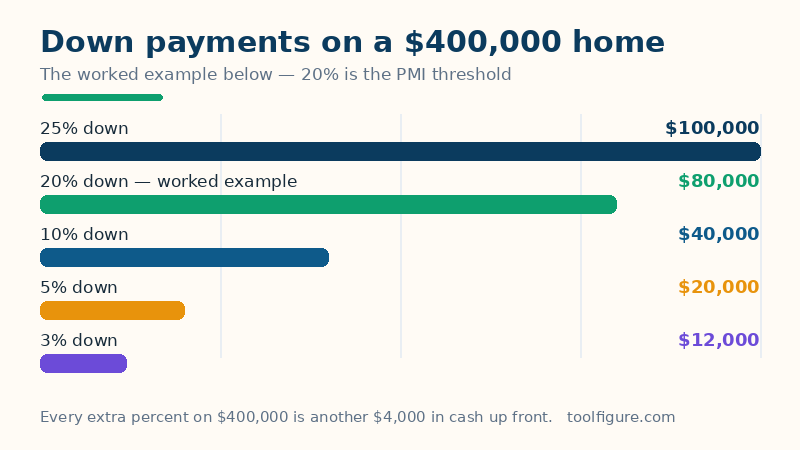
Every term is one of your inputs or one subtraction away from them. The home price is the agreed purchase price, not the loan. The down payment percentage is the share of that price paid from your own cash at purchase. The loan amount is simply the rest of the price — which is why the result always checks itself: down payment plus loan must equal the price exactly, and the page prints that sum so you can see it close. LTV restates the same split from the lender's side: an 80% LTV is the same fact as 20% down, read from the other end. The saving rows are plain division with one honest guard — if you have saved more than the deposit, the amount still to save is zero, never a negative number, and the surplus is reported as its own row instead.
Worked example: 20% down on a $400,000 home
The defaults above enter a price of $400,000, a down payment of 20%, $50,000 already saved and 24 months until the purchase. The down payment is 400,000 × 20 ÷ 100 = $80,000. The loan is 400,000 − 80,000 = $320,000, and the check closes: $80,000 + $320,000 = $400,000, the full price. The LTV is 320,000 ÷ 400,000 × 100 = 80.00% — exactly the threshold at which a conventional loan normally needs no private mortgage insurance. Against the target, $50,000 saved leaves $30,000 still to save, and $30,000 ÷ 24 months is $1,250.00 a month. That last figure is the one to judge the plan by: not whether 20% sounds right, but whether $1,250 a month is a saving rate your budget can actually hold for two years — and if it is not, the honest levers are a longer runway, a lower price, or a smaller percentage accepted with its PMI cost stated, not a target quietly assumed away.
What each percentage costs on the same home
| Down payment | Cash needed | Loan amount | LTV |
|---|---|---|---|
| 3% | $12,000.00 | $388,000.00 | 97.00% |
| 5% | $20,000.00 | $380,000.00 | 95.00% |
| 10% | $40,000.00 | $360,000.00 | 90.00% |
| 15% | $60,000.00 | $340,000.00 | 85.00% |
| 20% — worked example | $80,000.00 | $320,000.00 | 80.00% |
| 25% | $100,000.00 | $300,000.00 | 75.00% |
Two patterns are worth seeing in the table. First, the cash steps are even — every extra percentage point on a $400,000 home is another $4,000 — while the benefit is not: the step from 15% to 20% removes PMI entirely, which makes it worth more than the identical $20,000 step from 5% to 10%. Second, a smaller home changes the cash, not the logic: 10% down on a $250,000 home is $25,000 with a $225,000 loan, and 15% on a $350,000 home is $52,500 with a $297,500 loan — enter either above and the same rows return. The chart near the top draws the cash column, because the cash column is the plan.
Reading the result honestly — what a deposit is not
Four cautions belong with any figure from this page. The down payment is not the cash you need in total. Closing costs (commonly a few percent of the price), prepaid tax and insurance, and moving and furnishing costs all arrive in the same month; a plan that spends every saved dollar on the deposit leaves nothing for them, which is why lenders and advisers both treat an emergency reserve as separate money. 20% is a threshold, not a law. Many loans close at 3–10% down, especially for first-time buyers and under government-backed programmes; the trade is PMI and a larger loan, priced openly, against buying sooner — neither side of that trade is automatically right. A bigger deposit is not free either: every dollar into the deposit is a dollar out of your reserve, and it earns its return only as avoided interest and avoided PMI. And the monthly saving figure assumes no interest — it is the flat rate that reaches the target; saving into an interest-bearing account reaches it slightly sooner, which the savings goal calculator linked above models properly. Use this page to size the target and the gap; use the mortgage page to price what follows from it.
Frequently asked questions
How much should I put down on a house?
There is no single right percentage — there is a threshold and a trade. The threshold is 20%: at or above it, a conventional loan normally carries no private mortgage insurance, and the worked example's $80,000 on a $400,000 home sits exactly on it. Below it, loans are still widely available — 3%, 5% and 10% down are common — but you pay PMI and borrow more, so the monthly cost rises on both counts. The trade is against your reserve: a deposit that empties your savings leaves nothing for closing costs or emergencies. Put down the largest amount that still leaves a genuine reserve, and treat the 20% line as a priced option, not a rule.
What is loan-to-value ratio, and why do lenders care?
LTV is the loan as a percentage of the home's price (or appraised value, if that is lower): LTV = loan ÷ price × 100. A $320,000 loan on a $400,000 home is an 80.00% LTV — the mirror image of 20% down. Lenders care because LTV measures their cushion: the lower the LTV, the more of the home's value stands in front of their loan if prices fall or the loan defaults. That is why pricing, PMI and approval all step at LTV thresholds — 80% most famously, with smaller steps at 85, 90 and 95% on many products.
How much cash do I need beyond the down payment?
Plan for closing costs on top: lender fees, appraisal, title and recording charges, plus prepaid property tax and insurance, commonly totalling roughly 2–5% of the price — $8,000 to $20,000 on the worked example's $400,000 home — before moving and furnishing. The exact figure depends on the lender, the state and the loan type, and sellers sometimes credit part of it. This calculator deliberately sizes only the deposit, and says so on the page, so the two figures are never confused: get a closing-cost estimate from your lender and add it to the deposit target before judging whether you are ready.
Is it better to put 20% down or buy sooner with less down?
It depends on prices, rent and the PMI cost, and anyone who answers without those numbers is guessing. Buying sooner with 10% down on the worked example means $40,000 less cash, a $360,000 loan instead of $320,000, and PMI until the balance reaches 80% — but it also stops rent payments sooner and fixes the price earlier. Waiting for 20% avoids PMI and shrinks the loan, but at the example's $1,250 a month the extra $40,000 takes 32 more months to save, during which prices and rates can move either way. Run both deposits above, price both loans on the mortgage calculator, and compare totals — the arithmetic differs by household.
How long will it take to save a down payment?
Divide what is left by what you can save each month — or, as this page does, divide what is left by the months you have and read the monthly rate the deadline demands. In the worked example, $30,000 still to save over 24 months is $1,250.00 a month. Worked the other way: saving $1,000 a month toward that same $30,000 gap takes 30 months. Interest on the savings shortens both slightly; a pay rise or a lower target price shortens them a lot. If the monthly figure the deadline demands is not survivable, lengthen the deadline or lower the price — those are the only honest levers.