Why a cup of flour is not a cup of sugar
Every failed grams-to-cups conversion fails the same way: it treats the cup as a weight. A cup is a volume — 236.588 ml — and what that volume weighs depends on what fills it. A cup of rolled oats weighs 90 grams; a cup of honey weighs 340. Any single 'grams to cups' factor is therefore wrong for almost every ingredient, which is why this converter asks for the ingredient first and converts with that ingredient's stated weight per cup — the weights are printed here and shown beside every result, so the arithmetic can be checked rather than trusted. For pure unit-to-unit conversions with no ingredient involved — kilometres to miles, litres to gallons — the unit converter is the right page; this one exists for the kitchen, where the ingredient is the missing factor.
The method, with every factor defined
Cups = grams ÷ the ingredient's grams per cup · Grams = cups × grams per cup1 US cup = 16 tablespoons = 48 teaspoons = 236.588 ml · 1 ounce = 28.349523125 gramsGrams per cup used here: oats 90 · flour 120 · rice (uncooked) 185 · granulated sugar 200 · olive oil 216 · brown sugar (packed) 220 · butter 227 · milk 240 · water 240 · honey 340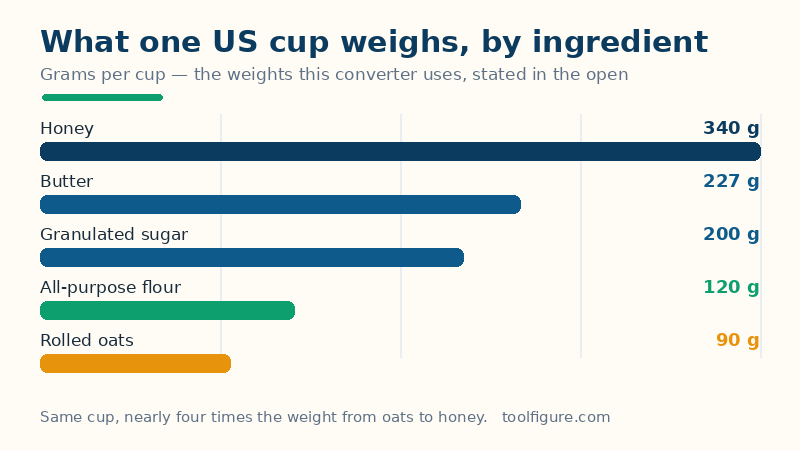
Read it in words: weight and volume meet only inside the ingredient. To turn grams into cups you divide by how many grams of that ingredient fill a cup; to go the other way you multiply. Spoons and millilitres are pure volume — a tablespoon is always a sixteenth of a cup, whatever fills it — so they convert through cups. Ounces are pure weight, converting through the exact ounce of 28.349523125 grams. Every figure on this page is one of those three moves, and the result table shows all six measures at once so the one your recipe uses is already there.
Worked example: 250 grams of flour, in every measure
The defaults above convert 250 grams of all-purpose flour at 120 g per cup. Cups: 250 ÷ 120 = 2.0833 cups. From there the volume measures follow by the cup's own divisions: tablespoons 2.0833 × 16 = 33.3333, teaspoons 2.0833 × 48 = 100.00 exactly — a useful check, since 250 g of flour filling exactly 100 level teaspoons is the kind of round landing that confirms the chain — and millilitres 2.0833 × 236.588 = 492.89 ml. In weight, ounces: 250 ÷ 28.349523125 = 8.8185 oz. The tablespoon reference beside the result completes the picture: one tablespoon of flour is 120 ÷ 16 = 7.5 g, the figure that makes small recipe adjustments — three extra tablespoons is 22.5 g — quick mental arithmetic.
Common amounts, converted
| Amount | Answer | How it is worked |
|---|---|---|
| 250 g all-purpose flour (worked example) | 2.0833 cups · 100.00 tsp · 8.8185 oz | 250 ÷ 120 g per cup |
| 2 cups butter | 454 g | 2 × 227 — a gram away from a pound (453.59 g) |
| 1 cup granulated sugar | 200 g · 1 tbsp = 12.5 g | The density itself, and 200 ÷ 16 |
| 100 g honey | 0.2941 cups · 4.7059 tbsp | 100 ÷ 340, then × 16 |
| 3 tablespoons flour | 22.5 g | 3 × 7.5 g per tablespoon |
| 500 g uncooked rice | 2.7027 cups | 500 ÷ 185 |
| 250 ml milk | 253.61 g · 1.0567 cups | 250 ÷ 236.588 ml per cup, then × 240 g |
The butter row explains a recipe mystery: American recipes say '2 cups of butter' and European ones say 'about 450 g' because both are describing the same two 227 g cups — a pound of butter, give or take a gram. The milk row shows the opposite near-miss: 250 ml of milk weighs 253.61 g, not 250 g, because milk is slightly denser than the volume it fills suggests at this page's 240 g per cup.
How to read your result — and the limits
The honest limit of every cooking converter, this one included, is the ingredient itself. Flour varies most: spooned-and-levelled flour is about 120 g a cup, but flour scooped hard from the bag can pack 140 g or more into the same cup — a swing no converter can see, and the reason serious baking recipes give grams. Brown sugar depends on packing (this page's 220 g is the packed standard recipes assume), butter's 227 g cup assumes it is measured as recipes do, in sticks or melted volume, and spoon measures are level spoons — a heaped tablespoon of flour can weigh half as much again. Treat conversions as accurate to the nearest few percent, weigh with a scale when a recipe is fussy (laminated doughs, macarons, bread), and use this page for what it is best at: translating a recipe written in the other system's language into yours, quickly, with the working visible.
Frequently asked questions
How many cups is 250 grams of flour?
2.0833 cups. All-purpose flour weighs 120 grams per US cup on this page, so 250 ÷ 120 = 2.0833 cups — also 33.3333 tablespoons, exactly 100 level teaspoons, and 8.8185 ounces. The same 250 grams of a different ingredient is a different answer: 250 g of granulated sugar is 1.25 cups, and of honey only 0.7353 cups.
Why does every ingredient convert differently?
Because a cup measures volume and a gram measures weight, and ingredients pack different weights into the same volume. A cup of rolled oats weighs 90 g; a cup of honey weighs 340 g — nearly four times as much. Any converter offering one universal grams-to-cups factor is silently assuming an ingredient, usually flour, and will be wrong for everything else.
Is a cup the same everywhere?
No. This page uses the US cup of 236.588 ml. A UK recipe's cup, where one appears, is usually the same US measure in modern books, but an Australian tablespoon is 20 ml, not the US 14.79 ml — four teaspoons, not three. When a recipe's origin is Australian, its tablespoons are the figure to double-check.
How accurate are these conversions?
To within a few percent for ordinary cooking — the limit is the ingredient, not the arithmetic. Flour is the least predictable: how it is scooped can move a cup from 120 g towards 140 g. For everyday cakes, sauces and doughs the figures here land close enough; for precision baking, weigh the ingredient and use the recipe's grams directly.
How do I convert tablespoons of an ingredient to grams?
Multiply the tablespoons by the ingredient's grams per tablespoon — grams per cup divided by 16. For flour that is 7.5 g per tablespoon, so 3 tablespoons is 22.5 g; for granulated sugar it is 12.5 g, so 3 tablespoons is 37.5 g. The converter shows the per-tablespoon weight of whichever ingredient you pick beside every result.
