The room is never the amount you order — cuts see to that
Flooring is bought by the box and laid by the cut, and those two facts are the whole calculation. A room's area is only the starting point: every row of planks ends in a cut, some offcuts are too short to start the next row, a few boards in every job are warped, chipped or simply the wrong shade, and the last row is almost never a full board's width. Manufacturers and fitters fold all of that into a waste allowance — and then the total is rounded up again, because shops sell whole boxes. This calculator does both steps in the open: area, plus the allowance for your pattern, divided by the coverage printed on the box. If the room is not a rectangle, get its area first with the square footage calculator and enter the two dimensions that give the same area.
The formulas, with every term defined
Room area = length × width · Amount to cover = area × (1 + waste % ÷ 100)Boxes = amount to cover ÷ coverage per box, rounded UP · Coverage bought = boxes × coverage per box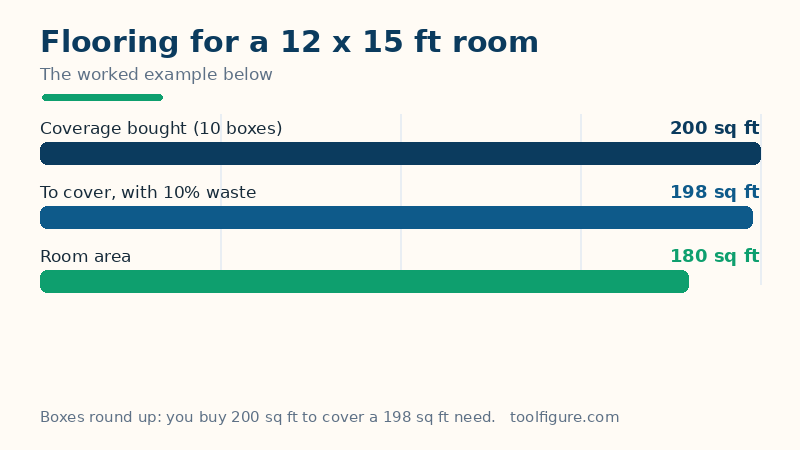
The waste percentage is the only judgement call in the page, so it deserves its numbers. For straight planks or boards in a rectangular room, 10% is the figure the trade works to: the end cuts of staggered rows mostly get reused as starters, and what is left covers the rejects. A diagonal layout cuts both ends of nearly every row at an angle and reuses far less — 15%. Herringbone and other patterns cut constantly and match grain or pattern as they go — 15% is the floor, 20% the safer figure, exactly as the tile calculator treats patterned tiling. Rooms with alcoves, chimney breasts, bay windows or several doorways waste more than open rectangles at any pattern, because every obstacle is a ring of cuts; add a few points rather than discovering it on the last wall.
Worked example: a 12 × 15 ft room, boxes of 20 sq ft
The defaults above give: room area 12 × 15 = 180 sq ft. The 10% waste allowance adds 18 sq ft, so the amount to cover is 198 sq ft. In boxes of 20 sq ft: 198 ÷ 20 = 9.9, rounded up to 10 boxes — 200 sq ft bought, 2 sq ft over the need. At $55 a box the shelf total is 10 × $55 = $550, which is $2.75 per sq ft bought. The bar chart above draws the three quantities: the room, the amount to cover, and what ten boxes actually contain. Note what the rounding did: the box step, not the waste step, supplied the last 2 sq ft — on small rooms that effect grows teeth, as the bathroom row below shows.
Other rooms, counted the same way
| Room | Area | To cover | Boxes | Bought | Cost |
|---|---|---|---|---|---|
| Room 12 × 15 ft, straight, +10% (worked example) | 180 sq ft | 198 sq ft | 10 | 200 sq ft | $550 |
| Bedroom 10 × 12 ft, straight, +10% | 120 sq ft | 132 sq ft | 7 | 140 sq ft | $385 |
| Living room 15 × 20 ft, straight, +10% | 300 sq ft | 330 sq ft | 17 | 340 sq ft | $935 |
| Same 12 × 15 ft room, diagonal, +15% | 180 sq ft | 207 sq ft | 11 | 220 sq ft | $605 |
| Bathroom 5 × 8 ft, straight, +10% | 40 sq ft | 44 sq ft | 3 | 60 sq ft | $165 |
| Metric room 4 × 5 m, boxes of 2 m², +10% | 20.00 m² | 22.00 m² | 11 | 22.00 m² | $605 |
The bathroom is the honest small print of every flooring job: it needs 44 sq ft and must buy 60, a third again, because three boxes is the smallest purchase that covers it. That leftover is not waste in any useful sense — it is the spare stock that lets a damaged board be swapped in five years without hunting a discontinued line — but on a quote it is real money, and on very small rooms it is worth pricing a product whose box coverage divides the room more kindly. The diagonal row makes the pattern point in cash: the same room, laid at 45 degrees, costs one more box — $55 — purely in extra cuts.
How to read your result, and the limits — read these
Buy every box in one order from one batch. Flooring shades vary between production runs the way tile dye lots do, and a top-up box bought later can sit visibly lighter or darker in the middle of the floor; the spare coverage this calculation leaves you is only a true spare if it matches. The count covers the flooring itself: underlay, vapour barrier, beading or scotia, thresholds and the adhesive or underlayment a particular product needs are separate lines, and carpet is a different purchase again — it is sold by the roll width and cut to the room, so this box arithmetic does not apply to it. Measure the room at its widest points and check both diagonals if it should be square; old rooms rarely are, and a room that is 15 ft at one end and 14 ft 8 in at the other is planned from the larger figure and trimmed, never the reverse. Finally, let the boxes acclimatise in the room for the time the manufacturer states before laying — boards that expand or shrink after fitting open gaps no quantity of spare material will hide. Walls first or floor first? If the room is also being decorated, the paint calculator works out the walls of the same room.
Frequently asked questions
How much flooring do I need for a 180 square foot room?
With the standard 10% waste allowance for straight planks: 180 × 1.10 = 198 sq ft to cover. In boxes of 20 sq ft that is 198 ÷ 20 = 9.9, rounded up to 10 boxes — 200 sq ft bought, at $55 a box a $550 order. Ordering the bare 180 sq ft (9 boxes) is the classic shortfall: the end cuts and rejects of the last rows are exactly what the allowance exists to pay for.
How much waste should I allow for flooring?
Ten percent for straight planks or boards in a rectangular room — the default above and the trade's standard figure. Fifteen percent for a diagonal layout, because nearly every row is cut at both ends and the offcuts rarely fit anywhere; 15–20% for herringbone and patterned work; and a few extra points on any room with alcoves, bays or several doorways, where the obstacle cuts multiply. When in doubt, round the allowance up: one box too many is a spare, one too few is a stalled floor.
Why does the number of boxes matter more than the square footage?
Because flooring is sold in whole boxes, the purchase jumps in box-sized steps: a room needing 198 sq ft buys 200, but a room needing 201 sq ft buys 220 — one extra square foot of need costs a whole box. Small rooms feel this most: the 40 sq ft bathroom in the table above must buy 60 sq ft. Choosing a product whose box coverage divides your room's need more evenly is a legitimate way to cut the real cost of a small job.
Does the calculation change for laminate, vinyl plank and hardwood?
The arithmetic is identical — area, allowance, box coverage — because all three are sold by the box with the coverage printed on it. What changes is the allowance you should choose: rigid vinyl plank cuts cleanly and wastes least, laminate is close behind, and solid hardwood wastes most, because individual boards get rejected for knots, colour and warp as well as cut. Keep 10% for vinyl and laminate laid straight; lean toward 12–15% for solid wood even in a simple room.
Should I buy extra flooring for future repairs?
The spare coverage the box rounding leaves you — 2 sq ft on the worked example, a generous 16 sq ft on the bathroom — is already a small repair stock, provided it comes from the same batch as the floor, which a single order guarantees. For a large or heavily used floor, adding one deliberate extra box is cheap insurance: product lines are discontinued constantly, and a perfect colour match five years later is usually unobtainable at any price.