The pour you cannot pause
Concrete is the one DIY material that punishes a shortfall in real time. Run out of paint and you drive to the shop; run out of concrete with half a slab placed and you get a cold joint, a weak line across the pour, and a truck's minimum-charge delivered in a panic. So this calculator does the job in the order a pour actually needs it: exact geometric volume first, then the waste allowance added openly, then that volume translated into the two ways concrete is actually bought — premix bags for small work and cubic yards (or metres) of ready-mix for everything bigger.
The formulas, with every term defined
Rectangular volume = length × width × thicknessRound volume = π × (diameter ÷ 2)² × heightCubic yards = cubic feet ÷ 27 · Cubic metres = cubic feet ÷ 35.3147Order volume = exact volume × (1 + waste % ÷ 100) · Bags needed = order volume (ft³) ÷ yield per bag, rounded UP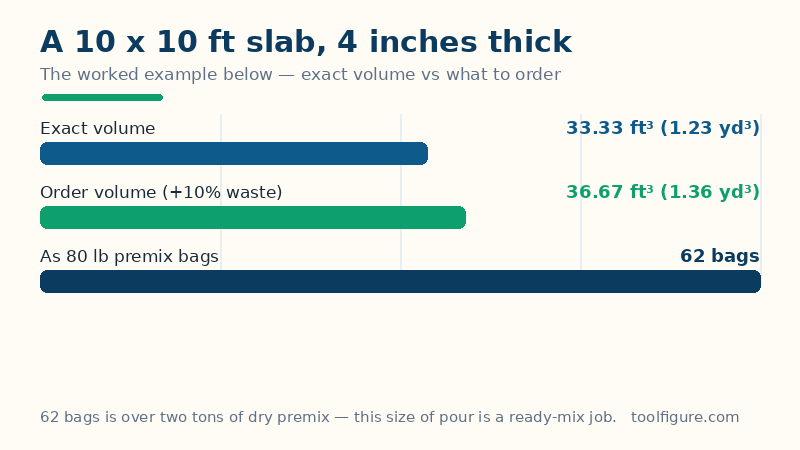
Two unit facts carry the whole calculation, and both are exact definitions rather than rules of thumb: there are 27 cubic feet in a cubic yard (3 ft × 3 ft × 3 ft) and 35.3147 cubic feet in a cubic metre. The bag yields are the manufacturers' own printed figures for standard premix: an 80 lb bag yields 0.60 ft³, a 60 lb bag 0.45 ft³ and a 40 lb bag 0.30 ft³ of placed concrete. Bag counts are always rounded up — 61.1 bags is 62 bags at the shop, and the leftover half-bag is cheap insurance next to a stopped pour. The waste allowance is yours to set: 10% is the standard default for a formed slab, because subgrade is never perfectly level and some concrete stays in the wheelbarrow, the pump line and the spillage pile.
Worked example: a 10 × 10 ft slab, 4 inches thick
The defaults above give: 10 × 10 × (4 ÷ 12) = 33.33 cubic feet exactly, which is 33.33 ÷ 27 = 1.23 cubic yards (0.94 cubic metres). Add the 10% allowance and the order volume is 36.67 ft³ = 1.36 cubic yards. In bags, that is 36.67 ÷ 0.60 = 61.1, so 62 × 80 lb bags (or 82 × 60 lb, or 123 × 40 lb) — which is exactly why a slab this size is normally a ready-mix job: 62 bags is over two tons of dry premix to move, mix and place before it starts to set. At $150 per cubic yard, the ready-mix itself costs 1.36 × 150 = $203.70 — before any delivery or short-load fee, which the limits section below is honest about. The bar chart above draws the three numbers that matter: exact volume, order volume, and the bag reality-check.
The same arithmetic on other common pours
| Pour | Exact volume | With 10% waste | 80 lb bags |
|---|---|---|---|
| Footing 20 ft × 1 ft × 8 in deep | 0.49 yd³ | 0.54 yd³ | 25 |
| Round column, 12 in across × 8 ft high | 0.23 yd³ | 0.26 yd³ | 12 |
| Slab 10 × 10 ft × 4 in (worked example) | 1.23 yd³ | 1.36 yd³ | 62 |
| Patio slab 12 × 8 ft × 4 in | 1.19 yd³ | 1.30 yd³ | 59 |
| Driveway slab 20 × 20 ft × 4 in | 4.94 yd³ | 5.43 yd³ | 245 |
| Metric slab 3 × 3 m × 100 mm | 0.90 m³ (1.18 yd³) | 0.99 m³ (1.29 yd³) | 59 |
Read the bag column as a decision line, not just a shopping list. A single post hole at 12 bags is a comfortable morning with a rented mixer. Anything past about 1 cubic yard — 46 bags of 80 lb before waste — crosses into ready-mix territory for most people: the truck costs more per yard than bags do, but it places in twenty minutes what bag-mixing spreads over a long day, and the concrete is one consistent mix rather than thirty batches. When the pour after this one needs finishing quantities, the paint calculator works the same way — measured area, an honest allowance, and the round-up shown.
How to read your result, and the limits — read these
The calculator assumes your forms are exactly the size you entered and perfectly level. Real ground is not: a slab formed at 4 inches over soil that dips an extra inch in the middle takes roughly 25% more concrete across that dip, which is what the waste allowance is really for — grading the base flat and compacting it earns back more concrete than any adjustment here. Thickness is the input to measure most carefully, because volume scales directly with it: at 5 inches instead of 4, the worked example jumps from 1.23 to 1.54 cubic yards before waste. Ready-mix is also sold in increments (often quarter or half yards) with delivery and short-load fees on small orders, so the cost line here covers the concrete itself at your price per yard — ring the plant for the delivered figure. This page works out quantity only: the mix strength, reinforcement, frost depth and permits a slab, footing or column legally needs are set by your local code and your structure, not by a volume formula.
Frequently asked questions
How much concrete do I need for a 10×10 slab?
At the standard 4-inch thickness: 10 × 10 × (4÷12) = 33.33 cubic feet = 1.23 cubic yards exactly, and 1.36 cubic yards once the usual 10% waste allowance is added. As bagged premix that is 62 × 80 lb bags, which is why slabs this size are usually ordered as ready-mix instead.
How many 80 lb bags of concrete are in a cubic yard?
One cubic yard is 27 cubic feet, and an 80 lb bag yields 0.60 cubic feet, so 27 ÷ 0.60 = 45 bags exactly fill a cubic yard — before any waste allowance. With 10% added, order about 50 bags per yard. The equivalents are 60 bags of 60 lb (0.45 ft³ each) and 90 bags of 40 lb (0.30 ft³ each) per exact yard.
How much extra concrete should I order for waste?
Ten percent is the standard allowance for a formed pour on a level, compacted base, and it is the default above. Drop to 5% for small, precisely formed work in rigid forms; go to 15% or more over rough, ungraded ground, where low spots silently add thickness — and extra thickness is volume nobody measured. Ordering a little too much is a wheelbarrow problem; ordering too little is a structural one.
How do I work out concrete for a round post hole or column?
Use the round mode: volume = π × (diameter ÷ 2)² × depth. A 12-inch diameter hole 8 feet deep is π × 0.5² × 8 = 6.28 cubic feet = 0.23 cubic yards, or 12 × 80 lb bags with 10% waste. If the hole bells out at the bottom or the tube sits above ground, measure the shape you actually have — flared footings hold noticeably more than the neat cylinder.
Is it cheaper to use bags or ready-mix?
Per cubic yard of material, bags usually win; per finished pour, ready-mix usually wins past about 1 cubic yard. The worked example's 62 bags weigh over 4,900 lb dry and must all be mixed and placed within the concrete's working time, while the truck delivers the same 1.36 yards as one consistent mix. Below roughly half a yard — footings, post holes, small repairs — bags are simpler and need no delivery fee or minimum order.