Four formulas, four answers — and why the range matters more
“Ideal weight” formulas are older than the BMI bands that replaced them in most clinics. Each one takes a base weight for a person exactly 5 feet tall and adds a fixed amount for every inch above that height; each author fitted those two numbers to a different group of people, so the formulas disagree — honestly and visibly. This calculator runs all four of the widely cited versions (Hamwi 1964, Devine 1974, Robinson 1983 and Miller 1983) for your height, averages them, and then does the most important thing any of them can do: it sets the answers against the BMI healthy range for the same height, which is nearly twenty kilograms wide. The formulas pick a point; the range describes the territory. Treat the point as a reference, never as a target your body owes you. This page is general educational information, not medical advice.
The formulas, with every term defined
Each formula: ideal weight (kg) = base weight at 5 ft + rate × inches over 5 ft (the rate subtracts for heights under 5 ft)Devine (1974): men 50 kg + 2.3 kg/inch · women 45.5 kg + 2.3 kg/inchRobinson (1983): men 52 kg + 1.9 kg/inch · women 49 kg + 1.7 kg/inchMiller (1983): men 56.2 kg + 1.41 kg/inch · women 53.1 kg + 1.36 kg/inchHamwi (1964): men 48 kg + 2.7 kg/inch · women 45.5 kg + 2.2 kg/inchBMI healthy range for comparison: from 18.5 × height (m)² to 24.9 × height (m)²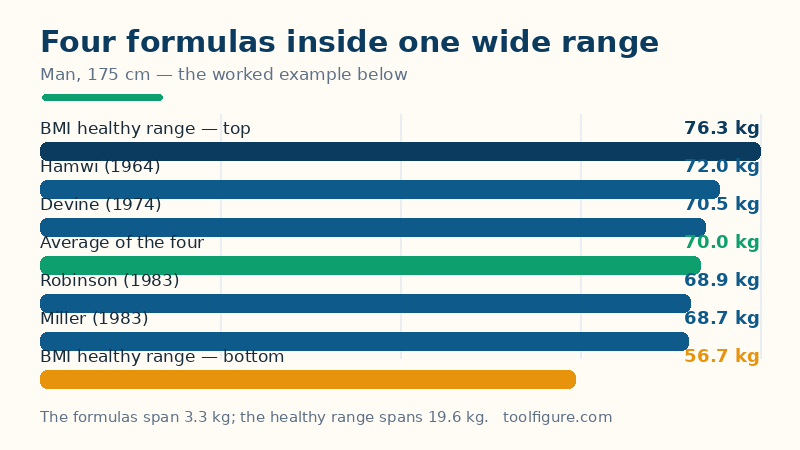
Read the rates and the disagreement explains itself. Hamwi adds weight fastest with height (2.7 kg an inch for men) and Miller slowest (1.41 kg), so the two formulas nearly agree around average heights and drift apart at the extremes — at 190 cm they are almost 11 kg apart, as the table below shows. Devine is the version most often used in medical settings, mainly for drug-dose calculations, because it was published for that purpose; that history makes it familiar, not truer. None of the four knows anything about your frame, muscle, age or health — height and sex are the only inputs, which is exactly their limitation.
Worked example: a man of 175 cm
The defaults above give: 175 cm is 68.90 inches, which is 8.90 inches over 5 feet. Devine: 50 + 2.3 × 8.90 = 70.5 kg. Robinson: 52 + 1.9 × 8.90 = 68.9 kg. Miller: 56.2 + 1.41 × 8.90 = 68.7 kg. Hamwi: 48 + 2.7 × 8.90 = 72.0 kg. The average of the four is 70.0 kg, and the formulas span just 3.3 kg. Now the comparison that puts them in their place: the BMI healthy range for 175 cm runs from 56.7 kg to 76.3 kg — a span of 19.6 kg, six times wider than the disagreement between the formulas. A woman's cross-check at 165 cm (4.96 inches over 5 feet): Devine 56.9 kg, Robinson 57.4 kg, Miller 59.8 kg, Hamwi 56.4 kg — average 57.7 kg, inside a BMI healthy range of 50.4 to 67.8 kg. Measured in imperial, the same man at 69 inches gets 70.7 / 69.1 / 68.9 / 72.3 kg, averaging 70.2 kg — the small shift is rounding between unit systems, not a different answer.
The average and the range, height by height (men)
| Height | Average of the four formulas | BMI healthy range |
|---|---|---|
| 160 cm | 57.8 kg | 47.4–63.7 kg |
| 170 cm | 65.9 kg | 53.5–72.0 kg |
| 175 cm | 70.0 kg | 56.7–76.3 kg |
| 180 cm | 74.1 kg | 59.9–80.7 kg |
| 190 cm | 82.3 kg | 66.8–89.9 kg |
Two patterns are worth seeing. The formula average always lands comfortably inside the BMI range — the formulas were built to describe the middle of it. And the ranges widen with height: being 10 kg from the formula average means something quite different at 160 cm, where the whole healthy range is 16 kg wide, than at 190 cm, where it is 23 kg wide. If you want the screening figure most clinicians start from, the BMI calculator places your actual weight on these same bands; the body fat calculator answers the different question of what that weight is made of.
How to read your result, and the limits — read these
Use the four-formula average the way you would use any average of expert guesses: as the centre of a plausible zone, with the BMI range as the outer fence. Being a few kilograms from the average is unremarkable — the formulas themselves disagree by that much at tall heights, and they cannot see the things that legitimately move a healthy weight: a broad frame, serious muscle (which is dense and heavy), age, pregnancy, or a medical condition. They were also fitted on mid-twentieth-century populations and are not validated for children or adolescents, whose healthy weight is assessed completely differently. What the formulas are genuinely useful for is orientation — a first figure to discuss, and a reminder that “ideal” in their name is a statistical label from 1964–1983, not a judgement about your body. If weight is a health question for you, the honest route is a clinician who can measure, take your history and talk about the whole picture; the calorie and BMR calculators on this site can then help with the arithmetic of any plan you agree together.
Frequently asked questions
Which ideal weight formula is the most accurate?
None of them measures you — each is a statistical line fitted to a group of people decades ago. Devine (1974) is the most widely used, largely because it was published for drug dosing and became standard in medical references; Robinson and Miller (both 1983) were attempts to correct it against newer data, and Hamwi (1964) is the oldest. On the worked example they span 68.7 to 72.0 kg for the same height, which is why this page shows all four and their average instead of picking a winner.
What is the ideal weight for my height?
As a worked reference: for a man of 175 cm the four formulas average 70.0 kg, and for a woman of 165 cm they average 57.7 kg. But the more honest answer is a range — the BMI healthy range for those heights is 56.7–76.3 kg and 50.4–67.8 kg respectively. Healthy bodies of the same height legitimately differ by frame and muscle, so read the formula figure as the middle of the range, not a pass mark.
Why do the formulas disagree more for tall people?
Because they add weight at different rates per inch of height — from 1.41 kg an inch (Miller, men) to 2.7 kg an inch (Hamwi, men). Near 5 feet the base weights dominate and the answers cluster; every inch further from 5 feet multiplies the rate difference. At 170 cm the spread is only about 1.5 kg; at 190 cm it reaches about 10.9 kg. The taller or shorter you are, the less any single formula deserves your trust.
Is ideal weight the same as a healthy weight?
No. 'Ideal body weight' is the historical name of these height formulas — a statistical construct originally built for insurance tables and drug dosing. A healthy weight is a clinical judgement that includes your BMI range, body composition, blood markers, fitness and history. Someone muscular can sit well above their formula figure in excellent health; someone at exactly the formula figure can still have health risks it cannot see. The formulas answer 'what did people of this height typically weigh in these studies?', nothing more.
Should I try to reach the exact figure this calculator gives?
No — and the page is built so you do not have to. The average of four disagreeing formulas is a reference point inside a healthy range that is roughly 20 kg wide; aiming for the decimal would be chasing rounding error. If you and a clinician decide your weight should change, the range — and how you feel, function and measure on real health markers — is the sensible guide, with the calorie calculator's gradual targets (±250–500 kcal a day) as the usual pace.