Why a card balance costs so much more than you charged
A credit card does not charge interest once — it charges it every month, on whatever balance is still standing, including interest added in earlier months. That is why two people with the same $5,000 balance can pay wildly different amounts to clear it: the balance is identical, but the monthly payment decides how long the interest meter runs. Pay close to the minimum and most of your early payments are swallowed by interest while the balance barely moves; pay a fixed, larger amount and the balance falls faster every month, so each month's interest charge shrinks with it. This calculator simulates your card month by month — interest added, payment taken off, repeat — and reports the three numbers a card statement never puts in one place: how many months until you are debt-free, how much interest you will pay in total, and what the balance truly costs. It also shows, on your own figures, what an extra $50 or $100 a month buys you, and the fixed payment that would clear the card in 12, 24 or 36 months.
How the payoff is calculated
Each month: interest = balance x (APR / 100 / 12), then balance = balance + interest − paymentPayment needed to clear a balance in n months: PMT = r x B / (1 − (1 + r)−n)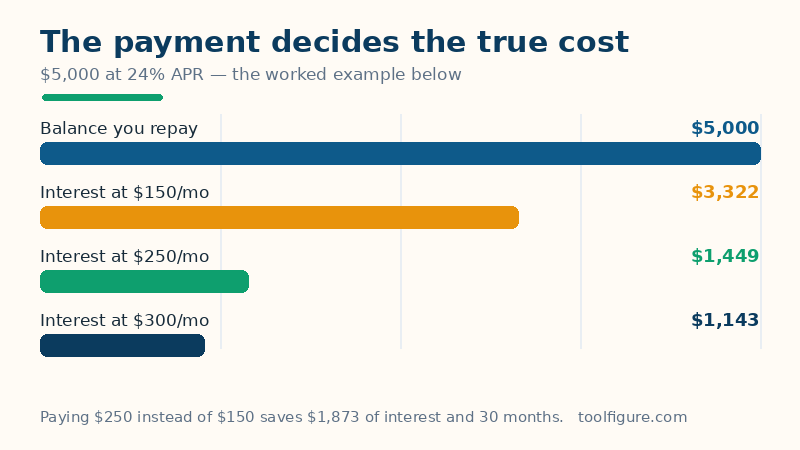
B is your current balance, APR is the card's annual percentage rate, r is that rate divided by 12 as a decimal, and the payment is the fixed amount you pay every month — the final month pays only whatever is left, which is why the last payment is usually smaller. The simulation matters more than any single formula here, because a card's minimum payment is typically a small percentage of the balance and shrinks as the balance falls, stretching the payoff over years. This page deliberately models a fixed payment instead: the single most effective change most cardholders can make is to freeze today's minimum as a fixed amount and never let it drift down. For several debts at once — cards, loans, a car — our debt payoff calculator compares the snowball and avalanche orders across all of them; this page is the deep dive on one card.
Worked example: $5,000 at 24% APR
You owe $5,000 at 24% APR — a monthly rate of 2%, so the first month alone adds $100 of interest. Pay a fixed $250 a month and the card is clear in 26 months: you pay $1,449.36 of interest, $6,449.36 in total, and the final payment is $199.36. Now hold the balance and rate still and move only the payment, because this comparison is the whole point of the page:
| Fixed monthly payment | Debt-free in | Total interest | Total cost |
|---|---|---|---|
| $150 | 56 months | $3,322.09 | $8,322.09 |
| $200 | 36 months | $2,000.56 | $7,000.56 |
| $250 | 26 months | $1,449.36 | $6,449.36 |
| $300 | 21 months | $1,143.34 | $6,143.34 |
Read the first and third rows together: paying $250 instead of $150 — $100 more a month — saves $1,872.73 of interest and finishes 30 months sooner. Prefer a deadline to a payment? The formula above gives the fixed payment that clears this same balance on a schedule: $472.80 a month clears it in 12 months, $264.36 in 24 months and $196.16 in 36 months. Notice how the required payment falls more slowly than the deadline lengthens — doubling the term from 12 to 24 months does not halve the payment, because the extra year of interest has to be paid too.
The minimum-payment trap, in plain terms
Card minimums are commonly set around 1–3% of the balance or a small fixed floor. On a $5,000 balance at 24% APR, a 3% minimum starts at $150 — the slow lane in the table above — and then it falls as the balance falls, so a minimum-only strategy takes even longer than the fixed-$150 row suggests and costs more interest. Two rules keep you out of the trap. First, any payment at or below the month's interest makes the balance grow: at 24% APR, $100 a month on $5,000 covers exactly the first month's interest and nothing else, which is why this calculator refuses to project a payment that does not beat the interest. Second, stop adding to the card while you clear it — new spending at 24% APR undoes the payment maths faster than any realistic extra payment can fix. Check the payment against what you actually take home with the paycheck calculator, and once the card is clear, the same fixed payment redirected into savings is exactly the habit the savings goal calculator is built around.
What this calculator assumes
One fixed APR for the whole payoff, one fixed payment made every month, no new purchases, no annual fees, no late fees and no penalty APR. Real cards break all of those in both directions: a 0% balance-transfer window can cut the interest to near zero (while adding a transfer fee this page does not model), and a single missed payment can trigger a penalty rate far above the one you entered. Treat the result as the honest cost of the plan you described — and if your real card's rate is about to change, run the number again at the new rate before you commit to a payment.
Frequently asked questions
How long will it take to pay off my credit card?
It depends almost entirely on the fixed amount you pay each month. On a $5,000 balance at 24% APR, $150 a month takes 56 months, $250 takes 26 months and $300 takes 21 months. Enter your own balance, APR and payment above for your exact month count and interest total.
Why does my payment need to be above the monthly interest?
Because interest is added before your payment is taken off. At 24% APR a $5,000 balance gains $100 of interest in the first month, so a $100 payment leaves the balance exactly where it started, and anything less makes it grow. The calculator warns you when a payment does not cover the first month's interest.
How much should I pay to be debt-free in 12 months?
Use PMT = r x B / (1 − (1 + r)^−n) with r as the monthly rate and n as the months. For $5,000 at 24% APR that is $472.80 a month for 12 months, $264.36 for 24 months or $196.16 for 36 months. The calculator prints all three figures for your own balance under the results table.
Is paying the minimum ever a good idea?
Only as a short-term bridge to protect your credit record while money is tight. Minimums are designed to fall as the balance falls, which stretches a $5,000 balance at 24% APR well beyond the 56 months a fixed $150 payment needs — and costs even more interest. Fixing the payment at today's minimum amount, and never letting it drop, is the simplest upgrade.
Does this calculator work for a 0% APR card?
Yes — enter 0% and the maths reduces to balance divided by payment, with zero interest. At 0%, $5,000 at $250 a month clears in exactly 20 months. Just remember a real 0% offer usually has an expiry date and sometimes a transfer fee, neither of which is modelled here.