A car payment is not the price of the car
Dealers quote a monthly payment because it sounds small. This calculator works the other way round: it starts from the full price of the vehicle and adds everything that quietly joins it — sales tax, title and dealer fees, and the interest charged over the whole loan — then subtracts what you put in up front as a down payment and a trade-in. What remains is the amount you actually finance, and the monthly payment that follows from it. The number worth remembering is at the bottom of the results table: the true total cost. On a typical five-year loan it is thousands of dollars above the sticker price, and knowing it before you negotiate changes what you negotiate about — the price of the car, not just the size of the payment.
The auto loan formula
Sales tax = (price − trade-in) × tax rateAmount financed = price + tax + fees − down payment − trade-inMonthly payment = F × r(1 + r)n ÷ ((1 + r)n − 1)F is the amount financed, r is the monthly rate (APR ÷ 100 ÷ 12) and n is the number of monthly payments. It is the same amortisation formula behind our general loan calculator; what makes an auto loan different is everything that happens before the formula — the tax, fees and trade-in that decide how big F really is. One warning about the tax line: many US states tax the price minus the trade-in value, as this calculator does, but some tax the full price, and rules differ by country and state. If your state taxes the full price, set the trade-in's tax effect aside by entering your own tax amount as a fee instead, and treat the result as the planning estimate it is.
Worked example: a $32,000 car over 5 years
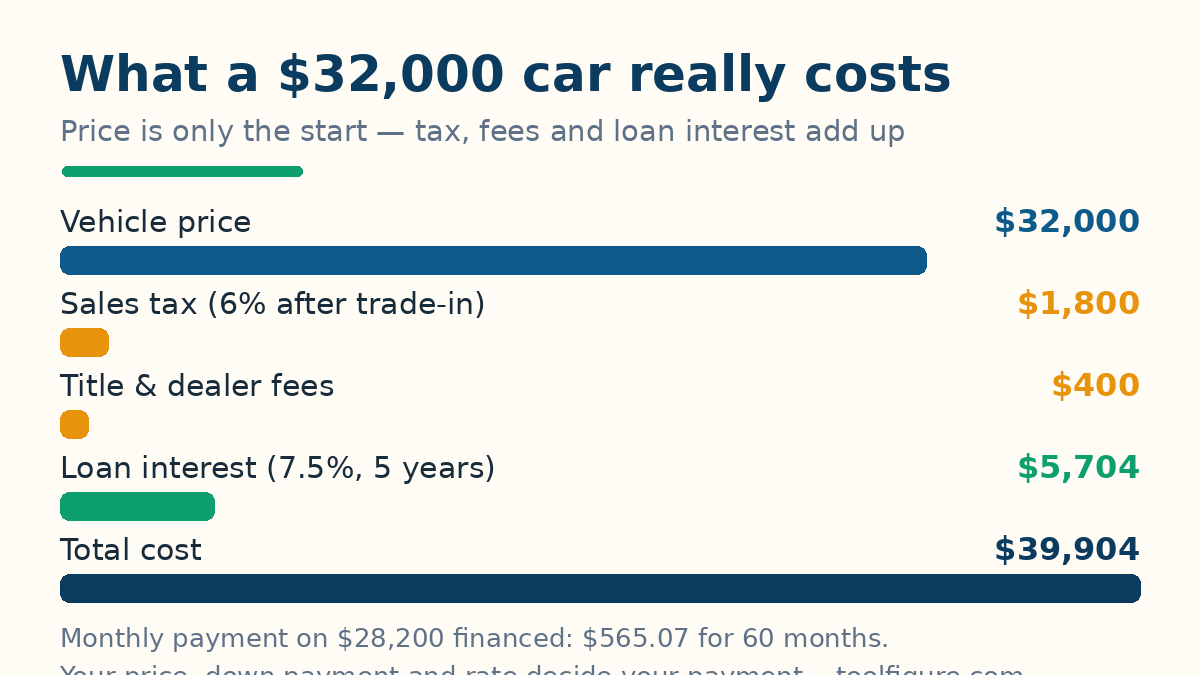
You buy a car for $32,000, put $4,000 down, trade in your old car for $2,000, pay 6% sales tax on the $30,000 difference ($1,800) and $400 of fees. Amount financed: 32,000 + 1,800 + 400 − 4,000 − 2,000 = $28,200. At 7.5% APR over 60 months the payment is $565.07 a month. Over the loan you pay $33,904.21 in total, of which $5,704.21 is interest. Add it all up and the $32,000 car costs $39,904.21 — the sticker price plus $7,904 of tax, fees and interest. Run your own figures above; if the total cost surprises you, the levers below are in the order they usually matter.
The four levers that move a car payment
The term is the most dangerous lever. Stretching the same $28,200 loan from 60 to 84 months drops the payment noticeably, but you pay interest for two extra years and risk owing more than the car is worth — being "upside down" — for much of the loan. The down payment is the safest lever: every extra $1,000 down is $1,000 you never pay interest on, and it protects you against that upside-down gap. The APR rewards shopping around: a single percentage point on a loan this size is worth several hundred dollars, so a quote from your own bank or credit union before you visit the dealer is real money. The price is the quiet lever: $1,000 off the negotiated price also removes the tax on that $1,000 and the interest on financing it. A longer term should be the last resort, not the first offer you accept — if a payment only fits at 84 months, the honest reading is that the car costs more than the budget allows, and a cheaper car or a bigger deposit built with our savings goal calculator is the fix.
Can you actually afford this payment?
A common planning guideline keeps all car costs — payment, insurance, fuel and maintenance — near or below about 15–20% of take-home pay, with the payment itself only part of that. Check the payment against your real take-home figure from the paycheck calculator, not against your salary: taxes shrink the salary first, and the car payment is paid from what is left. Remember too what this calculator leaves out, below, before you sign.
Frequently asked questions
How is a monthly car payment calculated?
First work out the amount financed: vehicle price, plus sales tax and fees, minus your down payment and trade-in. Then apply the standard loan formula — that amount, at the monthly interest rate, spread over the term. On $28,200 financed at 7.5% APR for 60 months, the payment is $565.07.
Does a trade-in reduce the sales tax on a car?
In many US states, yes: tax is charged on the price minus the trade-in value, which is how this calculator works — a $2,000 trade-in at a 6% rate saves $120 of tax on top of the $2,000 itself. Some states tax the full price instead, so check your local rule.
Is a longer car loan a good idea if the payment is lower?
Usually not. Extending from 60 to 84 months cuts the monthly payment but adds a large amount of interest and keeps you owing more than the car's value for longer. If the payment only fits on the longest term, a cheaper car or a larger down payment is normally the safer answer.
How much should I put down on a car?
A common target is around 20% of the price on a new car and at least 10% on a used one, plus enough to cover tax and fees. A larger down payment reduces the amount financed, the interest, and the risk of owing more than the car is worth.
What APR should I expect on an auto loan?
It depends mainly on your credit history, the term, and whether the car is new or used — used-car rates are usually higher. Get a quote from your own bank or credit union before visiting a dealer so you can compare the dealer's finance offer against a real alternative.