The salary-to-hourly formula
Hourly wage = annual salary ÷ (hours per week × weeks per year)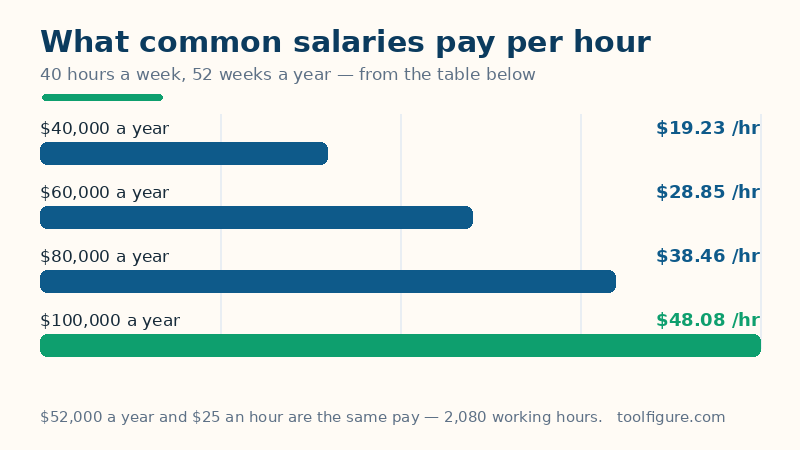
This salary to hourly calculator divides the annual salary by hours per week times weeks per year — the standard full-time year is 40 × 52 = 2,080 hours, which is why $52,000 a year and $25 an hour are the same pay. The table below shows common salaries from $30,000 to $120,000. Gross, not take-home. The standard full-time year is 40 × 52 = 2,080 hours, which is why "$52,000 a year" and "$25 an hour" are the same pay. If you get unpaid weeks off, reduce the weeks figure — the hourly equivalent of the same salary rises, because you earn it in fewer working weeks.
Common salaries converted (40 hrs/week, 52 weeks)
| Annual salary | Hourly | Annual salary | Hourly |
|---|---|---|---|
| $30,000 | $14.42 | $70,000 | $33.65 |
| $40,000 | $19.23 | $80,000 | $38.46 |
| $50,000 | $24.04 | $100,000 | $48.08 |
| $60,000 | $28.85 | $120,000 | $57.69 |
Gross, not take-home
This calculator converts gross pay — before tax, pension and other deductions. Your take-home hourly equivalent will be lower; check a recent payslip for your personal deduction rate if you need the net figure.
Worked example — a UK contract at 37.5 hours
Many UK contracts specify 37.5 hours a week rather than 40. A salary of £45,000 on those hours converts to 45,000 ÷ (37.5 × 52) = £23.08 an hour, £865.38 a week and £3,750 a month. Run the same salary at 40 hours instead and the hourly figure falls to £21.63 — the salary did not change, but the hours it buys did, which is why comparing two job offers by salary alone can mislead. The reverse direction matters too: a UK hourly rate of £15 at 37.5 hours a week is 15 × 37.5 × 52 = £29,250 a year, the figure to set against salaried offers.
Worked example — US salary versus a contract rate
An employee on $85,000 at 40 hours a week earns the equivalent of $40.87 an hour across 52 paid weeks. A contractor offered the "same" work must do better than $40.87 to break even: with four unpaid weeks off (48 working weeks), matching $85,000 needs 85,000 ÷ (40 × 48) = $44.27 an hour — and that still ignores the paid holidays, employer pension contributions and other benefits the employee receives on top. Setting the weeks field to your real working weeks is what turns this from a rough rule into an honest comparison.
How to read the table
The month row is the annual figure divided by 12 — not four times the weekly figure. Months average about 4.33 weeks, so a monthly salary is always more than four weekly pays; confusing the two is behind many budgeting surprises. The two-weeks row matches the common US biweekly pay cycle (26 paydays a year, which is why two months a year contain three paydays). If you entered an hourly wage instead, the note above the table confirms the conversion ran in that direction.
Limitations
Everything here is gross pay. Income tax, national insurance or Social Security, pension contributions and benefits in kind all sit outside the conversion, and they do not scale identically between salaried and hourly arrangements. Unpaid overtime is the other big distortion: a salaried role contracted at 40 hours but regularly worked at 50 has a true hourly equivalent a fifth lower than the figure shown — enter your honest hours if that is your situation.
Common mistakes
- Using 48 weeks for a salaried job. If your leave is paid, you are paid for 52 weeks — holidays are not unpaid weeks. Only contractors and unpaid-leave arrangements should reduce the weeks.
- Comparing gross hourly with net salary. Convert like with like: gross to gross. A take-home figure can be found from a payslip, but it is personal to your tax code and deductions.
- Treating a month as exactly four weeks. That understates monthly pay by about 8%. The table's month row uses year ÷ 12, the way payroll does.
- Ignoring benefits when comparing offers. An employer pension contribution of 5% on a £45,000 salary is £2,250 a year — worth about £1.15 an hour at 37.5 hours a week — before any other benefit is counted.
Related tools: Loan Calculator — Monthly payment, total interest, amortization schedule and extra-payment effect; Mortgage Calculator — Full monthly payment breakdown: P&I, tax, insurance, PMI and HOA; Compound Interest Calculator — Future value with monthly contributions, yearly table and growth chart.
Frequently asked questions
How much is $65,000 a year per hour?
At 40 hours a week for 52 weeks: $65,000 ÷ 2,080 = $31.25 per hour, before deductions.
What is the 2,080-hour rule?
It is the standard US full-time working year: 40 hours × 52 weeks. Employers use it to compare salaried and hourly roles.
Should I count holidays and vacation?
If you are paid for them, keep 52 weeks — you are paid for all of them. Contractors who are not paid for time off should subtract those weeks.
How do I compare a salaried offer with an hourly one?
Convert both to the same basis with this tool, then add the value of benefits (paid leave, pension matching, health cover) that hourly roles often lack.
How do I include a bonus or commission in the comparison?
Add the amount you realistically expect to earn in a typical year to the salary before converting, and note that it makes the hourly figure an average rather than a guarantee. If the bonus is uncertain, run the conversion twice — with and without it — to see the range you are really choosing between.
What hourly rate equals the minimum wage as a salary?
Enter the legal minimum for your country as the hourly wage and leave the salary blank — the table will show the weekly and annual equivalents for your hours. Minimum wage rates change most years and differ between the UK and US (and between US states), so use the current official rate for where you work.
The worked examples on this page were checked against this calculator on 18 October 2026.