What angular velocity is
Angular velocity, written ω, is how fast something turns — the angle it sweeps per second. A wheel, a motor shaft, a record on a turntable and a planet all have one, and the number is the same whether the object is a millimetre across or a planet wide: only the angle per second matters, never the size. The SI unit is the radian per second, because the radian is the angle that fits the circle it measures — one full turn is 2π radians, so a radian is about 57.2958 degrees, and the formulas of rotation (rim speed, centripetal acceleration, torque) all come out cleanest in radians. Workshops, though, count whole turns per minute, physics problems count degrees per second, and surveying instruments count gradians per second, so the same spin arrives under half a dozen labels. This page restates any angular velocity in all eight units at once, worked through radians per second with every factor defined, and answers the question the conversion alone cannot: at a radius you enter, how fast does a point on the rim actually move?
The formula
answer = radians per second ÷ (rad/s in one "to" unit)
rim speed = |radians per second| × radius
Three terms, all visible on the page. value is the number you enter. rad/s in one "from" unit is the definition of the unit you are converting from: 1 for radians per second itself, 1/60 for radians per minute, π/180 for degrees per second, π/10800 for degrees per minute, 2π for revolutions per second and for hertz, π/30 for revolutions per minute, and π/200 for gradians per second. answer is the result in the unit you asked for. radius is the distance from the centre to the moving point, in metres, and the rim speed is its product with the magnitude of the angular velocity — a speed, unlike a velocity, has no direction, which is why the absolute value appears here. The sign of the angular velocity itself is kept everywhere else: a negative value means the spin runs the other way, and every unit in the table keeps that sign.
Worked example
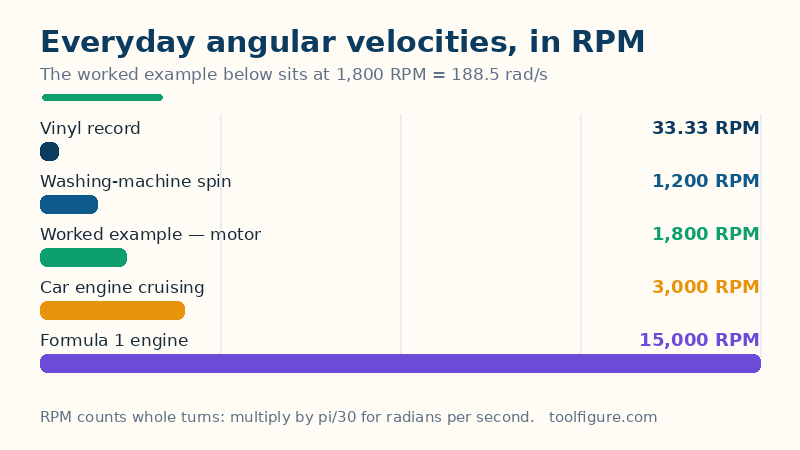
Convert 1,800 revolutions per minute to radians per second — the speed of an ordinary four-pole induction motor on a 60 Hz supply, and the figure a motor plate reaches for first — the way the tool does it.
Step 1 — get to radians per second. One revolution per minute is π/30 rad/s, so 1,800 × π/30 = 60π = 188.4956 rad/s, displayed as 188.5 rad/s at the page's two-decimal step for values above 10.
Step 2 — read the display. The headline reads 188.5 rad/s, and the detail line shows the working: 1,800 RPM = 188.5 rad/s — worked through radians per second: 188.5 rad/s ÷ the Radians per second factor.
Step 3 — read the table. The full table for this example reads: 188.5 rad/s, 11,309.73 rad/min, 10,800 °/s, 648,000 °/min, 30 rev/s, 1,800 RPM, 30 Hz and 12,000 grad/s. The rim-speed line, at the default radius of 0.25 m, reads 47.12 m/s (169.65 km/h): 188.4956 × 0.25 = 47.1239 m/s, and 47.1239 × 3.6 = 169.65 km/h.
Check it. Multiplying back from the exact value, 60π × 30/π = 1,800 RPM exactly — the π cancels, which is the whole point of working through radians. The displayed 188.5 is that exact value rounded to two decimals, so multiplying back from the display alone gives 1,800.06, a rounding shadow of 0.06 RPM, not a second answer. The rim speed checks the same way: 47.12 m/s × 3.6 = 169.63 km/h against the displayed 169.65, the two-decimal rounding again, on a figure that is itself exact before display.
Conversion table
The conversions motor work, physics homework and surveying reach for most, each one the same two steps as the example:
| From | To |
|---|---|
| 60 RPM | 6.2832 rad/s |
| 1 rad/s | 9.5493 RPM |
| 1 rad/s | 57.3 °/s |
| 10 rad/s | 95.49 RPM |
| 360 °/s | 6.2832 rad/s |
| 1 rev/s | 60 RPM |
| 50 Hz | 3,000 RPM |
| 3,000 RPM | 314.16 rad/s |
| 1 rad/s | 63.66 grad/s |
| 400 grad/s | 6.2832 rad/s |
Two rim-speed cross-checks for the extra line, each one the same multiplication: a 1,800 RPM shaft at a 0.1 m radius moves its rim at 18.85 m/s, and a vinyl record at 33.33 RPM carries its outer edge at 0.5323 m/s for a 0.1525 m radius — the record's slow spin is honest, and the edge is still moving, because every radius at the same spin moves at its own speed.
Reading the result, and its limits
Four distinctions keep this page honest. First, angular velocity is not angular acceleration: this page restates a steady spin, and the rate at which a spin itself changes — radians per second per second — is a different quantity that no conversion on this page can produce. Second, hertz equals revolutions per second only for full cycles: a hertz counts any repeating cycle per second, and it matches rev/s exactly when each cycle is one full turn, which is the case for a rotating shaft but not for every oscillation. Third, revolutions per minute carries no direction in workshop usage — a motor plate never says −1,800 RPM — while the signed radian and degree figures on this page do, so a negative result here means the spin reversed, and a plate reading must be given its direction separately. Fourth, angular velocity alone never gives a linear speed: the rim-speed line needs the radius, and the same 1,800 RPM is 18.85 m/s at 0.1 m and 188.5 m/s at 1 m, which is why a spin quoted without a radius cannot be compared with a speed at all. The angle converter on this site handles static angles; this page handles angles per second.
Related tools: Angle Converter — Degrees to radians and back, gradians, turns, arcmin/arcsec, mrad and NATO mils — every answer in all eight units, plus sin/cos/tan; Frequency Converter — Hz to kHz, MHz, GHz, THz, RPM and rad/s — every answer in all seven units, through the exact definitions; Speed Converter — Convert mph, km/h, m/s, ft/s, knots and Mach — every answer in all six units.
Frequently asked questions
What is the difference between RPM and rad/s?
RPM counts whole turns per minute and rad/s counts radians per second. One full turn is 2π radians, so 1 RPM = π/30 rad/s ≈ 0.10472 rad/s, and 1 rad/s ≈ 9.5493 RPM. Workshops quote RPM because turns are easy to count; physics uses rad/s because the rotation formulas — rim speed, centripetal acceleration, torque — come out without extra constants in radians.
How do I convert RPM to rad/s?
Multiply the RPM figure by π/30, which is about 0.10472. A motor at 1,800 RPM is 1,800 × 0.10472 = 188.5 rad/s, the worked example on this page. To go the other way, multiply rad/s by 30/π, about 9.5493.
Is hertz the same as revolutions per second?
For a rotating shaft, yes: one full turn per second is one cycle per second, so 30 rev/s = 30 Hz. In general a hertz counts any repeating cycle per second — a vibrating string, an alternating current — and it only equals rev/s when each cycle is one full turn.
What does a negative angular velocity mean?
The spin runs the other way. The magnitude is the speed of the turn and the sign is its direction, clockwise or anticlockwise. This page keeps the sign through every unit, and the rim-speed line uses the magnitude, because a speed has no direction.
