The formula: height × 0.84, then the position adjustment
The calculation has three steps, and the calculator shows all three so the answer can be checked by hand. Step 1, convert to inches: height in centimetres divided by 2.54 gives height in inches — 178 cm ÷ 2.54 = 70.08 in. Step 2, the base length: base = height in inches × 0.84, rounded to the nearest whole inch. The 0.84 factor is ToolFigure's own statement of the published chin-to-nose rule in numbers: at 5 ft 10 in it gives 59 in, which sits inside the 58–60 in range the dedicated hockey calculators print for that height, and at 5 ft 6 in it gives 55 in against their 54–56 in, and at 6 ft 2 in it gives 62 in against their 62–64 in. Step 3, the position adjustment: forwards subtract 2 in, defencemen add 2 in, all-round players add nothing — the published forward/defence split, stated as a number rather than left as advice. The recommended length is the adjusted figure, and the range is one inch either side of it, because no chart can place a player to the inch.
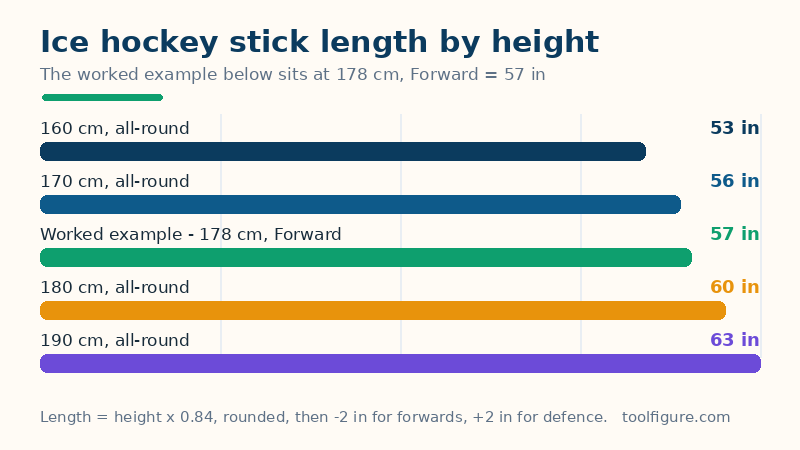
Worked example: 178 cm, forward
Take a forward who is 178 cm tall. Step 1: 178 ÷ 2.54 = 70.08 in. Step 2: 70.08 × 0.84 = 58.87, which rounds to a base of 59 in. Step 3: forward subtracts 2 in, so the recommendation is 57 in (144.8 cm), range 56–58 in (142.2–147.3 cm). The same answer comes out of the inches input: 70 in × 0.84 = 58.80, which rounds to the same base of 59 in, and forward again gives 57 in. The calculator converts inches to centimetres first and then uses the same steps, so the two units can never disagree by more than rounding. Other heights on the same steps read, all-round:
| Height | Base (all-round centre) | All-round range | Forward | Defence |
|---|---|---|---|---|
| 160 cm | 53 in | 52–54 in | 51 in | 55 in |
| 170 cm | 56 in | 55–57 in | 54 in | 58 in |
| 178 cm | 59 in | 58–60 in | 57 in | 61 in |
| 180 cm | 60 in | 59–61 in | 58 in | 62 in |
| 190 cm | 63 in | 62–64 in | 61 in | 65 in |
Notice that the position adjustment moves the whole range, not just the centre: the 178 cm forward's range is 56–58 in while the same player's defence range is 60–62 in, so position is worth four inches end to end — the difference between a quick-handling stick and a long-reach one.
How to read your result, and its limits
Three checks before buying. First, do the chin-to-nose check on skates: stand in your skates with the stick's toe on the floor beside you — the top should sit between your chin and your nose, and if it sits above your nose or below your chin, the check outranks this page, because skating posture and personal preference move the right length by an inch or two either way. Second, length is not the whole stick: flex, curve, lie and shaft shape are fitted separately, and flex in particular is chosen by weight and strength rather than height, so settle the length here and let a shop or a fitter settle the flex. Third, this page sizes ice hockey sticks, not field hockey sticks: field hockey uses a different chart entirely, with most adults on a 36.5 in stick, so do not carry a number from this page onto a field hockey pitch — and below 120 cm, junior ice sticks are sized by a shop's kids chart rather than this rule. For the rest of the kit, the skateboard size calculator sizes a deck from shoe size and style, and the golf club length calculator sizes a whole set from height and wrist-to-floor.
Related tools: Boxing Glove Size Calculator — The right boxing glove weight in ounces from your body weight and training type, with the bag, sparring and competition answers side by side.
Frequently asked questions
What length hockey stick do I need?
As a starting point, height in inches times 0.84, adjusted for position: a 178 cm (70.08 in) forward reads 57 in, range 56–58 in. Enter your height and position above and the calculator shows every step.
Should a forward use a shorter hockey stick?
Yes, by about two inches: forwards subtract 2 in here, so a 178 cm forward reads 57 in where an all-round player reads 59 in and a defenceman reads 61 in. The shorter stick favours quick puck handling; the longer one favours reach.
Where should a hockey stick reach on me?
Standing in skates with the toe on the floor, the top of the stick should sit between your chin and your nose. That check outranks any chart — if it disagrees with this page, trust the check.
Does this calculator work for field hockey sticks?
No: field hockey uses a different chart, with most adults on a 36.5 in stick. This page sizes ice hockey sticks only, from the chin-to-nose rule on skates.
