One exam, one unknown — the rest is already decided
By the time a final exam approaches, most of a course grade is already fixed: the coursework is marked, the quizzes are counted, and only the exam's share is still undecided. That makes the question students actually ask — what do I need on the final? — a single piece of algebra, not a mystery. This calculator works it in the open: the points you have already banked, the points the exam must still supply, and the score those points require. It is deliberately not the GPA calculator: GPA averages grades that are finished, across courses. This page looks forward inside one course, at the one grade that is not finished yet — the same forward-looking split the average calculator cannot make, because it treats every mark as equal and already earned.
The method, with every term defined
Points banked = current grade × ( 100 − exam weight ) ÷ 100Score needed = ( grade you want − points banked ) ÷ ( exam weight ÷ 100 )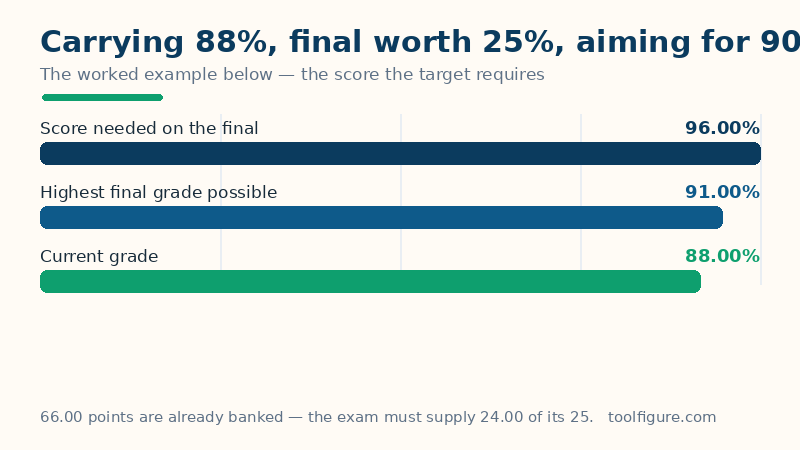
Your current grade is your average over everything except the final, and it covers (100 − weight) percent of the course — so it contributes that share of itself as banked points, points no exam performance can take away. The exam weight is the exam's share of the whole grade, stated in the syllabus: an exam worth 25 contributes at most 25 points, and a score of S percent on it contributes S × 25 ÷ 100. The score needed is the gap between your target and your banked points, divided by the weight — the division is the step intuition skips, and it is why a small gap can demand a huge score when the exam's share is small. If the answer comes out above 100, the target is arithmetically out of reach, and this page says so with the highest reachable grade beside it rather than printing a fantasy number.
Worked example: carrying 88%, final worth 25%, aiming for 90%
The defaults above are a student carrying 88%, with a final worth 25% of the course, aiming for 90%. The banked points are 88 × 75 ÷ 100 = 66.00. The exam must supply 90 − 66 = 24.00 of its 25 points, so the score needed is 24 ÷ 0.25 = 96.00% — demanding, but real: a perfect exam would finish at 66 + 25 = 91.00%, the ceiling for this student. The check row in the result is worth noticing: scoring exactly your current grade again (88%) finishes at exactly 88.00%, because a weighted average of two equal numbers is that number. And a zero on the exam finishes at 66.00% — the banked floor that no result can go below.
The same student, every target
| Final grade aimed for | Points the exam must supply | Score needed on the final |
|---|---|---|
| 80% | 14.00 | 56.00% |
| 85% | 19.00 | 76.00% |
| 88% (hold the current grade) | 22.00 | 88.00% |
| 90% — worked example | 24.00 | 96.00% |
| 91% (the ceiling) | 25.00 | 100.00% |
| 92% | 26.00 | 104.00% — not reachable |
Read the ladder from the bottom up: each extra point of final grade costs four points of exam score, because the exam is only a quarter of the course — the exchange rate is always 100 ÷ weight. That rate is what changes between courses. A second student carrying 75% with a final worth 30% who wants 80% has banked 75 × 0.70 = 52.50 points and needs 27.50 ÷ 0.30 = 91.67% on the exam; their exchange rate is kinder (about 3.3 exam points per grade point) because the exam counts for more. A third, carrying 92% with a final worth only 20% and aiming for 90%, has banked 73.60 and needs just 82.00% — a heavy coursework lead makes the exam a defence, not an attack.
How to read your result — and its limits
Plan around the score needed, but sanity-check it against the ceiling beside it: a target needing 96% is a study plan, a target needing 104% is a conversation with the instructor about extra credit or a retake, and this page's job is to tell you which one you are holding before the exam, not after. Four limits belong with the page. The weight must be the real one: some syllabi weight the final as a share of the exam category, drop the lowest quiz, or curve the class — any of those changes the arithmetic, and the weight to enter is always the exam's true share of the final number. Rounding is the school's, not yours: an 89.96 may or may not become a 90, so treat a score needed within a point of a boundary as needing the point above it. Current grade means before the final only: if your portal's average already includes a midterm that the final replaces, that average is not the input this formula wants. And a secured target is information too: when the needed score comes out below zero, the honest reading is that the target survives even a zero — which frees revision time for a course where it does not. What this page guarantees is the weighted-average arithmetic itself: given the current grade, the weight and the target, every banked point and required score follows exactly as written above.
Frequently asked questions
How do I calculate what I need on my final exam?
Work out the points you have already banked — your current grade times the share of the course that is not the exam — then divide the gap to your target by the exam's weight. Carrying 88% with a final worth 25% and aiming for 90%: banked points are 88 × 0.75 = 66, the gap is 24 points, and 24 ÷ 0.25 = 96 — you need 96% on the final. This page does exactly that, and shows the banked points and the highest grade still possible beside the answer.
What if the score I need is over 100%?
Then the target cannot be reached in that course as it stands — the calculator prints the honest figure (104%, say) together with the highest grade a perfect exam would give, rather than capping the answer at 100 and letting you believe. The realistic moves are to lower the target to what a strong-but-human score achieves, or to ask about extra credit, a dropped component or a retake policy. Knowing the ceiling before the exam is worth more than discovering it on the transcript.
My final is worth 40% and I have a 70% — can I still get an 80?
Yes, but it takes near-perfection: banked points are 70 × 0.60 = 42, the gap to 80 is 38 points, and 38 ÷ 0.40 = 95 — you need 95% on the final. The general rule the table on this page demonstrates: the smaller the exam's weight, the more extreme the score a comeback requires, because each exam point is diluted by the weight. At a 40% weight each exam point buys 0.4 grade points; at a 20% weight it buys only 0.2.
What grade do I finish with if I score the same as my current grade?
Exactly your current grade — always. A weighted average of two parts that are both 88% is 88%, whatever the weights are: 88 × 0.75 banked plus 88 × 0.25 from the exam is 66 + 22 = 88. That is why the result table carries the row: it is a built-in check on the arithmetic, and it frames the real question — the exam only moves your grade to the extent your score on it differs from the average you carried in.