BMR: the cost of staying alive, before you do anything
Your basal metabolic rate (BMR) is the energy your body spends in 24 hours at complete rest — lying still, awake, warm and fasted — on breathing, circulation, body temperature, cell repair and the brain. It is not a small overhead: for most adults the BMR is the largest single part of all the energy they burn, typically 60–70% of the day's total. Everything else — walking, working, training — is added on top of it, which is why the calorie calculator starts from this same number before applying an activity multiplier. This page works your BMR out with three published equations at once. They will not agree to the calorie, and that disagreement is itself useful information: it shows the size of the uncertainty before you build any plan on the figure. This is general educational information, not medical advice.
The three formulas, with every term defined
Mifflin-St Jeor (1990) — men: BMR = 10 × weight (kg) + 6.25 × height (cm) − 5 × age + 5 · women: the same, ending − 161 instead of + 5Harris-Benedict revised (1984) — men: BMR = 88.362 + 13.397 × weight (kg) + 4.799 × height (cm) − 5.677 × age · women: BMR = 447.593 + 9.247 × weight + 3.098 × height − 4.330 × ageKatch-McArdle — BMR = 370 + 21.6 × lean body mass (kg), where lean mass = weight × (1 − body fat % ÷ 100)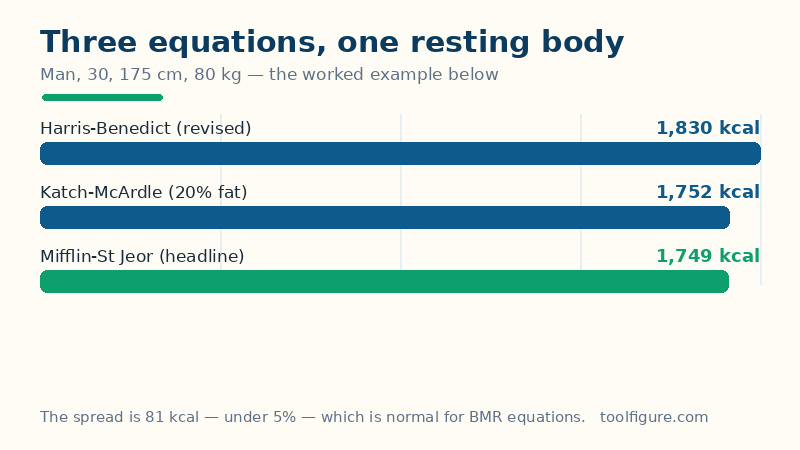
The first two equations read the same four facts about you — sex, weight, height, age — and differ only in the weights their authors fitted to measured data decades apart. Mifflin-St Jeor is the headline here because a 2005 review by the American Dietetic Association found it the most reliable of the widely used estimators for healthy adults. The third works differently: instead of total weight it uses lean body mass — everything that is not fat — because metabolically active tissue is what actually burns the energy. That is why Katch-McArdle needs a body fat percentage, and why it can disagree with the other two in an informative direction: two people of identical weight, one muscular and one not, get the same Mifflin figure but genuinely different Katch-McArdle figures.
Worked example: a 30-year-old man, 175 cm, 80 kg, 20% body fat
The defaults above give three answers. Mifflin-St Jeor: 10 × 80 + 6.25 × 175 − 5 × 30 + 5 = 800 + 1,093.75 − 150 + 5 = 1,749 kcal a day (1,748.75 before rounding). Harris-Benedict revised: 88.362 + 13.397 × 80 + 4.799 × 175 − 5.677 × 30 = 88.362 + 1,071.76 + 839.83 − 170.31 = 1,830 kcal a day. Katch-McArdle: lean mass is 80 × 0.80 = 64 kg, so 370 + 21.6 × 64 = 1,752 kcal a day. Resting, this body spends about 73 kcal an hour — roughly 1.2 kcal a minute, or 7,317 kJ a day. Read the spread honestly: the highest and lowest estimates differ by 81 kcal, under 5%. A cross-check with different inputs: a 30-year-old woman, 165 cm and 65 kg at 28% body fat, gets 1,370 kcal from Mifflin-St Jeor, 1,430 kcal from Harris-Benedict and 1,381 kcal from Katch-McArdle (lean mass 46.8 kg) — the same pattern of close-but-not-identical answers.
How BMR moves with age and weight
| Same man (175 cm, 80 kg), other ages | Mifflin BMR | Same man (age 30, 175 cm), other weights | Mifflin BMR |
|---|---|---|---|
| Age 20 | 1,799 kcal | 70 kg | 1,649 kcal |
| Age 30 | 1,749 kcal | 75 kg | 1,699 kcal |
| Age 40 | 1,699 kcal | 80 kg | 1,749 kcal |
| Age 50 | 1,649 kcal | 85 kg | 1,799 kcal |
| Age 60 | 1,599 kcal | 90 kg | 1,849 kcal |
The Mifflin arithmetic is deliberately plain: each year of age subtracts 5 kcal, each kilogram of weight adds 10. So a decade costs about 50 kcal a day — real, but modest — and the popular idea that metabolism “collapses” with age is mostly the equation's age term plus the muscle loss the equation cannot see. Weight moves BMR twice as fast per unit, which cuts both ways: a heavier body burns more at rest, and a body that loses weight genuinely needs less — the smaller figure after weight loss is arithmetic, not a “broken” metabolism.
BMR is not RMR, and neither is your daily total
Two confusions follow this number around. First, BMR versus RMR: resting metabolic rate is measured under looser conditions — no overnight stay in a laboratory, a shorter rest before measuring — and usually comes out slightly higher than a strict BMR for the same person. The terms are often used interchangeably online; the equations on this page estimate BMR-style values. Second, and more important, BMR is not what you should eat. It is the floor before any movement at all. Your actual daily requirement is BMR multiplied by activity — for the worked example, sedentary living already lifts 1,749 to about 2,099 kcal and moderate activity to 2,711 kcal, which the calorie calculator works through with goal targets. Eating at BMR while living a normal active life is a large deficit, not a maintenance plan.
How to read your result, and the limits — read these
Treat the headline figure as the centre of a range, not a point: for healthy adults Mifflin-St Jeor typically lands within about ±10% of a laboratory measurement, and individuals scatter on both sides. The equations cannot see muscle mass (except through the Katch-McArdle input), thyroid or other medical conditions, medication, or the metabolic adaptation that follows long dieting. They are not validated for children, and pregnancy and breastfeeding change requirements in ways they do not model. If the number matters — for a clinical nutrition plan, an eating-disorder recovery target, or elite sport — it can be measured directly by indirect calorimetry, and a clinician or registered dietitian is the right route to it. For everyday planning, use BMR as the foundation it is: the honest floor under your daily energy, with the activity picture built on top of it.
Frequently asked questions
What is a good BMR for my age?
There is no target BMR to aim for — it is a description of your body, not a score. For orientation, the worked example on this page (a 30-year-old man, 175 cm, 80 kg) comes out at 1,749 kcal a day by Mifflin-St Jeor, and a comparable 30-year-old woman (165 cm, 65 kg) at 1,370 kcal. BMR falls about 50 kcal per decade of age and rises about 10 kcal per kilogram of weight in that equation, so most healthy adults land somewhere between roughly 1,200 and 2,000 kcal a day.
What is the difference between BMR and TDEE?
BMR is what your body burns at complete rest — for the worked example, 1,749 kcal a day before any movement. TDEE (total daily energy expenditure) is BMR multiplied by an activity factor: the same body needs about 2,099 kcal sedentary and 2,711 kcal at moderate activity. Weight is maintained by eating near TDEE, not BMR. The calorie calculator on this site builds the full TDEE and goal picture from your BMR.
Why do the three equations give different answers?
Each was fitted to measurements from a different group of people in a different decade, so each splits the influence of weight, height and age slightly differently. On the worked example they span 1,749 to 1,830 kcal — under 5% apart, which is typical. Katch-McArdle can move further from the other two when body composition is unusual, because it works from lean mass rather than total weight; that difference is information, not an error.
Does a higher BMR mean I burn fat faster?
Not in the way the phrase suggests. A higher BMR mostly means a larger or leaner body spending more energy staying alive — about 10 kcal a day per extra kilogram in the Mifflin equation. It does not switch on any special fat-burning mode, and deliberately chasing a higher BMR matters far less than total daily activity and intake. Building muscle raises BMR modestly through lean mass, which the Katch-McArdle equation shows: each extra kilogram of lean mass adds about 21.6 kcal a day.
How accurate is a BMR calculator?
For healthy adults, Mifflin-St Jeor is typically within about ±10% of a laboratory measurement, and the American Dietetic Association's review found it the most reliable of the common equations. It cannot account for muscle mass beyond the optional Katch-McArdle input, medical conditions, or medication. If you need a measured value — for clinical or elite-sport purposes — indirect calorimetry with a professional is the accurate route.