A retirement date is just a birthday — the countdown is the interesting part
Ask someone when they retire and they usually answer with an age: "at 65". The date that age produces, and the number of days between now and that date, is what this calculator works out. Enter a date of birth and a retirement age and it gives the retirement date itself, then counts the span from any start date you choose in the units people actually plan with: calendar days, Monday-to-Friday business days, weekend days, whole weeks, and a years-months-days breakdown. It is a countdown, not a pension forecast — for the money side of the same question, the retirement savings calculator projects what a pot could grow to by the date this page finds.
The formula, with every term defined
Retirement date = date of birth + retirement age in years (same month and day; a 29 February birthday retires on 28 February in a non-leap year)Days remaining = retirement date − count-from date, in whole calendar daysBusiness days = the Monday-to-Friday days inside that span, counted on the (start, end] rule: the start day itself is not counted, the retirement day isYears, months, days = the calendar breakdown of the same span, borrowing the length of the month before the end date when the day count goes negative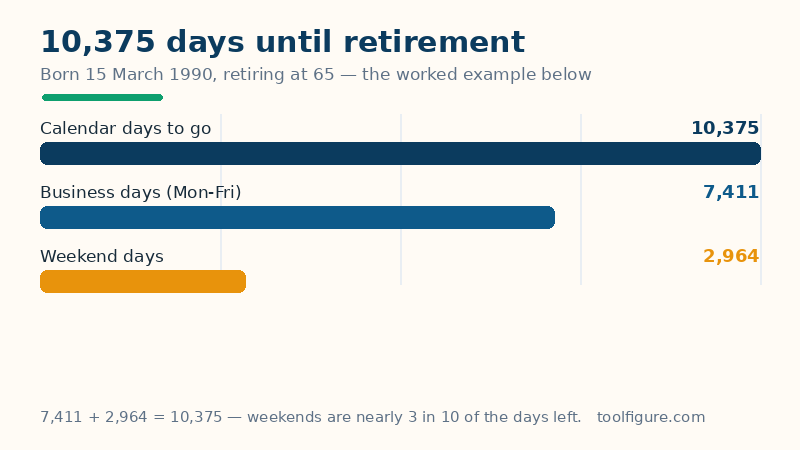
Two conventions are worth stating plainly, because they explain almost every "your number differs from mine" argument. First, the day count is a difference, not an inclusive count: from today to tomorrow is one day remaining, not two. Second, business days exclude public holidays — holidays differ by country and employer, and no honest general tool can know yours. The business days calculator lets you deduct a holiday count of your own once you know it.
Worked example: born Thursday 15 March 1990, retiring at 65
The defaults above are chosen so every figure can be checked against a calendar. Born 15 March 1990, retirement at 65 falls on Monday 15 March 2055. Counted from Sunday 18 October 2026 — when the person is exactly 36 years, 7 months and 3 days old — that is 10,375 days to go: 28 years, 4 months and 25 days, or 1,482 weeks and 1 day, or 249,000 hours. The split of those days is the number that surprises people: only 7,411 are business days, while 2,964 are weekend days — and 7,411 + 2,964 = 10,375, so the split accounts for every day in the span. Fewer than three in ten of the days left before retirement are working days at all, before holidays and leave come off the business figure too.
What changing the retirement age does
| Retirement age | Retirement date | Days to go |
|---|---|---|
| 60 | Tue 15 Mar 2050 | 8,549 |
| 62 | Fri 15 Mar 2052 | 9,280 |
| 65 | Mon 15 Mar 2055 | 10,375 |
| 67 | Thu 15 Mar 2057 | 11,106 |
| 70 | Mon 15 Mar 2060 | 12,202 |
Read the gaps, not just the rows. Moving from 65 to 67 adds 731 days — two years including the 2056 leap day — while retiring at 60 instead of 65 removes 1,826 days, five years of countdown. A second example shows the same shape at a different age: born 10 June 1985 and retiring at 67 gives a retirement date of Monday 10 June 2052, which is 9,367 days — 25 years, 7 months and 23 days — after 18 October 2026. And if the date your inputs produce has already passed, the calculator says so directly and reports how many days ago it fell, rather than showing a negative countdown.
How to read your result, and the limits
The business-days figure is the planning number: it is the count of days on which work, contributions and deadlines can actually happen, and it is always about 71–72% of the calendar figure for a long span. The calendar figure is the honest one for everything else — savings have calendar days to compound over, not business days. The limits: a "retirement age" is a plan, not a fact. Statutory pension ages, employer scheme rules and personal circumstances set real dates that may not sit exactly on a birthday; some schemes retire members at the end of a month or tax year instead. This page counts to the birthday itself and says so. It also cannot know your holidays, part-time pattern or career breaks — treat the business-day count as the ceiling that those things reduce. For a general countdown to any date — a wedding, an exam, a visa expiry — the countdown calculator is the same counting engine pointed at an arbitrary target, and the age calculator gives the exact age in years, months and days behind the first row of the table above.
Frequently asked questions
How is the retirement date worked out?
It is the birthday on which the chosen retirement age is reached: the date of birth with the retirement age added to the year, keeping the same month and day. Someone born on 15 March 1990 who retires at 65 retires on 15 March 2055. A 29 February birthday is observed on 28 February in years without a 29 February.
Why are there so many fewer business days than calendar days?
Because weekends are about two sevenths of all days. In the worked example, 10,375 calendar days contain 7,411 Monday-to-Friday days and 2,964 weekend days. Public holidays and annual leave reduce the working figure further — this calculator counts weekends only and says so.
What if my retirement date has already passed?
The calculator reports it plainly: it shows the date your chosen retirement age was reached and how many days ago that was. Raise the retirement age to count down to a later, future date instead.
Is my state pension age the same as the date here?
Not necessarily. This page counts to the birthday at the age you enter. Statutory pension ages are set by governments, can fall between birthdays, and change over time — check your own scheme or pension authority for the official date, then enter that age here to get the countdown.
Does the countdown include today?
It is a difference count: from the count-from date to the retirement date. If the retirement date is tomorrow, the answer is 1 day to go. The start day itself is never counted as a day remaining, which matches how the days-between and countdown calculators on this site count.