Two numbers: what your body burns at rest, and what it burns living
Every daily calorie figure is built from two numbers. The first is your basal metabolic rate (BMR) — the energy your body spends in a day at complete rest, keeping you warm, breathing and repaired. The second is your total daily energy expenditure (TDEE): the BMR scaled by how active your life actually is. Eat around your TDEE and weight holds steady; eat persistently below it and weight falls; above it, weight rises. This calculator works both numbers out with the Mifflin-St Jeor equation — the estimator a 2005 review by the American Dietetic Association found most reliable for healthy adults — then turns them into concrete daily targets. It is general educational information, not medical or dietetic advice: bodies differ in ways no four-input formula can see.
The formula, with every term defined
BMR (men) = 10 × weight (kg) + 6.25 × height (cm) − 5 × age (years) + 5BMR (women) = 10 × weight (kg) + 6.25 × height (cm) − 5 × age (years) − 161TDEE = BMR × activity multiplier: 1.2 sedentary · 1.375 light · 1.55 moderate · 1.725 active · 1.9 athleteWeight-change targets: about 3,500 kcal ≈ 1 lb of body fat, so ±500 kcal a day ≈ ∓1 lb a week, and ±250 kcal a day ≈ ∓0.5 lb a week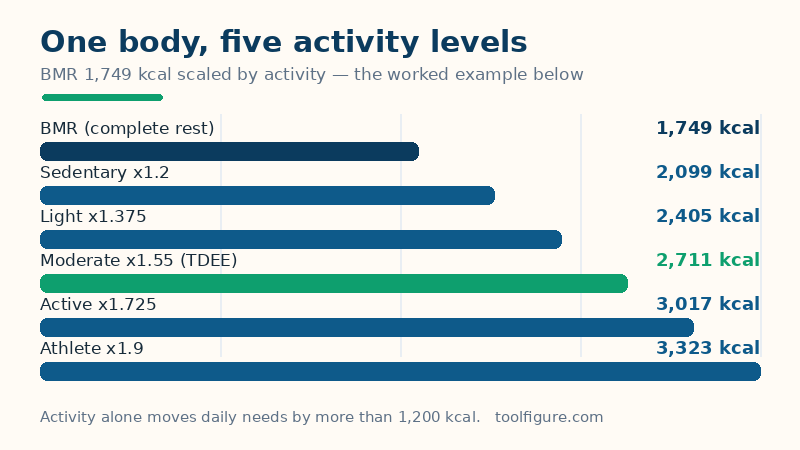
Each term earns its place. Weight dominates because a larger body has more tissue to maintain; height stands in for overall frame; the age term falls by 5 kcal per year because resting metabolism genuinely slows as muscle mass declines; and the +5 / −161 constants capture the average difference in body composition between men and women of the same size. The activity multipliers are deliberately coarse — five honest bands rather than a pretence of precision — and the 3,500 kcal rule is a planning approximation: real weight change is slower and less linear than the rule suggests, because the body adapts as it loses weight.
Worked example: a 30-year-old man, 175 cm, 80 kg, moderately active
The defaults above give: BMR = 10 × 80 + 6.25 × 175 − 5 × 30 + 5 = 800 + 1,093.75 − 150 + 5 = 1,749 kcal a day (1,748.75 before rounding). At the moderate multiplier, TDEE = 1,748.75 × 1.55 = 2,711 kcal a day (2,710.56 before rounding) — that is the maintenance figure, the amount this person can eat day after day and hold 80 kg. The goal table is then simple arithmetic on that anchor: losing a pound a week means about 2,211 kcal, losing half a pound means 2,461 kcal, and gaining runs the other way at 2,961 and 3,211 kcal. The macro split shown under the result divides maintenance 30/40/30: protein 813 kcal (203 g), carbohydrate 1,084 kcal (271 g), fat 813 kcal (90 g) — protein and carbohydrate carry about 4 kcal per gram, fat about 9.
The same body at every activity level
| Activity level | Multiplier | TDEE (kcal/day) |
|---|---|---|
| Sedentary — desk job, little exercise | ×1.2 | 2,099 |
| Light — exercise 1–3 days a week | ×1.375 | 2,405 |
| Moderate — exercise 3–5 days a week | ×1.55 | 2,711 |
| Active — exercise 6–7 days a week | ×1.725 | 3,017 |
| Athlete — physical job or twice-daily training | ×1.9 | 3,323 |
The spread is the lesson: activity moves this body's needs by more than 1,200 kcal a day between the desk and the building site — far more than any single food choice. It is also where most estimates go wrong, because people grade their own activity generously. If a training week is three gym sessions and an otherwise seated job, that is light, not moderate. A cross-check with different inputs: a 30-year-old woman, 165 cm and 65 kg, has a BMR of 10 × 65 + 6.25 × 165 − 150 − 161 = 1,370 kcal, and at light activity a TDEE of 1,884 kcal — noticeably lower than the male example, driven mostly by the smaller weight and the −161 constant.
How to read your result, and the limits — read these
Use the maintenance figure as a starting hypothesis, not a verdict: eat at it for two to three weeks, weigh yourself a few mornings a week, and adjust by 100–200 kcal in the direction the trend demands — your own data corrects the formula's error within a month. The honest limits: Mifflin-St Jeor is typically within about ±10% for healthy adults, and further out at the extremes of body composition, because it cannot see muscle — a very muscular and a very sedentary person of the same weight get the same BMR here and do not have the same metabolism. The equation is not for children, and pregnancy and breastfeeding change requirements in ways it does not model. The weight-change targets assume the change is mostly fat and the pace stays linear; in practice loss slows as you get lighter, which is normal adaptation, not failure. Finally, the commonly cited floors — do not plan below about 1,500 kcal a day for men or 1,200 for women without medical supervision — are flagged under your result whenever a target crosses them. Anyone with a medical condition, a history of disordered eating, or medication that affects weight should take these numbers to a clinician or registered dietitian rather than acting on them directly. For the companion figure most people check alongside calories, the BMI calculator places the same height and weight on the standard weight bands.
Frequently asked questions
Which formula does this calorie calculator use?
The Mifflin-St Jeor equation (1990), which a major review by the American Dietetic Association found to be the most accurate widely used estimator of resting metabolic rate for healthy adults: 10 × weight in kg, plus 6.25 × height in cm, minus 5 × age, plus 5 for men or minus 161 for women. Your BMR is then multiplied by an activity factor to give your TDEE.
What is the difference between BMR and TDEE?
BMR is what your body burns in a day at complete rest — no steps, no exercise, just staying alive. TDEE is BMR plus everything you actually do: moving, working, training. In the worked example the BMR is 1,749 kcal but the TDEE at moderate activity is 2,711 kcal. Weight is maintained by eating at TDEE, not BMR — eating at BMR while living an active life is a substantial deficit.
How many calories should I eat to lose weight?
The standard planning rule is that about 3,500 kcal of deficit adds up to roughly a pound of fat, so eating about 500 kcal a day below your TDEE targets about a pound a week, and 250 below targets about half a pound. Loss slows as you get lighter and your TDEE falls with your weight, so recalculate every few weeks — and do not plan below roughly 1,500 kcal (men) or 1,200 kcal (women) without medical supervision.
Why did my calorie target come out lower than expected?
Usually the activity level. The gap between sedentary (×1.2) and moderate (×1.55) is worth over 600 kcal a day for an average body, and most people overrate their band: a desk job with three weekly gym sessions is light activity. Try the honest band, track your weight trend for two to three weeks at that target, and adjust by 100–200 kcal based on what actually happens.
Are these calorie numbers exact?
No — no equation can be. Mifflin-St Jeor lands within about ±10% of measured resting metabolism for most healthy adults, and activity multipliers add their own roughness. That is exactly why the page frames the result as a starting point to correct against your own weight trend, rather than a prescription. Smartwatch and gym-machine calorie readouts are usually less accurate than this estimate, not more.