A ratio is a comparison — and it has three everyday jobs
A ratio compares two quantities in the same breath: 2:3 means "for every 2 of the first thing, there are 3 of the second". That one idea shows up in three jobs people constantly need. Simplifying: a screen's 1920 x 1080 pixels, a recipe's 24:36 grams — the comparison is clearer in lowest terms (16:9, 2:3). Proportions: if 2 parts concentrate make 3 parts drink, how much makes 8 parts concentrate? One value in the pattern is missing, and the ratio itself tells you what it must be. Splitting: divide money, ingredients or screen space in a ratio — share $50 as 2:3 and the parts are not $25 each but $20 and $30. This calculator does all three jobs from one pair of inputs; pick the job from the menu above and it shows the working, not just the answer. A ratio is really a fraction in a second outfit — A:B is the same comparison as A/B — so the simplifying engine here is the same greatest-common-divisor idea that powers our fraction calculator.
The three formulas
Simplify: divide A and B by their greatest common divisor (GCD)Proportion A : B = C : ? → ? = (B x C) ÷ ASplit a total T in the ratio A : B → first part = T x A ÷ (A + B), second part = T x B ÷ (A + B)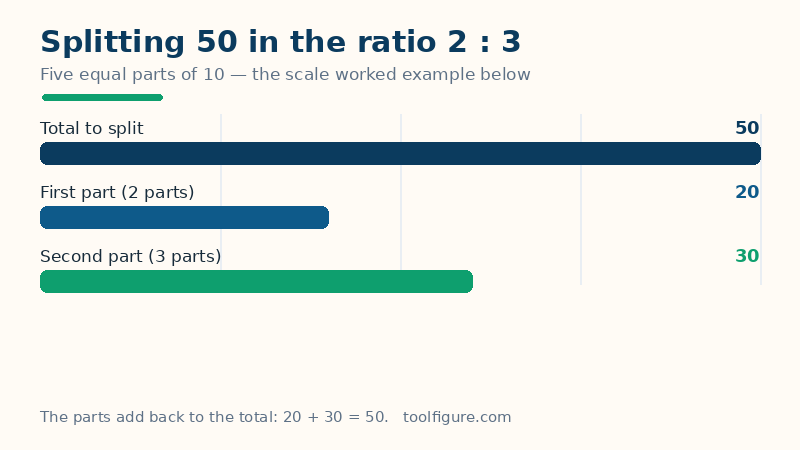
A and B are the two values of your ratio, in order — order matters, because 2:3 and 3:2 are opposite comparisons. In a proportion, C is the known third term: the pattern A:B repeats at a new size starting from C, and the missing fourth term keeps the comparison identical, which is why the formula multiplies across (B x C) and divides back by A — the method schools call cross-multiplication. In a split, A + B counts the total number of equal parts the whole is notionally cut into: 2:3 is five parts, so each part is worth one fifth of the total, and the shares are simply 2 of those parts and 3 of them. Every result on this page can be checked by hand from those three lines — that is the point of showing them.
Worked example 1: simplify 24 : 36
Take the ratio 24 : 36 — say, 24 grams of flour to 36 grams of sugar. The greatest common divisor of 24 and 36 is 12 (the divisors of 24 are 1, 2, 3, 4, 6, 8, 12, 24; of 36: 1, 2, 3, 4, 6, 9, 12, 18, 36; the largest shared one is 12). Divide both sides by 12: 24 ÷ 12 = 2 and 36 ÷ 12 = 3, so the simplified ratio is 2 : 3. Nothing about the comparison changed — 2:3, 24:36 and 200:300 are the same relationship at different sizes — but the smallest version is the one you can hold in your head. The same example as shares: together the two values total 60, so the first is 24/60 = 40% of the whole and the second is 36/60 = 60% — exactly the shares the simplified 2:3 promises (2 of 5 parts, 3 of 5 parts). Two more simplifications worth recognising on sight: 45:60 divides by 15 to give 3:4, and the screen resolution 1920:1080 divides by 120 to give 16:9 — the aspect ratio printed on every monitor box.
Worked examples 2 and 3: the missing value, and the split
| Job | Given | Working | Answer |
|---|---|---|---|
| Proportion | 2 : 3 = 8 : ? | ? = (3 x 8) ÷ 2 | 12 |
| Split a total | 50 in the ratio 2 : 3 | 5 parts, one part = 10 | 20 and 30 |
| Split a total | 100 in the ratio 2 : 3 | 5 parts, one part = 20 | 40 and 60 |
Check the proportion the way the calculator does: 2 ÷ 3 = 0.6667 and 8 ÷ 12 = 0.6667 — equal, so 2:3 and 8:12 really are the same ratio, and 12 is right. This is the arithmetic behind scaling recipes, map scales (1:50,000 means 1 cm on paper is 50,000 cm — 500 metres — on the ground) and mixing anything "in the same strength". The split rows show why "in the ratio 2:3" is not "half each": the total is cut into 5 parts, not 2, and doubling the total doubles both parts while the ratio stays untouched. The bars under the calculator draw the 50 split — 20 against 30 — and the same share logic (40% and 60%) is what our percentage calculator expresses in percent form.
Reading ratios without tripping
Three cautions save most ratio mistakes. First, units must match before you compare: a ratio of 1 metre to 50 centimetres is not 1:50 — convert first (100 cm : 50 cm) and it simplifies to 2:1. Second, a ratio is not a fraction of the total: in a 2:3 mix, the first ingredient is 2/5 of the whole, not 2/3 — the denominator of the share is the sum of the parts. That mix-up is the single most common ratio error, and the shares row in the results table exists to catch it. Third, ratios with more than two parts (a recipe at 2:3:1, a budget split 50:30:20) extend the same rules — simplify by the GCD of all of them, split by dividing the total by the sum of all parts — but this calculator handles two-part ratios; for a three-part split, run it twice (split between the first part and the rest, then split the rest). And when a comparison is really about change over time rather than parts of a whole, you want a percentage change instead — a different question with its own tool.
Frequently asked questions
How do you simplify a ratio?
Divide both values by their greatest common divisor — the largest number that divides both exactly. For 24:36 the GCD is 12, so 24 ÷ 12 = 2 and 36 ÷ 12 = 3, giving 2:3. The comparison never changes, only the size of the numbers describing it: 24:36, 12:18 and 2:3 are all the same ratio.
How do you find the missing value in a proportion?
Use ? = (B x C) ÷ A for A : B = C : ?. For 2 : 3 = 8 : ?, that is (3 x 8) ÷ 2 = 12. You can always check the answer: the two sides must divide to the same number — 2 ÷ 3 = 0.6667 and 8 ÷ 12 = 0.6667, so the proportion holds.
How do you split an amount in a ratio?
Add the parts to find how many equal shares the total is cut into, divide the total by that count, then multiply by each part. Splitting 50 in the ratio 2:3: there are 5 parts, one part is 50 ÷ 5 = 10, so the shares are 2 x 10 = 20 and 3 x 10 = 30 — which add back to 50, as they must.
Is a ratio the same as a fraction?
They describe the same comparison in different outfits: the ratio A:B corresponds to the fraction A/B, and simplifying either uses the same greatest-common-divisor step. The difference is in reading shares: in the ratio 2:3, the first value's share of the whole is 2 out of 5 parts (40%), not the 2/3 that a quick glance suggests.
What does a 16:9 aspect ratio actually mean?
That for every 16 units of width there are 9 units of height — the shape of nearly every modern screen. It is the simplified form of real resolutions: 1920 x 1080 divides by 120 to give exactly 16:9, and so does 1280 x 720 (dividing by 80). If a resolution does not simplify to 16:9, the screen will stretch the picture or add black bars.