Inflation is compound interest working against you
Inflation means each year's prices are a percentage higher than the year before — and, like interest, it compounds. A 3% rise this year applies to prices that already include last year's 3% rise, so the gap between today's price and the future price widens faster than simple addition suggests. That one mechanism answers two questions people constantly mix up. First: what will something that costs a given amount today cost in the future? Second, the mirror image: if you will receive a fixed amount in the future — a salary, a pension, a savings pot — what is it worth in today's buying power? This calculator does both directions on your own figures: enter an amount, the average inflation rate you want to test, and the years, and it returns the future cost, the extra added by inflation, the cumulative inflation over the whole period, and the today's-money value of that future amount. Try more than one rate before you plan around any of them — the sections below explain why no single rate deserves your trust.
The inflation formula
Future cost = amount today x (1 + r)nValue in today's money = future amount / (1 + r)nCumulative inflation = ((1 + r)n − 1) x 100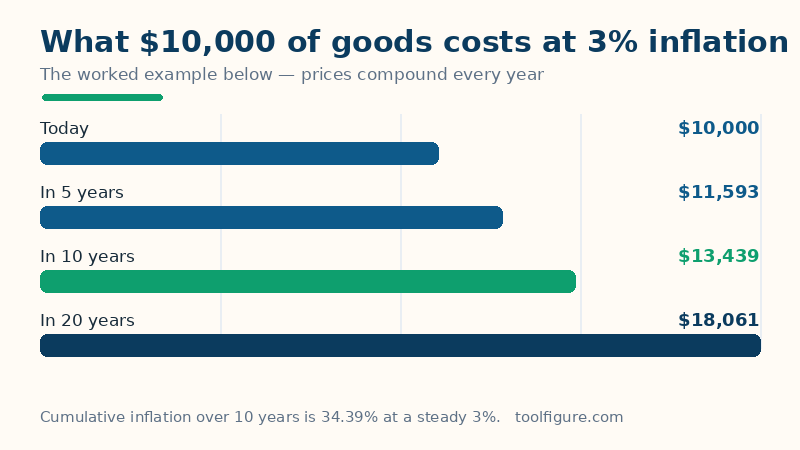
Amount today is the price or sum you start with, r is the average yearly inflation rate as a decimal (3% = 0.03), and n is the number of years. The first formula is exactly the compound-growth formula from our compound interest calculator, pointed at prices instead of savings — which is the whole story of inflation in one line: your money needs to compound at least as fast as prices, or it falls behind while its balance still rises. The second formula simply runs the first one backwards, dividing instead of multiplying, to translate a future nominal amount into the goods it will actually buy. Nothing here predicts the real future rate; the calculator tests the rates you give it, honestly and exactly.
Worked example: $10,000 at 3% for 10 years
Take $10,000 of goods today, an average inflation rate of 3% and a horizon of 10 years. The growth factor is (1.03)10 = 1.343916, so the future cost is 10000 x 1.343916 = $13,439.16 — inflation adds $3,439.16, a cumulative rise of 34.39%. Run it backwards: $10,000 received in 10 years is worth 10000 / 1.343916 = $7,440.94 in today's money, a loss of $2,559.06 (25.59%) of buying power while the number on the bank statement never changed. Stretch the same 3% rate over longer horizons and compounding does its quiet work:
| Horizon at 3% | Future cost of $10,000 today | $10,000 then, worth today |
|---|---|---|
| 5 years | $11,592.74 | $8,626.09 |
| 10 years | $13,439.16 | $7,440.94 |
| 20 years | $18,061.11 | $5,536.76 |
| 30 years | $24,272.62 | $4,119.87 |
Read the last row slowly: at a modest, historically ordinary 3%, prices roughly two-and-a-half times in 30 years, and cash held still keeps barely 41 cents of every dollar's buying power. That is the arithmetic behind every long-term plan on this site — why the retirement calculator's projected pot needs its growth, and why comparing a savings account's APY against the inflation rate matters more than the APY alone: a 5% return in a 3% inflation world is a real gain of roughly 2%, not 5%.
The rate you choose changes everything
Hold the $10,000 and the 10 years still and move only the rate. At 2% the future cost is $12,189.94; at 3% it is $13,439.16; at 5% it is $16,288.95. A three-point difference in the assumed rate is a $4,099 difference in the answer — larger than most people's margin for error in the amount itself. Two habits follow. First, never plan on one rate: run a low, a middle and a high case and make sure the plan survives the high one. Second, know what the official figures actually measure. Headline inflation (in the US, the Consumer Price Index published by the Bureau of Labor Statistics) averages thousands of prices; your personal inflation can be very different — a renter whose landlord raises rent 8% while electronics fall in price lives in a different inflation world from a homeowner with a fixed mortgage. Use the official rate as your middle case, then adjust toward what your own big costs are doing.
What this calculator assumes — and what inflation really does
One steady average rate for the whole period, applied once a year. Real inflation arrives unevenly — a sharp spike, then quiet years — and a spike early in the period does more damage than the same spike late, because every later year compounds on top of it; the steady-rate result is the clean average of that mess, not a forecast. The calculator also treats every dollar of your basket alike, while real price rises concentrate in housing, healthcare, education and food at different times. Finally, a negative rate (deflation) is allowed above: prices fall, the future cost drops below today's amount, and cash gains buying power — rare and usually brief, but the maths handles it honestly instead of refusing. Treat every result here as a scenario to plan against, not a promise about future prices.
Frequently asked questions
How do I calculate the future cost of something with inflation?
Multiply today's cost by (1 + r) raised to the number of years, where r is the yearly inflation rate as a decimal. At 3% for 10 years the factor is 1.343916, so $10,000 of goods today costs $13,439.16 — the calculator above does this for any amount, rate and horizon.
What is $10,000 worth in 10 years at 3% inflation?
In buying power, $7,440.94 of today's money. The nominal $10,000 does not change, but at 3% inflation prices rise 34.39% over the decade, so the future $10,000 buys what $7,440.94 buys now — a 25.59% loss of purchasing power.
What inflation rate should I use?
Run three cases rather than trusting one: a low case near 2% (the target many central banks aim for), a middle case near your country's recent long-run average (about 3% is a common planning figure for the US), and a high case of 5% or more to stress-test the plan. Official past rates come from statistics agencies such as the US Bureau of Labor Statistics (CPI).
Is inflation the same as compound interest?
The maths is identical — a percentage applied repeatedly to a growing base — but the direction is opposite for you. Compound interest grows savings; inflation grows prices, which shrinks what savings buy. A savings return only truly gains when it beats inflation: 5% growth against 3% inflation is roughly a 2% real gain.
How long does it take for prices to double?
Divide 72 by the inflation rate for a close estimate (the Rule of 72). At 3%, prices double in about 24 years — the exact figure from the formula is just under 23.5 years. At 5% it takes about 14.2 years, and at 2% about 35 years. The horizon table above shows the same effect: at 3%, $10,000 becomes $18,061 in 20 years and $24,273 in 30.