How much rent can you actually afford?
Most rental listings are priced to test your optimism, not your budget. The standard guardrail is the 30% rule: spend no more than 30% of your gross monthly income on rent, and the home stays affordable alongside tax, bills, debts and saving. It is a rule of thumb, not a law of physics — a high earner with no debts can stretch past it more safely than a lower earner with a car payment — which is why this calculator shows three levels instead of one verdict. Enter your salary and it converts it to monthly gross pay, then gives a cautious 25% rent, the standard 30% figure and a 35% stretch, each with its yearly cost. Add any rent you are actually considering, plus your other monthly debt payments, and it checks that specific home for you: the rent as a percentage of your pay, rent and debts combined against the 36% guideline many landlords and lenders watch, and how much gross pay is left afterwards. Compare the result with your real take-home pay from the paycheck calculator before you sign anything — the 30% rule is measured on gross pay, but rent is paid out of net pay.
The rent affordability formula
Monthly gross pay = annual salary / 12Affordable rent (30% rule) = monthly gross pay x 0.30Rent-to-income = rent / monthly gross pay x 100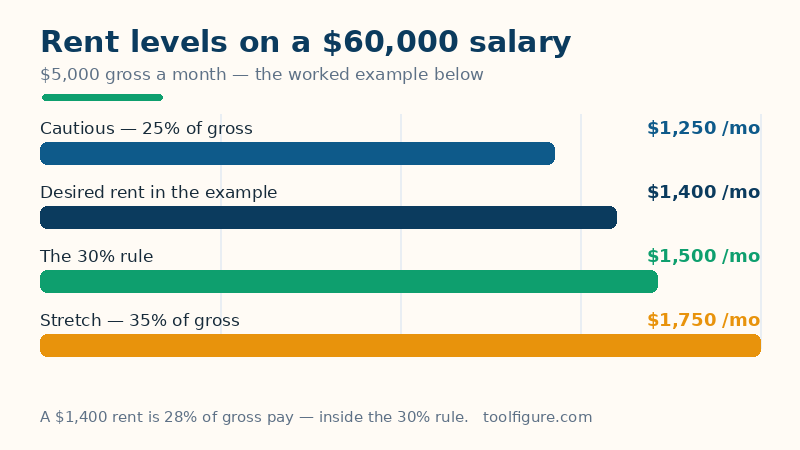
Every variable is one you already know: your annual salary before tax, the rent asked, and your other monthly debts — car payments, card minimums and loan repayments, the same debts our debt payoff calculator helps you clear. The 36% figure in the check is the combined version of the rule: rent plus recurring debts above roughly 36% of gross pay is where lenders start treating a household budget as loaded, and where landlords worry a tenant will struggle in a bad month. Nothing here uses net pay on purpose — the published rules are all stated on gross income, so the calculator follows them exactly and leaves the net-pay reality check to the section below.
Worked example: a $60,000 salary and a $1,400 apartment
You earn $60,000 a year, which is $5,000 a month before tax, and you carry $250 a month of other debt payments. The three levels come out at: cautious 25% = $1,250 a month ($15,000 a year), the 30% rule = $1,500 a month ($18,000 a year), and stretch 35% = $1,750 a month ($21,000 a year). Now check the apartment you are looking at: at $1,400 a month it takes 1400 / 5000 x 100 = 28.0% of gross pay — inside the 30% rule. Add the debts and the combined load is (1400 + 250) / 5000 x 100 = 33.0% of gross pay, inside the 36% guideline, leaving $3,350 of gross pay a month before tax, bills, food and everything else. That is a rent this salary can carry. Had the same apartment cost $1,800, the rent alone would be 36.0% of gross and rent plus debts 41.0% — the calculator would flag both, and the honest reading is that one bad month, one car repair, starts a debt spiral.
Why landlords ask for 3x the rent — and what the rule misses
The "income must be 3 times the rent" line in listings is the 30% rule viewed from the other side: a $1,500 rent times 12 months, divided by 0.30, implies a $60,000 salary — the same maths as the worked example, run backwards. Knowing that lets you negotiate or target listings realistically instead of applying and hoping. But treat every percentage rule as a starting point, because three real costs sit outside it. First, net pay: taxes and deductions mean $5,000 gross is not $5,000 in the bank; if your take-home is $3,900, a $1,500 rent is 38% of the money you actually receive. Second, upfront costs: deposit, first month, moving and furnishing routinely add two to three months of rent before you sleep a night in the place — a cost no monthly percentage shows. Third, what the rent replaces: a pricier flat that removes a car payment or a long commute can be cheaper overall than a "compliant" rent plus $250 of debts and daily travel. Work your own hourly equivalent on the salary to hourly calculator, keep a savings buffer building with the savings goal calculator, and let the percentages veto the clearly unaffordable homes rather than pick the home for you.
Frequently asked questions
How much rent can I afford on a $60,000 salary?
Under the 30% rule, $60,000 a year is $5,000 a month before tax, so the standard affordable rent is $1,500 a month. A cautious level is $1,250 (25%) and a stretch is $1,750 (35%). A $1,400 rent, for example, is 28.0% of gross pay — inside the standard rule.
What is the 30% rule for rent?
Spend no more than 30% of your gross monthly income on rent. It is the most widely used affordability guideline for renters and the mirror image of the landlord rule that your income should be at least 3 times the monthly rent. This calculator also shows 25% and 35% so you can judge your own margin instead of treating one percentage as a law.
Should rent be calculated on gross or net pay?
The published rules — 30% for rent, 36% for rent plus debts — are stated on gross pay, and this calculator follows them so its results match what landlords and lenders check. For your own safety margin, also compare the rent with your take-home pay: a rent that is 30% of gross can be close to 40% of net, which is why the cautious 25% level exists.
How do other debts change what rent I can afford?
Landlords and lenders look at the combined load. Rent plus recurring debt payments above about 36% of gross pay is treated as stretched: on a $5,000 monthly gross, a $1,400 rent plus $250 of debts is 33.0% and passes, while the same rent plus $600 of debts reaches 40.0% and would concern most landlords even though the rent alone looks fine.
What income do I need for a $2,000 rent?
Run the 30% rule backwards: $2,000 / 0.30 = $6,667 a month, or about $80,000 a year. At the cautious 25% level the same rent needs about $96,000 a year. Enter your actual salary above to see exactly where a given rent lands for you.