Overtime is two rates in one week, not one bigger paycheck
A week with overtime in it is paid at two different rates, and most pay confusion comes from blurring them together. The regular hours pay the plain hourly rate; only the hours past the threshold earn the multiplier — time and a half, or double time where that applies. This calculator keeps the two piles separate in the open: regular pay, overtime pay, and only then the total, so you can check a payslip line by line instead of squinting at one lump sum. It then stretches the same week into the monthly and yearly equivalents, because overtime is usually judged by what it adds over a year, and it reports the blended rate — total pay divided by total hours — which is the honest single number for comparing this week against a different job's flat offer. The salary to hourly calculator runs the neighbouring conversion for salaried pay, and the hours calculator totals the clocked hours themselves before any rate is applied.
The formulas, with every term defined
Overtime rate = Hourly rate × Overtime multiplierRegular pay = Regular hours × Hourly rate · Overtime pay = Overtime hours × Overtime rateTotal weekly pay = Regular pay + Overtime pay · Blended rate = Total weekly pay ÷ Total hoursYearly equivalent = Weekly pay × 52 · Monthly equivalent = Weekly pay × 52 ÷ 12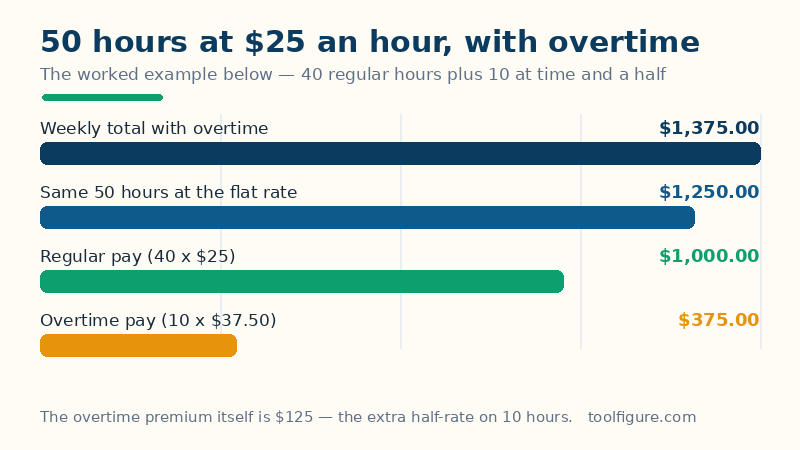
The hourly rate is the plain rate for standard hours. The overtime multiplier is the factor the overtime hours earn: 1.5 is time and a half — the plain rate plus a 50% premium — and 2 is double time. Note what the formula does not do: the multiplier touches only the overtime hours. Paying every hour at 1.5× would be a raise, not overtime, and the premium this page reports — the gap between the real total and what the same hours would pay flat — is exactly the extra half-rate on the overtime hours alone. Regular hours and overtime hours are split at your workplace's threshold: under US federal rules that is 40 hours in a workweek for most non-exempt employees, which is why the defaults split a 50-hour week at 40 — but enter the split your own contract or local rule produces if it differs.
Worked example: 50 hours at $25 an hour, time and a half
The defaults above enter a rate of $25, 40 regular hours, 10 overtime hours and the standard 1.5 multiplier. The overtime rate is 25 × 1.5 = $37.50 an hour. Regular pay is 40 × $25 = $1,000.00; overtime pay is 10 × $37.50 = $375.00; the week totals 1,000 + 375 = $1,375.00. The premium inside that figure is worth isolating: the same 50 hours at the flat rate would pay 50 × $25 = $1,250.00, so overtime adds $125.00 — exactly the extra $12.50 on each of the 10 overtime hours. Across the 50 hours, the blended rate is 1,375 ÷ 50 = $27.50 an hour, and overtime supplies 375 ÷ 1,375 = 27.27% of the week's pay from 20% of its hours. If every week looked like this one, the monthly equivalent is 1,375 × 52 ÷ 12 = $5,958.33 and the year pays 1,375 × 52 = $71,500.00 — against $52,000.00 for the same job with no overtime at all. The chart near the top draws the week's three piles.
What the overtime hours are worth, hour by hour
| Overtime hours | Overtime pay | Weekly total | Yearly equivalent |
|---|---|---|---|
| 0 | $0.00 | $1,000.00 | $52,000.00 |
| 5 | $187.50 | $1,187.50 | $61,750.00 |
| 10 — worked example | $375.00 | $1,375.00 | $71,500.00 |
| 15 | $562.50 | $1,562.50 | $81,250.00 |
| 20 | $750.00 | $1,750.00 | $91,000.00 |
The table is a straight line, and that is the point: at a fixed rate and multiplier, every overtime hour adds the same $37.50, so the only question a schedule really asks is how many of those hours there are. The same shape holds at other rates. At $20 an hour with 40 regular and 8 overtime hours at 1.5×, the overtime rate is $30.00, overtime pay is $240.00 and the week totals $1,040.00 — $54,080.00 over a year. At double time the multiplier does the lifting instead: $20 an hour, 40 regular hours and just 5 hours at 2× gives a $40.00 overtime rate, $200.00 of overtime pay and a $1,000.00 week. And at $30 an hour with 12 overtime hours, overtime pay reaches $540.00 on top of $1,200.00 regular pay — a $1,740.00 week, $90,480.00 a year. Enter any of those above and the same rows return.
Reading the result honestly — thresholds, exemptions and tax
Four cautions belong with any figure from this page. The threshold is a legal rule, not a universal constant. US federal law (the FLSA) sets overtime after 40 hours in a workweek for non-exempt employees, but some states add daily triggers — California, for example, generally pays overtime after 8 hours in a day as well — and other countries set their own weekly limits and premiums. Not every worker is covered: salaried employees classified as exempt do not earn overtime under the FLSA at all, however many hours they work, and classification depends on duties and salary level, not on a job title. The yearly equivalent is a projection, not a promise: it assumes the entered week repeats 52 times, while real overtime comes in seasons and surges — treat it as the value of the pattern, not a forecast. And this is gross pay: income tax, social contributions and deductions come afterwards, which is the paycheck calculator's territory — overtime is taxed as ordinary income at your usual rates, though a larger paycheck is sometimes withheld as if the higher amount were permanent, with the difference settled when the year's tax is filed. Use this page to verify the arithmetic on a payslip or to price a schedule before you agree to it; for a dispute about what you were owed, the payslip, the contract and your local labour authority are the authorities that count.
Frequently asked questions
How is overtime pay calculated?
In two piles. Regular hours multiply by the plain hourly rate, and overtime hours multiply by the rate times the multiplier — 1.5 for time and a half. In the worked example: 40 hours × $25 = $1,000.00 of regular pay, the overtime rate is $25 × 1.5 = $37.50, 10 overtime hours × $37.50 = $375.00, and the week totals $1,375.00. The common mistake is applying the multiplier to the whole week: that would give $1,875.00, which is a 50% raise on every hour, not overtime — the premium applies only to the hours past the threshold.
What does time and a half actually mean?
It means each overtime hour pays the normal rate plus half as much again — a multiplier of 1.5. At $25 an hour, time and a half is $37.50: the $25 you would have earned anyway, plus a $12.50 premium. So 10 overtime hours at $25 an hour are worth $375.00, of which $125.00 is the premium over flat-rate pay. Double time is the same idea at a multiplier of 2 — $50.00 an hour at a $25 base rate — and typically applies to Sundays, public holidays or hours past a second, higher threshold, depending on the contract and local rules.
When does overtime start — after 40 hours a week, or 8 hours a day?
Both systems exist, and which one governs you depends on where you work. US federal law sets the trigger weekly: overtime after 40 hours in a workweek for non-exempt employees, however the hours are spread across days. Some US states add a daily trigger on top — California generally requires overtime after 8 hours in a single day and double time after 12 — and many other countries define overtime against their own statutory working week. This calculator takes the split as you enter it, so count your regular and overtime hours by the rule that applies to you, then let the page do the money.
Is overtime taxed at a higher rate?
No — overtime pay is ordinary income, taxed at the same rates as your regular pay. It can look taxed more heavily on a single payslip because payroll withholding often treats the larger paycheck as if you earned that amount every pay period, pushing part of it into a higher withholding bracket for that period. Across the full year the position is corrected when the tax return is filed, and any over-withholding comes back as a refund or a smaller balance due. The exact mechanics differ by country and by tax system; what never happens anywhere is a separate, permanent 'overtime rate' of income tax on the hours themselves.
How do I turn a week of overtime into a monthly or yearly figure?
Multiply the weekly total by 52 for the year, and divide that by 12 for the average month. The worked example's $1,375.00 week is $71,500.00 a year and $5,958.33 a month — a month is not four weeks (52 ÷ 12 ≈ 4.33), which is why multiplying a week by 4 understates it. A fortnightly paycheck is simpler: two of these weeks is $2,750.00 before deductions. Remember that all three figures assume the same overtime every week; if your overtime is seasonal, annualise the busy and quiet weeks separately and average them by how many of each the year really holds.